
Carbon fiber filament changed what a desktop printer can do. Brackets that used to crack, housings that sagged near a warm engine bay, drone arms that flexed under load: reinforced spools solve those problems, and the machines below are built to feed them without clogging or drama. This roundup covers two printers and eight spools, because the honest truth is that your results depend on both halves of the pairing. Whether you’re printing functional parts in a garage workshop or prototyping enclosures at a desk, there’s a match here for your skill level and your budget.
The Shortlist At A Glance
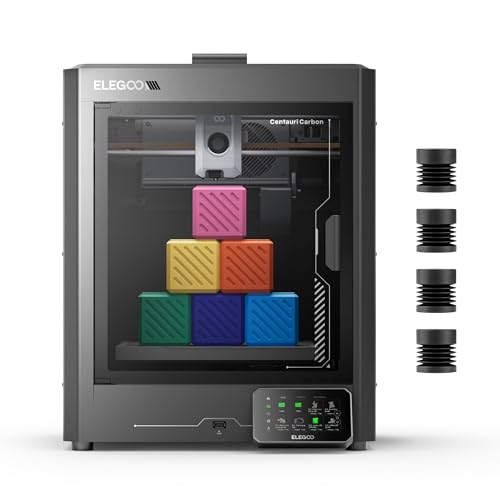
ELEGOO Centauri Carbon CoreXY 3D Printer

FLASHFORGE Carbon Fiber PETG Filament 1.75mm Black 1kg

IEMAI Carbon Fiber PETG Filament 1.75mm Matte Black 1kg

FLASHFORGE Carbon Fiber PETG Filament 1KG (Black)
Creality K1C High-Speed 3D Printer

SUNLU PA6-CF Carbon Fiber Nylon Filament 1KG
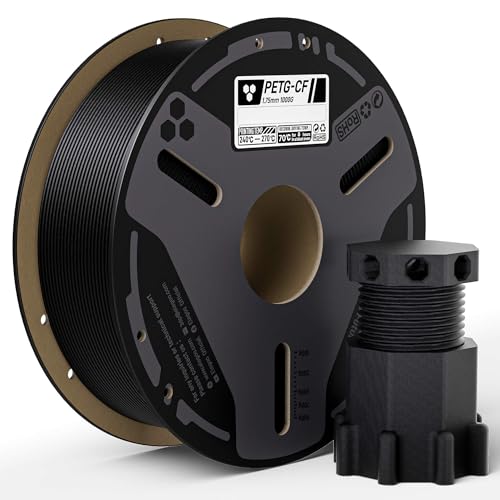
ELEGOO PETG-CF 3D Printer Filament 1.75mm Black 1KG

Polymaker Fiberon PA612-CF15 Filament 0.5KG

Creality Hyper PLA-CF Filament 1.75mm 1KG

Creality Hyper PLA-CF Matte Finish Filament 1.75mm
More Details On Our Top Picks
The Centauri Carbon takes the setup anxiety out of composite printing. It ships fully assembled and pre-calibrated, so the first evening looks like unboxing, plugging in, and loading a spool rather than an afternoon of belt tensioning. The CoreXY motion design keeps the print head light, which is how it sustains 500mm/s travel without the frame wobbling.
For carbon fiber work specifically, the 320°C nozzle matters: it opens the door to hotter materials beyond basic PLA blends. The built-in camera lets you check a long job from another room, something you’ll appreciate once a nylon spool ties up the machine overnight.
Strong Points
- Auto calibration handles bed leveling for you, which removes the most common beginner frustration entirely.
- A 256x256x256mm build volume fits a week’s worth of functional parts, not just trinkets.
- The 320°C hotend supports higher-temp filaments that standard printers simply refuse.
- Touchscreen controls keep daily operation simple even mid-project.
Things To Consider
- Owners commonly report that abrasive CF filaments wear brass nozzles faster, so budget for hardened replacements.
- The enclosed footprint needs a dedicated shelf or bench spot.
Key Specs
Made For
First-time printer owners who want composite capability on day one without a calibration learning curve.
Where A Sibling Pick Shines
Shoppers chasing maximum speed for batch production will get more out of the Creality K1C’s 600mm/s motion system instead.
PETG-CF is the gentlest way into carbon fiber printing, and this FLASHFORGE spool explains why. The base polymer already prints easily at modest temperatures, and the fiber reinforcement adds rigidity without turning the material brittle. In practice, that means drawer pulls, camera mounts, and shelf brackets come off the bed feeling solid rather than springy.
Compared with plain PETG, the blend also tolerates warmer surroundings better, so parts living near electronics or inside a car hold their shape. You don’t need an exotic machine either; any printer with a decent all-metal hotend manages it.
Highlights
- Reinforced stiffness makes load-bearing prints genuinely usable around the house.
- Improved heat resistance over standard PETG suits parts near warm equipment.
- Forgiving print behavior means fewer failed spools while you learn.
Worth Noting
- Abrasive fibers gradually wear untreated brass nozzles, a maintenance cost worth planning for.
- Damp filament causes stringing, so sealed storage between projects pays off.
Who Should Grab It
Makers moving up from PLA who want stronger parts without fighting a difficult material.
Swap It Out When
Anyone needing maximum impact toughness outdoors should reach for the ELEGOO PETG-CF spool instead.
IEMAI loads this spool with roughly 20% chopped carbon fiber, a generous ratio for the price bracket. That infusion shows up where it counts: printed jigs and mounting plates resist flexing under screw tension, which is exactly the failure mode that frustrates people printing functional hardware. The matte black finish also hides layer lines better than glossy stock.
Diameter consistency is the quiet hero here. At a stated accuracy of plus or minus 0.03mm, extrusion stays predictable, so flow tuning rarely needs babysitting mid-spool.
Upsides
- High fiber content delivers noticeable structural strength in brackets and housings.
- Tight dimensional accuracy keeps extrusion steady across the whole kilogram.
- Matte surface finish flatters visible parts like enclosures and covers.
- Good dimensional stability helps assembled pieces fit together predictably.
Small Caveats
- Stiffer blends snap rather than bend under extreme shock, so crash-prone builds need care.
- Like all CF-PETG, it prefers a dry box in humid climates.
Right Fit For
Workshop tinkerers printing jigs, fixtures, and mechanical components that must hold alignment.
Another Choice May Suit
Printers wanting factory-dried filament straight from the box may prefer the FLASHFORGE 1KG black spool reviewed earlier.
This second FLASHFORGE entry sits a step above the earlier spool on precision. Where the value option targets easy printing, this one advertises a tighter plus-or-minus 0.02mm diameter tolerance, and that difference is real on tall prints where small flow errors accumulate into visible banding. Surface quality on finished parts tends toward clean and consistent, according to widespread owner feedback.
The blend keeps PETG’s natural impact resistance while adding fiber-driven rigidity and temperature headroom, a combination that suits anything from tool holders to drone accessories.
Bright Spots
- Plus or minus 0.02mm accuracy produces smoother walls on tall, detailed models.
- Retains PETG’s toughness, so parts survive drops better than stiff PLA blends.
- Ships dried and sealed, reducing first-print stringing surprises.
Points To Note
- Once opened, humidity creeps in quickly; a storage container with desiccant extends spool life.
- Requires temperatures above basic PLA settings, ruling out very old hotends.
Quick Facts
Who Will Love This
Hobbyists who notice surface blemishes and want display-worthy finishes from a workhorse material.
Look Elsewhere When
Budget-conscious beginners printing rough prototypes will be happier with the cheaper FLASHFORGE value spool above.
Speed is the K1C’s whole personality. Its CoreXY kinematics, where both motors drive the gantry from fixed positions, allow 600mm/s peak speeds and aggressive acceleration while the lightweight head keeps corners crisp. For anyone batching out replacement parts, that translates into finishing a day’s queue before dinner.
The direct-drive extruder grips filament firmly, which matters with rigid CF blends that hate being pushed through long Bowden tubes. A tri-metal “Unicorn” hotend reaches 300°C, covering the nylon and PETG composites in this list, and the AI camera watches for failed layers so a midnight spaghetti disaster doesn’t waste a kilogram.
Reasons To Buy
- 600mm/s top speed with auto leveling turns around prototypes in hours, not days.
- Direct extrusion feeds stiff, abrasive filaments reliably without grinding.
- Silent mode keeps late-night printing neighbor-friendly.
- AI camera monitoring catches failures early and saves material.
Softer Spots
- High-speed settings demand good slicer profiles; expect some tuning time upfront.
- The 300°C ceiling stops short of the hottest engineering polymers.
Whose Shelf It Belongs On
Semi-professional users and rapid-prototyping enthusiasts who value throughput over everything else.
Reach For A Different Pick When
First-time owners wanting a gentler learning curve will find the ELEGOO Centauri Carbon more approachable.
This is the spool you buy when a part absolutely cannot fail. SUNLU blends 80% PA6 nylon with 20% carbon fiber, producing prints with the kind of stiffness and heat tolerance you’d associate with commercial components. Gears, clamps, and automotive interior clips printed from this material shrug off conditions that would warp ordinary plastics.
Layer adhesion deserves a mention too. Nylon composites sometimes delaminate along Z, yet owners commonly report strong bonding here, meaning tall parts stay structurally trustworthy.
Plus Points
- 20% fiber loading yields engineering-grade rigidity for load-bearing applications.
- Excellent heat resistance suits engine-bay-adjacent and outdoor uses.
- Strong layer adhesion keeps tall prints from splitting along seams.
- A full kilogram covers several substantial projects.
Honest Caveats
- Nylon absorbs moisture aggressively; drying before every session is widely reported as essential.
- Needs a capable hotend and heated bed, so entry-level printers struggle.
- Expect a steeper tuning curve than PETG blends.
At A Glance
Who It Suits Best
Experienced makers printing mechanical parts for tools, vehicles, or machinery where failure isn’t an option.
Not Your Match When
Beginners still learning temperature basics should start with the friendlier ELEGOO PETG-CF spool instead.
ELEGOO leans into toughness with this blend. While many carbon fiber mixes trade resilience for rigidity, this PETG-CF keeps impressive impact strength, so a dropped enclosure or knocked-over tool holder cracks less often than its stiffer rivals. Garden gear, bike accessories, and shop organizers all benefit from that character.
It also behaves well outdoors, resisting the sun-and-rain degradation that shortens the life of basic PLA parts. Pair it with either printer in this list and you have a dependable everyday setup.
Standout Traits
- Exceptional impact resistance means fewer shattered parts after accidental knocks.
- Weathers outdoor exposure far better than standard PLA.
- Prints at approachable temperatures on most mid-range machines.
Minor Gripes
- Surface sheen is less refined than dedicated matte blends, in our view.
- Seal the bag between uses; absorbed moisture shows up as bubbling.
The Right Fit
Practical makers printing items that live outside, in the garage, or anywhere bumps happen.
Consider Something Else When
Shoppers prioritizing glass-smooth cosmetic finishes will prefer the matte IEMAI spool covered earlier.
Polymaker’s Fiberon line exists to bring engineering composites down to desktop prices, and the PA612-CF15 is its most forgiving ambassador. The PA612 base polymer is notably less thirsty for moisture than standard PA6 nylon, which removes the single biggest headache in nylon printing. Left on the desk overnight, it won’t ruin itself the way fussier nylons can.
The formula is tuned for speed too, running happily on mainstream and even entry-level machines. The half-kilo spool keeps the entry cost reasonable for a trial run.
Positives
- Low moisture sensitivity makes storage and handling dramatically easier than PA6.
- Optimized for high-speed printing on common consumer printers.
- Strong, stiff parts suitable for genuine functional duty.
Trade Offs
- The 0.5kg spool runs out fast on large or repeated jobs.
- Still benefits from a drybox during long humid summers, per owner reports.
Details At A Glance
Best Suited To
Makers curious about nylon composites who want premium behavior without a full kilogram commitment.
Skip It When
High-volume production printing calls for the better per-kilogram economics of the SUNLU PA6-CF.
Not every carbon fiber project needs industrial muscle. Creality’s Hyper PLA-CF is the affordable gateway: it prints at up to 300mm/s, bonds layers well, and adds meaningful stiffness over plain PLA without demanding exotic hardware. For rapid iteration, where you burn through five prototype versions in an afternoon, cheap-and-fast beats expensive-and-slow every time.
The stated plus-or-minus 0.03mm diameter tolerance keeps flow predictable, and it works on most standard FDM printers, no upgrades required.
What We Like
- Speeds from 50 to 300mm/s make quick prototyping genuinely quick.
- Balanced strength and adhesion produce reliable everyday parts.
- Runs on nearly any FDM printer without modification.
Areas To Watch
- PLA-based blends soften in hot cars or direct summer sun.
- Abrasive fibers still wear brass nozzles over time.
Feature Snapshot
Built With In Mind
Students, tinkerers, and prototype churners who go through filament quickly and watch spending.
Where Another Pick Suits Better
Parts facing real heat loads deserve the SUNLU PA6-CF nylon instead of this PLA blend.
Think of this as the sibling of the previous Creality spool with a cosmetic upgrade. The matte formulation diffuses light across layer lines, so finished models read smooth even under close inspection, a trait cosplay prop makers and product designers tend to prize. Mechanically it holds the same story: roughly 30% better flexural and impact figures than standard PLA, plus tensile strength that edges past ABS.
Speed credentials carry over too, with the same 50 to 300mm/s window and tight diameter control.
Best Bits
- Matte surface hides layer lines for display-ready results straight off the bed.
- Higher tensile strength than ABS with easier printing behavior.
- About 30% stronger than plain PLA in bending and impact tests reported by the maker.
Room For Improvement
- Heat deflection remains PLA-typical, so avoid dashboards and sunny windowsills.
- Matte texture slightly dulls fine detail compared with gloss blends.
Perfect Match For
Prop builders, model makers, and anyone whose prints end up on a shelf rather than under load.
A Better Fit Elsewhere
Structural brackets and fixtures call for the tougher ELEGOO PETG-CF spool from earlier in the list.
What Matters Most Before Choosing 3d Printers For Carbon Fiber Filament
Match The Machine To The Material
Carbon fiber filaments split into families, and each has demands. PLA-CF prints cool and easy, PETG-CF wants moderate heat, and nylon blends need a hotend pushing 280°C or beyond plus a heated, often textured bed. Buying a spool your printer can’t melt is the classic wasted purchase, so check nozzle limits first.
Nozzles And Abrasion
Chopped fibers act like liquid sandpaper inside a hotend. Brass nozzles, the default on most machines, develop an enlarged orifice within a few kilograms of CF filament, which subtly changes flow. A hardened steel or ruby nozzle costs little relative to the frustration it prevents.
Drying And Storage
Every reinforced polymer listed here absorbs ambient moisture to some degree. Wet filament steams in the nozzle, producing stringy surfaces and weak layers. A sealed container with desiccant, or a dedicated dryer box, is the cheapest insurance in this hobby.
Tolerance Tells The Story
Diameter accuracy numbers like plus or minus 0.02mm versus 0.03mm sound trivial until a tall print develops banding. Tighter tolerance generally means steadier extrusion and cleaner walls, which matters most on visible or precision-fit parts.
A Few Things Worth Knowing First
Traps First Timers Fall Into
The most common mistake is buying a high-performance nylon spool for a printer with a 260°C hotend ceiling. The second is skipping the dryer and blaming the brand for stringy results. Start with a PETG-CF or PLA-CF blend, learn its quirks, then climb the ladder.
What Separates Premium From Basic
Pricier spools buy tighter diameter control, better drying at the factory, and more consistent fiber distribution, which shows up as fewer failed prints per kilogram. Higher-end printers add enclosed chambers, cameras, and faster motion systems. Paying up earns time and reliability, not magic.
Frequently Asked Questions
Do carbon fiber filaments require a special 3D printer?
Most PLA-CF and PETG-CF blends run fine on standard FDM machines with an all-metal hotend. Nylon composites need higher nozzle temperatures and usually an enclosed chamber for best results.
Why does carbon fiber filament wear out nozzles?
The chopped fibers are highly abrasive and slowly erode soft brass as they pass through the melt zone. Hardened steel or ruby nozzles resist this wear far longer.
Is carbon fiber filament stronger than regular PLA?
Yes, in stiffness and heat resistance, though the gains vary by blend. Reinforced parts resist bending and warping noticeably better, which is why they’re favored for functional components.
How should I store carbon fiber filament?
Keep spools sealed with desiccant in an airtight container or a filament dryer. Moisture absorption causes steam bubbles, stringing, and weak layer bonding during printing.
Can beginners print with carbon fiber filament?
Absolutely, starting with a PLA-CF or PETG-CF blend. These behave much like their base polymers, so the learning curve is gentle before moving to demanding nylons.
Closing Remarks
The right pairing depends on what you print. Pair the ELEGOO Centauri Carbon or Creality K1C with a PETG-CF spool and you’ll cover ninety percent of everyday functional needs, then graduate to SUNLU’s nylon when a part truly has to endure. Whichever route you take, invest in a hardened nozzle and a drybox early; those two small purchases protect everything else on this list. Happy printing.