
Printing your own shirts at home sounds simple until you’re staring at a wall of frames, emulsions, and squeegees with no idea where to start. The right setup depends on how far you want to go: a weekend craft project needs very different gear than a small run of band merch. This guide sorts ten solid options into clear lanes, from all-in-one starter kits to a proper printing press, so you can match the equipment to your actual ambitions instead of guessing.
Your Options, Compared

Speedball Advanced All-In-One Screen Printing Kit with LED UV Lamp

Speedball Intermediate Screen Printing Kit (Made in USA)
Speedball Beginner Screen Printing Craft Vinyl Kit

Caydo Screen Printing Frame with Squeegee

Ecotex PWR Screen Printing Emulsion, 1 Qt

Worown 8 x 10 Inch Wood Silk Screen Frame with Squeegee

Caydo 3-Size Wood Silk Screen Printing Frames with Mesh

VEVOR 6-Piece Aluminum Silk Screen Frames, 20×24 Inch

VEVOR 1 Color 1 Station Screen Printing Press

Ecotex Beginner Screen Printing Emulsion, 8oz
Inside Each Recommended Option
Photo emulsion is the method most professional-looking prints come from, and this kit removes the biggest hurdle: the light source. The included LED UV exposure lamp means you can burn a design into your screen in the evening without waiting for sunshine or rigging up work lights.
You get a 10 x 14 inch wooden screen frame with base, plus the inks and tools Speedball bundles into its other kits. For anyone moving past paper stencils toward crisp, repeatable graphics, that combination saves several separate purchases.
Useful Touches
- The LED lamp makes exposure timing consistent regardless of weather or season.
- A 10 x 14 inch screen handles most chest-size graphics comfortably.
- Everything arrives matched to one brand, so ink, emulsion, and cleaner are designed to work together.
- The frame base keeps your screen steady during squeegee passes.
Things To Consider
- Wooden frames can loosen or warp over years of washing, so dry them thoroughly after cleanup.
- Photo emulsion involves more steps than stencil methods, and first attempts often need practice.
Built With In Mind
Hobbyists ready to graduate from cut stencils to true photo emulsion printing at a kitchen table or craft room bench.
A Better Fit Elsewhere
If chemicals feel intimidating, the Speedball Beginner Craft Vinyl Kit offers a no-emulsion route into screen printing.
This kit teaches you both major fabric techniques in one box: drawing fluid for hand-painted designs and diazo photo emulsion for detailed artwork. That dual approach matters because many people discover they prefer one method after trying both, and buying separately gets expensive fast.
Alongside the 10 x 14 inch screen and Red Baron squeegee, you receive black and red fabric inks, screen filler, drawing fluid, diazo emulsion with sensitizer, remover, and Speed-Clean. The instruction booklet walks through each stage, which helps when you’re learning terminology like “screen filler” for the first time.
Bright Spots
- Two fabric ink colors let you experiment with layering right away.
- Both stencil-free and photographic methods are covered by one purchase.
- Made in USA manufacturing appeals to shoppers tracking origin.
- Cleanup chemistry (remover and Speed-Clean) is included rather than sold apart.
Worth Noting
- Ink quantities are modest, around four ounces each, so larger runs mean reordering.
- The diazo sensitizer must be mixed in before use, an extra step some newcomers find fiddly.
At A Glance
Who It Suits Best
Intermediate hobbyists printing on fabric who want to compare techniques before investing in bigger equipment.
Where Another Pick Shines
Total newcomers wanting the simplest possible start may prefer the Speedball Beginner Craft Vinyl Kit instead.
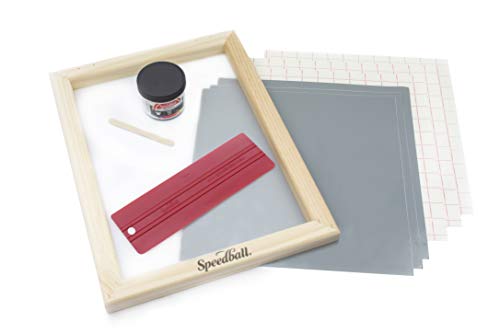
Already own a cutting machine like a Cricut? This kit turns your vinyl cutter into a stencil maker for screen printing, skipping emulsion entirely. You cut your design from vinyl, apply it to the 10 x 14 inch wood-framed mesh, and pull ink through with the included Red Baron squeegee.
The appeal is obvious for crafters: no darkroom-style exposure, no sensitizers, no washout timing. One fabric ink comes in the box, enough to test the workflow on shirts or tote bags before scaling up. Compared with the Speedball Intermediate Kit’s chemical-heavy approach, this is the gentlest entry point in the lineup.
Notable Upsides
- No photo emulsion or exposure light needed, which cuts cost and complexity.
- Your existing cutting machine produces precise, repeatable stencils.
- Vinyl stencils peel off cleanly, making screen reuse straightforward between designs.
- Works for home decor projects beyond apparel.
Small Caveats
- Only one ink color ships with the kit, so multi-color designs require separate purchases.
- Designs are limited to what your cutter can handle in size and detail.
Right Fit For
Vinyl crafting enthusiasts who want durable printed results on fabric without learning darkroom techniques.
Swap It Out When
Shoppers without a cutting machine will get more value from the Speedball Intermediate Kit, which includes everything standalone.
Most budget bundles give you one squeegee and call it done. Caydo includes two spreading tools here: a wooden-handled squeegee measuring about 9.4 x 4.3 inches and a plastic scraper around 6.9 inches wide. Different blade shapes suit different ink viscosities and project scales, so having both on hand genuinely changes what you can attempt.
The wooden frame itself measures 10 x 14 x 0.8 inches, matching the standard size used by Speedball kits, meaning replacement screens and accessories stay compatible. In a busy craft room, that interchangeability counts for more than it sounds.
Useful Strengths
- Two scraper styles cover both fine-detail pulls and broad ink coverage.
- Standard 10 x 14 sizing keeps it compatible with common accessories.
- Sturdy 0.8-inch frame depth resists flexing under pressure.
- Suits everything from casual crafts to more deliberate print sessions.
Points To Note
- No inks or emulsion ship with the frame, so budget for those separately.
- Wood frames need careful drying after washing to avoid warping over time.
Who Will Love This
DIYers who already own inks and want a dependable frame-and-squeegee pairing for regular weekend projects.
Reach For A Different Pick When
Anyone needing multiple screen sizes at once should look at the Caydo three-frame set reviewed below.
Emulsion choice quietly decides whether your screens survive a long print run. Quick refresher: emulsion is the light-sensitive coating that blocks ink everywhere except your design. Water-based inks slowly dissolve ordinary emulsions, which is why this purple PWR formula exists. It’s built to resist water-based and plastisol inks alike, so switching ink types never forces a re-coat.
The quart container arrives premixed and ready to coat, removing the measuring guesswork that trips up two-part emulsions. For anyone pulling dozens of shirts in a session, that durability difference shows up by shirt twenty.
Standout Benefits
- Water-resistant formulation holds up through long water-based ink runs.
- Compatible with plastisol too, so one jug covers mixed workflows.
- Premixed consistency reduces failed exposures from uneven mixing.
- Quart volume supports many screens before restocking.
Details To Watch
- Requires a proper exposure unit and washout setup, so total beginners may feel overwhelmed.
- Coated screens need a dust-free, light-safe place to dry between jobs.
Quick Facts
Whose Shelf It Belongs On
Home printers running repeated production batches who need emulsion that won’t break down mid-run.
Another Choice May Suit
First-timers experimenting on small projects will find the smaller Ecotex Beginner Emulsion easier to manage.
Not every project needs a big screen. Pocket prints, kids’ art sessions, card making, and small logo work all fit inside this 8 x 10 inch frame, and the smaller footprint stores easily in a drawer between uses. The natural wood construction stays rigid, and the mesh is bound at 110 white threads per inch, a count that balances detail with easy ink passage.
The paired squeegee measures roughly 6 x 4.3 inches with a rubber blade, sized proportionally so your pulls stay controlled on the narrower surface. Compared with the larger Caydo frame above, this one trades coverage area for convenience and price.
The Upside
- 110 mesh handles moderately detailed designs without clogging quickly.
- Rubber-bladed squeegee gives smooth, even ink distribution.
- Compact size suits apartment desks and shared craft spaces.
- Natural solid wood frame holds shape during normal use.
Less Ideal Details
- The 8 x 10 inch opening limits you to small-format graphics.
- Wood and rubber parts should be cleaned promptly to keep edges sharp.
Product Snapshot
Who Should Grab It
Casual crafters and parents printing small motifs on fabric, paper, or cards without dedicating serious space.
Consider Something Else When
Full-chest t-shirt graphics demand the 10 x 14 inch Caydo frame or the larger VEVOR aluminum screens.
Owning three screen sizes changes how you plan projects. This set covers 10 x 14, 8.2 x 12.2, and 6.7 x 10.6 inch frames, all stretched with 110 white mesh and all about 0.6 inches thick. A large graphic goes on the biggest frame while a pocket logo waits on the smallest, and neither job blocks the other.
Each frame carries the same mesh count, so exposure settings and ink behavior stay predictable as you swap sizes. Against buying the single Worown frame, this bundle costs more upfront but eliminates the “wrong size” problem entirely.
Advantages To Know
- Three graduated sizes cover everything from tags to full fronts.
- Uniform 110 mesh keeps results consistent across all frames.
- Multiple screens let different designs cure or dry simultaneously.
- Thin 0.6-inch profiles stack neatly in storage.
Factors To Consider
- No squeegees or inks included, so complete beginners still need extras.
- Wood frames benefit from gentle washing and full air-drying to last.
Best Suited To
Growing hobbyists juggling varied project sizes who’ve outgrown a single-frame setup.
Look Elsewhere When
High-volume shirt production calls for the aluminum VEVOR six-pack with its tougher 160 mesh.
Aluminum frames are what commercial shops use, and for good reason: metal doesn’t swell, warp, or loosen the way wood eventually does. VEVOR supplies six of them at a generous 20 x 24 inches, each tensioned with high-count 160 nylon mesh that resolves finer detail than the 110 mesh on the wooden picks earlier in this list.
Laser-welded joints keep the structure stable through daily production cycles. Sealing tape is included for taping the inner edges, a small touch that keeps ink from seeping behind the mesh. Six identical frames also mean you can prep a week’s worth of designs in one coating session.
Everyday Perks
- 160 mesh captures finer line work than beginner-grade screens.
- Aluminum alloy construction withstands repeated washing without deforming.
- Six frames support batch preparation for busy weekends.
- Large 20 x 24 inch surface fits oversized prints and posters.
- Sealing tape simplifies edge prep before each print run.
Trade Offs To Consider
- Minor surface scratches from post-weld polishing are normal and don’t affect function.
- The size demands a dedicated work table and storage space most casual crafters lack.
Technical Highlights
Made For
Serious home printers producing shirts regularly who’ve outgrown wooden hobby frames.
Where A Sibling Pick Fits
Occasional crafters will find the Caydo three-size wooden set far easier to store and handle.
Everything before this point assumes you’ll hold the screen by hand. A press changes that: the frame clamps in place, the platen holds the shirt flat, and registration stays locked between prints. The result is consistent placement across an entire run, something hand-printing rarely achieves past a dozen garments.
This single-color, single-station unit uses a cold-rolled steel body with electrostatic coating, weighs about 24 pounds, and pairs with platens around 21 x 18 inches. Assembly is required, and the included wrenches and screwdriver handle the bolts. It’s the natural partner to the VEVOR aluminum frames reviewed just above.
Positive Takeaways
- Fixed registration keeps every shirt’s print placement identical.
- Steel body provides a stable platform that doesn’t shift mid-pull.
- Basic tools ship in the package for assembly.
- Single-station footprint fits a garage corner or spare room.
Some Limits To Know
- Assembly takes real time, and first-time builders should set aside a patient afternoon.
- One color and one station cap multi-color designs until you upgrade.
The Right Fit
Semi-serious home shops fulfilling small orders who need repeatable quality beyond hand-held printing.
Skip It When
Weekend crafters printing a few shirts a month are better served by the simpler Speedball kits.
Two-part emulsions punish beginners: mix wrong, expose wrong, wash out wrong, start over. This purple formula sidesteps all of it by arriving premixed and presensitized, ready to coat straight from the bottle. It’s engineered to work with any screen printing ink type, including both plastisol and water-based varieties.
The 8-ounce bottle suits smaller projects and experimentation, which is exactly when you want less commitment sitting on the shelf. Where the quart-sized Ecotex PWR targets production volume, this one targets the learning curve, and it does that job well.
Good Reasons To Consider
- No sensitizer mixing means fewer variables between you and a clean exposure.
- Water-resistant once cured, holding up against both major ink families.
- Small bottle size keeps waste low while you practice coating technique.
Points To Keep In Mind
- Eight ounces coats only a handful of screens, so frequent printers will outgrow it quickly.
- Coated screens still need a dark, dust-free drying spot before exposure.
Essential Details
Perfect Match For
First-time emulsion users practicing on a few screens before committing to larger quantities.
Not Your Match When
Printers running weekly production should step up to the Ecotex PWR quart for better value per screen.
What Matters Most Before Choosing At Home Screen Printing
Match the Method to Your Goals
Stencil and vinyl methods deliver results in an afternoon, while photo emulsion rewards patience with sharper, more durable prints. Decide whether you’re decorating occasional gifts or building toward small-batch production. Your answer determines whether a simple frame or a full kit with exposure gear makes sense.
Mesh Count Shapes Your Detail
Mesh count refers to threads per inch in the screen fabric. Lower counts around 110 pass thicker ink layers and suit bold graphics; higher counts near 160 resolve fine lines and text. Wooden hobby frames typically carry 110 mesh, while aluminum pro frames push higher.
Think About Space and Cleanup
Emulsion work needs a dim room for coating, a dark spot for drying, and a washout area. A 20 x 24 inch frame won’t fit a kitchen table workflow. Honest measurement of your available space prevents an expensive purchase that lives in a closet.
Plan for Consumables Early
Frames last years, but inks, emulsion, and cleaning solutions run out constantly. Budgeting for refills from day one keeps momentum going instead of stalling mid-project.
Key Considerations Across These Picks
Traps First Timers Fall Into
The classic mistake is buying a professional press before mastering a basic screen. Start with a kit that matches your current skill, then upgrade once technique improves. Another common slip: forgetting consumables. A frame without ink, emulsion, and cleaner prints nothing.
The Case For Spending Up
Higher-tier gear earns its price through durability and consistency. Aluminum frames outlast wood by years, higher mesh counts capture finer detail, and a press locks registration in ways hands cannot. Pay more once output volume justifies it, not before.
Frequently Asked Questions
Can I screen print at home without a darkroom?
Yes, though photo emulsion needs a dim space for coating and drying. Vinyl stencil kits skip darkness requirements entirely since no light-sensitive chemicals are involved.
What mesh count works best for t-shirt designs?
Around 110 mesh handles bold graphics and general fabric work well. Finer text and detailed linework benefit from 160 mesh screens.
How long does screen printing emulsion last once opened?
Storage life varies by formula and conditions, so check the manufacturer’s guidance on the container. Cool, dark storage generally extends usability.
Do I need a press to print multiple shirts?
A press greatly improves consistency across runs of a dozen or more garments. Small batches remain very manageable with hand-held frames and a steady table.
Is screen printing hard to learn as a beginner?
Stencil-based methods feel approachable within a first session. Photo emulsion adds steps that typically take a few practice rounds to master.
Bottom Line
Start where your ambition actually sits. Casual crafters get everything they need from the Speedball Beginner Vinyl Kit or a compact Worown frame, while committed learners should reach for the Speedball Advanced kit with its LED exposure lamp. Production-minded printers will appreciate the VEVOR aluminum frames and press pairing. Whichever direction you take, buy your consumables alongside the hardware so the first session starts the moment the box opens.
