
Starting a banjo or banjolele from scratch means one thing: the instrument either invites you to keep playing or it fights you at every fret. High string action, unstable tuning, and heavy bodies are the usual reasons new players quit within a month. This list focuses on starter-friendly builds with low action, complete accessory kits, and sizes that fit real hands and small apartments, so your first practice sessions feel like progress instead of a wrestling match.
Your Options, Compared

Kmise Banjolele Banjo Ukulele Concert 23 Inch
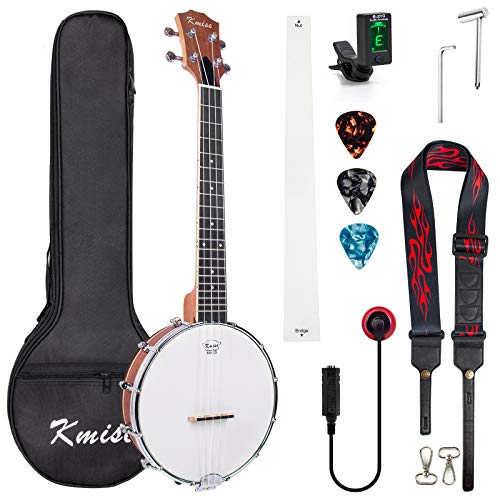
Kmise Tenor Banjolele 26 Inch Banjo Ukulele

Kmise Banjo Ukulele Concert 23 Inch (Type 4)

AKLOT 5 String Open Back Banjo Maple Remo Head

Banjo Chord Chart Laminated 11×17

Costzon 5-String Banjo 24 Bracket Beginner Kit

Kcelarec 6-String Banjo Guitar 39 Inch

Mulucky Banjolele BU806 23 Inch Sapele Dark Brown

Mulucky Banjolele BU8017 23 Inch Sapele
The Details Behind The Selections
The fastest way to lose a beginner is sore fingertips, and that’s where this concert-size banjolele earns its place. Its strings sit just 3mm above the 12th fret, low enough that chords need only a light press, which matters most during those first weeks of daily practice.
Aquila strings from Italy paired with closed geared tuners give it a bright, snappy voice that holds pitch between sessions. The kit bundles a bag, tuner, strap, spare strings, picks, wrench, and bridge, so nothing extra is needed to start tonight.
Real Benefits
- Low 3mm action spares beginner fingers from pressing hard
- Built-in truss rod lets you raise or lower the neck relief with the included wrench as your playing evolves
- Polyester head responds quickly, giving chords that percussive snap without aggressive strumming
- Hook-style strap attaches to the metal frame, so no drilling into the instrument is required
- Smooth fretboard and finished fret wires reduce hand scratches during long sessions
Things To Consider
- Availability has been inconsistent, so checking current stock before committing makes sense
- Drumhead surfaces collect dust and fingerprints, so an occasional wipe keeps it looking fresh
Key Specs
Who Will Love This
Ukulele players ready for banjo character without learning a four-finger-new tuning will settle in fast here.
Where A Sibling Pick Shines
Players wanting a bigger, warmer voice should look at the Kmise Tenor Banjolele 26 Inch instead.
Where the smaller Kmise concert model leans bright and punchy, this tenor version plays a smarter trick: its sapele backboard comes off. Attached, the sound resonates with extra brightness; removed, the tone turns smooth and mellow, almost like two instruments in one body.
At 26 inches, the longer scale suits teens and adults who find concert ukes cramped, and the brownish-yellow finish photographs nicely in living-room jam videos. The bundle still covers the essentials: bag, tuner, strap, pickup, ruler, wrench, and bridge.
Notable Upsides
- Detachable backboard gives you both resonant-bright and open-mellow voices
- Longer tenor scale offers more room between frets for adult fingers
- Included pickup supports plugging into an amp for group settings
- Size works across ages, useful in households sharing one instrument
Small Caveats
- The removable panel adds a step when packing up after practice
- Larger body may feel bulky for very young children compared with the Mulucky BU8017
Right Fit For
Singers and songwriters who want tonal flexibility in a single travel-friendly package will get the most from this one.
Consider Something Else When
Total beginners on a strict budget are usually happier with the simpler Kmise Concert 23 Inch (Type 4).
This is the no-frills route into banjolele territory, and honestly, that’s not a bad thing. The Type 4 build skips the accessory pile and concentrates on the fundamentals: closed gear tuners treated with oil so they resist rust, plus neatly seated fret wires over a smooth fingerboard.
You may find the stripped-down approach refreshing in a market crowded with bundled extras. Lower action keeps early chord shapes comfortable, and the compact 23-inch body stores easily in a closet or dorm corner.
What Stands Out
- Oiled closed-gear pegs tune finely and hold position through practice sessions
- Lower string height eases the finger pressure every new player dreads
- Finished fret edges protect hands during repeated sliding along the neck
Points To Note
- No bag, tuner, or strap in the box, so budget for those separately
- Fewer published specs than newer Kmise models make comparison shopping harder
Made For
Shoppers testing whether the banjolele sound suits them before investing in a fuller setup.
Swap It Out When
Anyone wanting a ready-to-play bundle out of the box should step up to the Kmise Concert 23 Inch listed first.
Most picks here are banjoleles, but traditional bluegrass calls for the real five-string format, and AKLOT delivers it in all maple. Tiger-stripe maple from Europe frames a professional Remo drumhead held by 18 brackets, a combination that produces the crisp, clear attack folk players chase.
An open back design keeps weight down and tone airy, closer to old-time clawhammer styles than a heavy resonator banjo. The package includes two wrenches, four picks, strings, a tuner, strap, ruler, cleaning cloth, and gig bag, which covers nearly every maintenance task a newcomer faces.
Practical Pluses
- All-maple construction projects a bright, articulate voice suited to rolls
- Remo head with 18 brackets stays stable under tension changes
- Open back keeps the instrument lighter for long porch sessions
- Two tuning wrenches mean one can live in the gig bag permanently
Worth Bearing In Mind
- Maple finishes benefit from occasional conditioning in dry climates
- Five-string technique has a steeper curve than the four-string banjoleles here
Feature Rundown
Who Should Grab It
Dedicated bluegrass and old-time students who know they want the classic five-string path from day one.
Not Your Match When
Ukulele-first learners will adapt faster to any of the four-string options, particularly the Mulucky BU806.
An instrument is only half the equation for a beginner; knowing what to do with your right hand closes the loop. This 11-by-17 laminated chart maps the fretboard notes, five basic roll patterns, and standard G-tuning chords onto a single sheet meant for wall mounting.
Lamination survives the inevitable coffee-ring and pencil-smudge reality of a practice corner. Instead of flipping through a book mid-exercise, a glance upward keeps momentum going, which quietly doubles effective practice time for many new players.
Everyday Wins
- Roll patterns printed at eye level speed up muscle-memory building
- Laminate wipes clean after years of daily reference
- Covers G tuning, the standard starting point for five-string study
A Few Limitations
- Focused on five-string G tuning, so four-string banjolele owners get less value
The Right Fit
New five-string students practicing at home who want constant visual reinforcement beside their instrument.
Another Choice May Suit
Four-string players should pair their banjolele with app-based lessons instead of this chart.
Compared with the AKLOT’s 18 brackets, Costzon goes to 24 around the head, which generally means more even tension and steadier tone across the drum surface. A geared fifth-string tuner is the detail experienced players notice first: it adjusts the short drone string precisely, something friction tuners handle poorly.
The frame pairs a wood panel with sapele back and sides and a rosewood-style fingerboard, materials chosen for durability against wear. A 420D oxford cloth bag, strap, wiper, and three picks round out the starter loadout.
Advantages To Know
- Geared fifth tuner makes drone-string adjustments accurate and repeatable
- 24 brackets hold even head tension for consistent response
- Sapele and rosewood-style components resist corrosion and daily handling
- Suits country, folk, and bluegrass repertoires equally well
Details To Watch
- More brackets mean slightly more work when reheading down the road
- Full-size five-string body takes up more storage space than the 23-inch banjoleles
At A Glance
Who It Suits Best
Folk and country learners wanting a traditional five-string with modern tuning hardware at an accessible level.
Look Elsewhere When
Players prioritizing premium tonewoods will find the all-maple AKLOT a stronger long-term companion.
Already own a guitar? Then this 39-inch six-string banjo guitar is the shortest path to banjo tone, because standard guitar chord shapes transfer directly. No new tunings, no unfamiliar fingerings, just a drumhead voice underneath familiar muscle memory.
The build mixes solid wood and metal components, and the kit ships with screwdriver and wrench tools for adjusting neck bend and string height yourself. Owners commonly report that having these tools on hand makes routine upkeep far less intimidating than sending an instrument away for service.
Useful Touches
- Six strings tuned like a guitar mean zero learning-curve penalty for guitarists
- Included tools cover neck and action adjustments at home
- Striking finish stands out visually in a band setting
Factors To Consider
- At 39 inches it’s the largest item here, demanding dedicated storage
- Less authentic for purists chasing traditional four- or five-string technique
Whose Shelf It Belongs On
Guitarists curious about banjo texture who refuse to start their musical education over from zero.
Reach For A Different Pick When
Complete newcomers with no guitar background should begin on the Mulucky BU8017’s friendlier four-string layout.
Weighing roughly 1.6 kilograms, the BU806 is the featherweight of this list, light enough to sling on backpack straps for a beach day or a busking afternoon. Its synthetic head paired with nylon strings lands somewhere between banjo snap and ukulele warmth, a blend that suits casual singalongs.
Sapele wood in a dark brown satin finish resists humidity swings reasonably well, which campers and van-lifers tend to appreciate. The travel kit adds a padded gig bag, clip-on tuner, three celluloid picks, and a starter guide covering basics.
Strong Points
- Lightweight body with backpack straps makes carrying effortless
- Nylon strings feel gentler on fingertips than steel alternatives
- Satin sapele finish handles humid outdoor conditions gracefully
- Starter guide helps absolute novices make sound quickly
Softer Spots
- Nylon strings stretch for the first week or two, so frequent retuning is normal early on
- The compact head produces less volume than larger banjos in noisy settings
Quick Facts
Who Should Grab It
Campers, travelers, and street performers who want banjo flavor packed inside ukulele convenience.
Skip It When
Homebound players chasing maximum volume should consider the Kmise Tenor 26 Inch’s resonant option instead.
The BU8017 shares DNA with the BU806 above, same 23-inch sapele body, same synthetic-head-and-nylon recipe, but runs about 200 grams heavier. That slight extra mass can actually help stability on your lap during seated practice, depending on how you hold the instrument.
Like its sibling, it includes the padded bag, clip-on tuner, three celluloid picks, and a starter guide, making it a genuinely self-contained first purchase. In our view, the choice between the two Muluckys comes down to carry weight versus lap feel rather than sound quality.
Strengths Worth Knowing
- WeatherKing-style synthetic head delivers crisp twang with warmth
- Sapele construction boosts resonance while resisting moisture
- Complete travel kit removes the need for separate accessory purchases
Trade-Offs To Consider
- Slightly heavier than the BU806 for extended standing play
- Four-string format won’t satisfy players set on bluegrass rolls
Product Snapshot
Built With In Mind
Younger students, smaller-framed players, and apartment dwellers who want big personality in a small footprint.
A Better Fit Elsewhere
Adults with prior string experience often prefer the richer, adjustable Kmise Concert 23 Inch reviewed earlier.
What Matters Most Before Choosing Banjoes For Beginner
String Count Shapes Everything
Four-string banjoleles reuse ukulele tuning, so anyone with uke experience starts halfway home. Five-string models unlock traditional bluegrass rolls but demand new right-hand technique. Six-string banjo guitars suit guitarists who want banjo texture without changing habits.
Action And Playability Beat Prestige
Action, the distance between strings and frets, decides whether early practice feels pleasant or painful. Anything near 3mm at the 12th fret, like the Kmise concert models, treats beginner fingers kindly. Adjustable truss rods add future-proofing as your technique develops.
Kits Save Real Money
A tuner, strap, bag, and picks bought separately often cost a meaningful fraction of the instrument itself. Bundled kits such as the AKLOT or Mulucky packages cover those gaps immediately. Solo instruments make sense only when you already own accessories.
Weight And Storage Are Lifestyle Decisions
A 1.6-kilogram banjolele travels in a backpack; a 39-inch banjo guitar needs closet real estate. Match the instrument to your living situation honestly, because an inconvenient instrument gets played less, no matter how good it sounds.
Key Considerations Across These Picks
Wrong Turns To Avoid
The most common slip is buying a five-string for bluegrass dreams while loving ukulele chords, then abandoning it within weeks. Another trap is ignoring action height entirely; high strings punish uncalloused fingers faster than anything else. Check what a bundle actually includes before assuming a case comes standard.
Where The Extra Money Goes
Higher-tier builds spend on tonewood selection, bracket counts, and geared tuners rather than flashy cosmetics. An all-maple body with a branded head holds tone and resale value better. Paying up pays off once you’ve confirmed the instrument family fits your musical taste.
Frequently Asked Questions
Is a banjolele easier to learn than a banjo?
For most people, yes. Four-string banjoleles share ukulele tuning and lighter string tension, so chords come faster.
Can a complete beginner use a six-string banjo guitar?
Guitarists absolutely can, since the tuning matches standard guitar. Total newcomers usually progress quicker on a four-string banjolele.
How often does a beginner banjo need retuning?
New nylon strings stretch for a week or two, requiring frequent tuning. Afterward, quality geared tuners hold pitch well between sessions.
Do I really need the bundled accessories?
A tuner is non-negotiable, and a strap frees both hands while learning. Bundles typically cost less than buying each piece separately.
What size suits a child best?
Concert-scale 23-inch banjoleles fit smaller hands comfortably. Full-size five-strings suit teens and adults with longer reaches.
Closing Thoughts
Your first banjo-family instrument should disappear into the background while you learn, not fight you over sore fingers and slipping tuners. Start with the format that matches your musical taste, prioritize low action and a complete kit, and let the upgrade urge wait until you’ve earned it. Any of these nine will carry you from first clumsy chords to confident playing, and that journey is the whole point.
