
Bare metal starts rusting the moment air touches it, and a weak primer lets that happen right under your fresh topcoat. The seven black epoxy primers below cover everything from quick touch-up cans to gallon kits built for full restorations, plus one undercoat made for countertops instead of cars. Whether you’re sealing a motorcycle frame or prepping MDF for a bar-top pour, there’s a fit here for your project size and skill level.
The Leading Options At A Glance

VHT SP652 All-Weather Epoxy Paint Satin Black 11 oz
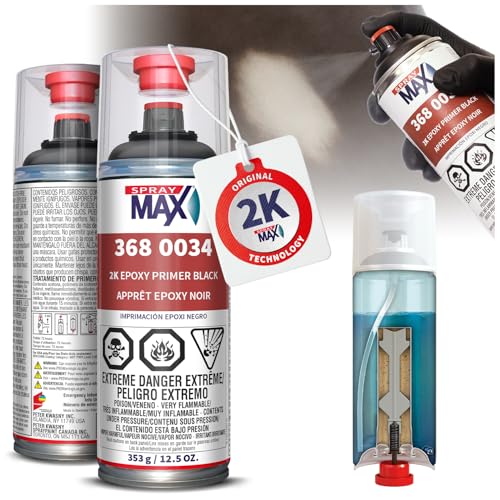
SprayMax 2K Epoxy Primer Black 12.5 oz

SprayMax 3680034 Matte Black 2K Epoxy Primer Aerosol (2 Pack)

Custom Shop Black DTM Epoxy Primer/Sealer 1/2 Gallon Kit

Custom Shop Black DTM Epoxy Primer/Sealer 1 Gallon Kit

Custom Shop Black DTM Epoxy Primer/Sealer 1 Quart Kit

Stone Coat Countertops Epoxy Undercoat Black 1 Quart
More On The Choices That Made The List
This can skips the primer step entirely, which makes it the fastest route from rusty bracket to finished part in this whole lineup. VHT formulates it to mimic a baked-on finish, so brackets, exhaust shields, and patio hardware get a satin black coat that shrugs off salt and road grime.
It’s sold in single cans and multi-packs, so you can buy one for a weekend fix or stock up for a fleet of garden tools. For most small outdoor projects, that flexibility beats committing to a mixed kit you may not finish before it cures.
Where It Excels
- One-step application means no separate primer purchase or extra drying stage between coats.
- Handles intermittent heat up to 250°F, enough for engine-adjacent parts and sun-exposed hardware.
- Resists rust, chemicals, and salt, which matters on coastal driveways and winter roads.
- Aerosol format reaches awkward angles without dragging out compressor equipment.
Things To Consider
- An 11 oz can covers far less area than the Custom Shop kits later in this list, so large panels will eat cans quickly.
- Satin sheen won’t match gloss factory finishes, so color-matched repairs may stand out slightly.
The Right Fit
Weekend DIYers refreshing outdoor fixtures, brackets, and small metal parts who want corrosion protection without mixing anything.
Swap It Out When
If bare aluminum or galvanized steel is your substrate, the SprayMax 3680034 Matte Black 2K Epoxy Primer handles those trickier metals with stronger adhesion.
Where the VHT above is a paint-plus-primer hybrid, this SprayMax is a true two-component (2K) system: you activate the hardener inside the can, then spray a professional-grade epoxy film. That chemistry is what body shops rely on when adhesion and rust blocking actually matter.
The variable nozzle gives you control you don’t get from a standard hardware-store can, and dust-dry times around 15 minutes keep a fender repair moving in one afternoon. You’ll still want a respirator and decent ventilation, since activated 2K product isn’t casual garage material.
The Upside
- Bonds hard to steel, aluminum, and galvanized metal, the three surfaces that defeat cheaper primers.
- Dust-dry in roughly 15 minutes and sandable within hours, so same-day topcoating is realistic.
- Variable nozzle delivers an even fan pattern without a compressor or spray gun investment.
- Creates a sealed foundation that accepts nearly any topcoat cleanly.
Small Caveats
- Once activated, the can has limited working time, so plan your session before you press the button.
- Proper surface cleaning and sanding are non-negotiable; skipping prep shows up as peeling later.
Feature Snapshot
Made For
DIY restorers and mobile detailers tackling car panels, motorcycle frames, or spot repairs where shop-quality adhesion is the goal.
Another Choice May Suit
For full-vehicle coverage, the Custom Shop Black DTM Epoxy Primer/Sealer 1 Gallon Kit offers far more volume per dollar than repeated cans.
This is the sibling of the SprayMax above with two differences worth knowing: a matte finish and a two-can pack. Aluminum, anodized surfaces, and galvanized sheet are exactly the problem children this formula was built to grip, and owners commonly report it seals them where single-component sprays fail.
Because it’s recoatable with both solvent- and waterborne basecoats plus single-stage topcoats, it slots into almost any existing paint workflow. The matte black also works as a final finish on brackets and under-hood parts where shine would look wrong.
Advantages To Know
- Excellent adhesion on critical surfaces like aluminum, where many primers lift or flake over time.
- Insulating and sealing properties block moisture from reaching bare metal underneath.
- Accepts standard solvent-based, waterborne, and single-stage topcoats without compatibility headaches.
- Two-pack format covers multi-panel jobs without a mid-project reorder.
Points To Note
- Surfaces must be cleaned and sanded first; it’s formulated for prepared metal, not painted-over rust.
- Matte sheen limits its use as a standalone finish on visible exterior panels.
Core Details
Who Should Grab It
Restorers working with aluminum trim, castings, or galvanized panels who need reliable sealing in aerosol form.
Reach For A Different Pick When
Glossy show finishes call for the Custom Shop Black DTM Epoxy Primer/Sealer 1/2 Gallon Kit, which is designed as a sealer under topcoats rather than a visible finish.
Now we’re into gun-applied territory. This half-gallon kit pairs a quart of KEP Series epoxy primer with a quart of hardener at a simple 1:1 mix ratio, and it’s rated direct-to-metal (DTM), meaning it goes straight onto bare steel or aluminum with no etch coat underneath.
The resin system grips bare metal, fiberglass, gelcoat, body filler, sanded OEM finishes, and many rigid plastics, which makes it a genuine do-everything sealer for a restoration bay. At 2.1 VOC it also clears emissions rules in most regulated regions, though you should confirm your local limit before ordering.
What Makes Sense
- 1:1 mix ratio removes measuring guesswork compared to 4:1 or 2:1 systems.
- Adheres to an unusually wide substrate list, including gelcoat and rigid plastics.
- Anti-corrosive formulation protects bare steel through the full build process.
- Half-gallon volume suits several panels or a small vehicle without waste.
Trade Offs
- You’ll need a spray gun, compressor, and mixing cups; there’s no aerosol shortcut here.
- Mixed epoxy has a finite pot life, so batch sizes should match what you can spray promptly.
Key Specs
Right Fit For
Hobbyist restorers with basic spray equipment working through multi-panel projects or a small vehicle shell.
Not Your Match When
First-timers testing their setup should start with the Custom Shop Black DTM Epoxy Primer/Sealer 1 Quart Kit to avoid leftover mixed material going to waste.
Same KEP Series chemistry as the half-gallon kit above, doubled in volume. A full gallon of mixed epoxy is what a complete respray demands once you account for multiple coats on every panel, door jambs, and the trunk floor people always forget.
The 1:1 ratio and 2.1 VOC rating carry over unchanged, along with the broad substrate list spanning bare steel, aluminum, fiberglass, gelcoat, filler, and sanded OEM paint. In our view, this is the version to order when the project list already exceeds two panels; buying small kits repeatedly costs more per ounce and risks slight batch-to-batch variation.
The Helpful Details
- Gallon volume covers full vehicles with margin for second coats and missed spots.
- Identical 1:1 mixing keeps workflow consistent with smaller Custom Shop kits.
- Anti-corrosive resin protects stripped shells sitting between work sessions.
- Functions as both primer and sealer, consolidating two products into one mix.
Things To Weigh Up
- Unmixed shelf life is finite; epoxy hardener degrades slowly even sealed, so buy for near-term projects.
- Overkill for single-fender repairs, where the quart kit is the smarter spend.
Who Will Love This
Serious DIY restorers and small shops planning a complete bare-metal respray with proper spray equipment.
Consider Something Else When
Countertop and woodworking projects belong with the Stone Coat Countertops Epoxy Undercoat Black, which is formulated for porous surfaces rather than metal.
The smallest entry in the KEP Series line, pairing a pint of primer with a pint of hardener. That’s enough mixed material for a hood, a set of wheels, or a motorcycle tank, which is precisely the scale most first spray-gun projects live at.
Nothing about the chemistry changes from the larger kits: 1:1 mix, 2.1 VOC, direct-to-metal adhesion across steel, aluminum, fiberglass, gelcoat, filler, and sanded OEM finishes. The honest read is that this is the least risky way to learn how epoxy behaves in your gun before committing to gallon quantities.
Everyday Advantages
- Lowest-cost entry point into true 2K epoxy among the Custom Shop options.
- Pint-plus-pint sizing matches typical single-part project scope with minimal leftovers.
- Full anti-corrosive performance identical to the gallon version, no diluted formula.
- Small batches mean less pressure against pot-life clocks for slower sprayers.
Less Ideal Details
- Coverage runs out fast on anything bigger than a few panels; budget accordingly.
- Still requires gun, compressor, and PPE, so total setup cost exceeds any aerosol here.
Product At A Glance
Who It Suits Best
Newcomers to sprayed epoxy doing their first bare-metal panel, wheel set, or bike frame with modest equipment.
Where A Sibling Pick Shines
Larger restorations justify stepping up to the Custom Shop Black DTM Epoxy Primer/Sealer 1 Gallon Kit for better volume economics.
Everything before this point targets metal; this quart targets wood, MDF, plywood, cabinets, and appliances ahead of a decorative epoxy pour. Two brushed or rolled coats build a firm, sealed base that keeps expensive countertop resin from soaking into porous material and looking thin.
The black pigment does double duty as a backdrop for metallic and marble-effect pours, deepening the final look considerably. Application needs nothing fancier than a brush or roller, making it the most approachable item on this list by a wide margin.
Practical Pluses
- Seals porous MDF and plywood so pour epoxy sits dense and thick instead of absorbing in.
- Works on countertops, tables, bar tops, cabinets, and appliances with one product.
- Brush-and-roller application requires zero spray equipment.
- Black base amplifies depth in decorative metallic pours.
Worth Bearing In Mind
- Plan on two coats for a properly sealed foundation, which stretches a quart thinner than expected on large counters.
- Not suited to automotive or bare-metal use; the Custom Shop kits handle that side of the category.
Essential Details
Built With In Mind
Home crafters pouring epoxy countertops or river tables who want a sealed, color-corrected base without spray gear.
Look Elsewhere When
Automotive panels and rust prevention call for the SprayMax 2K Epoxy Primer Black, whose corrosion protection is engineered for metal, not wood.
What Matters Most Before Choosing Black Epoxy Primers
Match The Chemistry To Your Surface
Epoxy primers fall into two camps: single-component coatings like the VHT that cure from the can, and 2K systems where you trigger a hardener at mix time. Single-component wins on convenience; 2K wins decisively on adhesion and long-term corrosion blocking. Bare steel, aluminum, and galvanized sheet generally deserve the 2K treatment, while lightly rusted brackets and outdoor fixtures often don’t.
Volume Versus Project Scope
An 11 oz aerosol covers small parts; a quart kit handles a few panels; a gallon kit exists for full vehicles. Buying too small means mid-project reorders and possible shade variation between batches, while buying too big leaves hardened product aging on a shelf. Estimate your square footage honestly, then add one coat of margin.
Equipment And Prep Reality
Gun-applied kits assume you own a compressor, HVLP gun, mixing cups, and respiratory protection, and they demand clean, sanded surfaces regardless of brand claims. Aerosols trade some film quality for near-zero setup. Neither path forgives skipped prep, so factor sanding time into your plan before the primer ever arrives.
Local Rules And VOC Limits
Products like the Custom Shop line carry a 2.1 VOC rating, which satisfies stricter regions but not necessarily every jurisdiction. A quick check of your local coating rules prevents an unusable purchase, particularly for commercial or industrial applications.
Key Considerations Across These Picks
Traps First Timers Fall Into
The most common mistake is spraying epoxy over loose rust or glossy paint and expecting adhesion miracles; every product here assumes cleaned, sanded, degreased surfaces. Another frequent slip is ignoring pot life on 2K systems, leaving mixed material curing in the cup. Buy the smallest kit that fits the job until your pace is proven.
What Separates Premium From Basic
Higher-tier 2K systems cost more because of hardener chemistry, corrosion inhibitors, and tighter quality control on pigment and film build. That money buys durability measured in years on salted roads, not months. For heirloom restorations and daily drivers, the upgrade pays for itself; for a garden bench, it doesn’t.
Frequently Asked Questions
Do black epoxy primers need a topcoat?
Most are designed as a foundation for basecoat or single-stage paint, though some matte versions double as a final finish on hidden parts. Leaving them exposed outdoors long-term invites UV chalking, so topcoating is the safer default.
Can epoxy primer go directly over rust?
Epoxy bonds best to clean, sanded metal, and loose rust underneath will compromise the film. Surface rust should be removed or converted first; these products seal sound metal, not decay.
What does 2K mean on a primer can?
It signals a two-component system where a hardener activates the resin at the moment of mixing. The result is a harder, more chemically resistant film than single-component aerosols achieve.
How long does mixed epoxy primer stay usable?
Pot life typically runs under an hour depending on temperature, so mix only what you can spray promptly. Leftover mixed material hardens in the cup and cannot be revived.
Is epoxy undercoat safe for kitchen countertops?
Products like the Stone Coat undercoat are made specifically as a base beneath food-safe-rated pour epoxies. Always follow the pour epoxy manufacturer’s curing instructions before any food contact.
Bottom Line
Your project size decides most of this for you. Grab the VHT for quick outdoor fixes, the SprayMax cans for aluminum and spot repairs, and step up to the Custom Shop kits once panels multiply. Countertop creators have the Stone Coat undercoat waiting. Whichever direction you go, prep the surface properly and let the epoxy do the job it was engineered for.
