
Whether you trim scrapbook pages at the kitchen table or slice open shipping boxes all week, a dull or wobbly cutter slows everything down. The right tool makes clean cuts feel effortless instead of a fight with frayed edges and slipped measurements. This roundup covers seven craft cutters spanning guillotine paper trimmers, rotary blades, utility knives, and precision flush cutters, so you can match the tool to the job instead of forcing one blade to do everything.
The Choices Worth Comparing
Swingline ClassicCut Lite Guillotine Trimmer 12″

TIFICAL 4 Pack Retractable 18mm Box Cutter

Firbon 12 Inch Guillotine Paper Trimmer (Gray)

Firbon 12 Inch Guillotine Paper Trimmer (Pink)
Fiskars SureCut Deluxe Paper Cutter 12″
EamPrsk 5 Inch Flush Cutters, 2 Pack

DIYSELF 8 Pack Small Box Cutters
The Details Behind The Selections
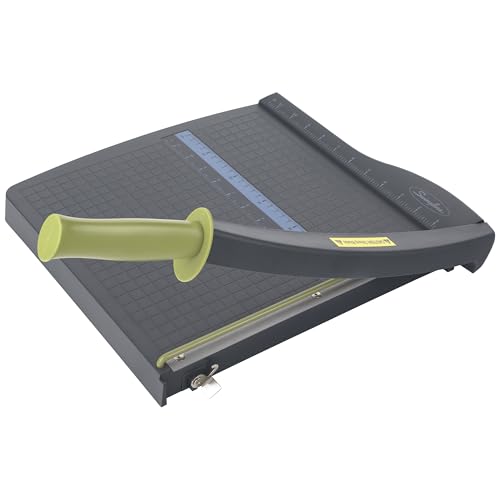
A guillotine trimmer uses a hinged arm-mounted blade that swings down onto stacked paper, which is why it handles multiple sheets better than sliding-blade designs. This Swingline pairs that mechanism with a durable plastic base, keeping weight down so you can move it between desk and shelf without much thought.
The 12-inch cutting length covers letter-size stock with room to spare, and an alignment grid helps you line up edges before committing to a swing. For anyone cutting handouts, invitations, or craft paper a few times a week, this setup covers most of what lands on the mat.
The Practical Payoff
- The plastic base keeps it light enough to tuck into a drawer after each session.
- An alignment grid means fewer crooked cuts when you’re working quickly.
- The swinging blade slices through stacks of up to 10 sheets in one pass.
- Owners commonly report it stays accurate through years of light office use.
Points To Note
- Plastic construction trades some heft and rigidity compared with metal-base rivals like the Firbon below.
- Keep fingers clear of the blade path; the arm has no guard rail like rotary models offer.
Key Specs
Who It Suits Best
Teachers, home-office workers, and casual crafters who need dependable trims without dedicating permanent bench space.
Where A Sibling Pick Shines
Anyone cutting thick stacks daily will prefer the Firbon 12 Inch Guillotine Paper Trimmer (Gray), whose stainless blade and non-slip feet handle heavier routines.
Getting four utility knives in one pack changes how you work: one lives in the kitchen junk drawer, one rides in the car trunk, one stays at the workbench, and a spare waits its turn. The 18mm blade width gives you more steel behind the edge than slim hobby knives, which matters when you’re scoring cardboard or slicing tape seams all afternoon.
The retractable design lets you dial out just enough blade for shallow cuts, then lock it back fully before the knife goes into a pocket. High-carbon steel holds a finer edge longer than basic carbon blades, according to the manufacturer, and edge retention is exactly where cheap box cutters usually disappoint.
The Good Stuff
- High-carbon steel resists dulling through long sessions of box opening.
- Four knives mean you stop hunting for the one you misplaced last week.
- Retraction control keeps exposed blade minimal during carry and storage.
Small Caveats
- Replacement 18mm blades are a consumable cost worth budgeting for over time.
- No self-retracting safety mechanism, so habit-forming retraction is on you.
- Blade changes require loosening the housing, which slows mid-task swaps.
Made For
Shoppers who open packages daily and want spare knives stationed wherever the boxes tend to pile up.
Skip It When
Hobbyists needing fine detail work should look at the EamPrsk flush cutters instead, since a wide utility blade can’t reach tight component gaps.
Compared with the Swingline’s plastic body, this Firbon leans on a curved-edge blade made from 3Cr13 stainless steel, a grade chosen for holding a keen edge while resisting corrosion. The curve matters more than the spec sheet suggests: it rolls into the cut rather than chopping straight down, which leaves cleaner paper edges with less tearing along the line.
Rubber feet anchor the base during the downward stroke, so the whole unit doesn’t creep across the table on harder pulls. Dual inch and centimeter scales sit alongside an alignment grid, handy when a pattern calls for metric sizing. You may find the 12-sheet ceiling modest next to commercial stack cutters, but for classroom prep or card-making batches, it’s a sensible limit.
Where It Delivers
- Stainless blade keeps its edge through repeated batch-cutting sessions.
- Non-slip feet hold the base steady, protecting cut accuracy.
- Dual measurement scales serve both US and metric project plans.
- Curved edge reduces fraying on coated and glossy papers.
Things To Weigh Up
- Twelve sheets per pass falls short for high-volume office jobs.
- Wipe the blade dry after humid-season storage to prevent spotting.
Feature Snapshot
Right Fit For
Small-business owners and frequent card makers who cut stacks weekly and want a step up from plastic-bodied trimmers.
Another Choice May Suit
Photo and scrapbook workers chasing pixel-straight lines will get more value from the Fiskars SureCut Deluxe, whose wire guide shows the exact cut path before the blade moves.
This is the same machine as the gray Firbon reviewed above, wearing a different finish. Every functional detail carries over: the 3Cr13 stainless curved blade, the 12-sheet capacity, the rubber feet, and the dual-scale alignment grid. Nothing about performance separates the two colors, so your decision comes down entirely to workspace aesthetics.
That said, color isn’t trivial in a shared craft room. A distinct shade makes it obvious whose trimmer is whose, and it’s easier to spot when it slides behind fabric bins. In most home studios, that small visibility win earns its keep over months of use.
Strengths Worth Knowing
- Identical stainless blade and grid accuracy as the gray version.
- The pink finish stands out in crowded shared supply areas.
- Rubber feet keep cuts consistent on slick desktop surfaces.
Less Ideal Details
- Same 12-sheet ceiling, so bulk jobs still demand patience.
- Light-colored finishes may show scuffs and ink marks sooner.
Built With In Mind
Crafters who want heavy-duty trimmer mechanics in a color that matches a personal studio setup.
Reach For A Different Pick When
Office environments favoring neutral equipment should order the Firbon Gray variant instead, since function is identical and gray blends into professional settings.
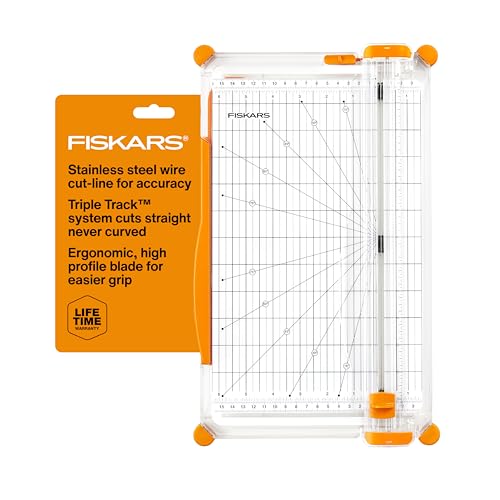
Rotary trimmers slide a circular blade along a rail rather than swinging down, trading raw stacking power for surgical straightness. Fiskars leans into that strength with two smart touches. First, a stainless wire sits exactly where the blade will travel, so you see the finished cut line before anything moves. Second, the TripleTrack system interlocks the blade carriage with the rail, which is the mechanical reason wandering cuts become rare.
The high-profile carriage offers a comfortable grip during long trimming runs, and the compact footprint suits desks where a guillotine arm would feel bulky. One honest trade-off: single-sheet precision comes before volume, so big stacks belong to the Firbons.
A Few Strong Suits
- The wire guide shows your cut location precisely, saving mis-trimmed photos.
- TripleTrack rail interlock keeps every pass dead straight.
- Lightweight build travels easily to crops and workshops.
Worth Noting
- Rotary action suits thinner loads better than tall stacks.
- Blade replacement cartridges add a recurring ownership cost.
Quick Facts
Whose Shelf It Belongs On
Scrapbookers and photographers trimming single sheets where a millimeter off ruins the layout.
Swap It Out When
Volume cutters processing reams of handouts should choose the Swingline ClassicCut Lite, whose guillotine arm chews through 10-sheet stacks faster.
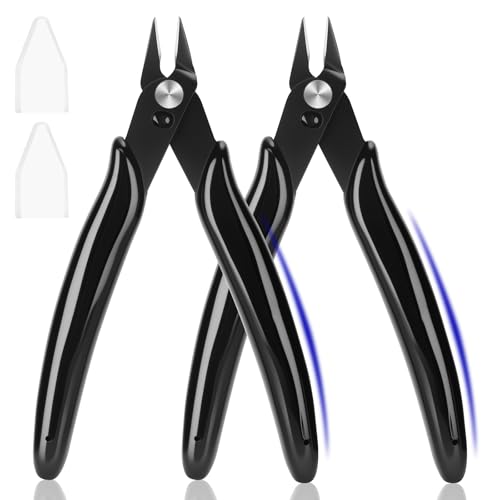
Flush cutters snip wire ends level with the surrounding surface, unlike standard diagonal pliers that leave a sharp pin. These EamPrsk tools bring beveled 0.6-inch jaws sized for narrow gaps, which is exactly what circuit-board repair, jewelry making, and zip-tie cleanup demand. At five inches overall, they fit comfortably in a palm-sized grip for detail sessions that would cramp larger pliers.
The manganese steel bodies carry a black oxide coating for rust resistance, a practical touch given how often these live in garage drawers where humidity does quiet damage. Two in a pack means one for the electronics bench and one for the toolbox, and honestly, having a designated zip-tie pair saves arguments with household members.
What Pays Off
- Beveled micro jaws reach recessed leads and tight component spacing.
- Black oxide coating slows rust in damp workshop conditions.
- Two-pack pricing covers multiple stations without doubling spend.
- Compact size reduces hand fatigue during extended detail work.
Details To Watch
- Jaws are built for soft wire and ties, not hardened steel cable.
- Spring tension isn’t specified, so return feel varies by unit.
Core Details
Who Should Grab It
Electronics hobbyists, model builders, and jewelers who need clean, close cuts in cramped spaces.
Consider Something Else When
Cardboard and packaging work calls for the TIFICAL 18mm box cutter set, since flush jaws aren’t shaped for slicing flat materials.
Eight knives sounds excessive until you count the places a cutter belongs: kitchen drawer, desk, garage, glovebox, craft cart, tackle box. That’s the pitch here. Each retractable unit handles cardboard, foam board, tape, plastic wrap, and thick paper, making them useful well beyond package duty.
Where these differ from the TIFICAL four-pack is distribution strategy. Eight smaller cutters scattered through a busy household or mailroom beat four concentrated ones for pure availability. The comfortable grip supports longer cutting sessions, though you give up the wider 18mm blade of the TIFICAL set, so heavy scoring tasks feel slightly less planted.
Where It Excels
- Eight units let you station a cutter nearly everywhere boxes arrive.
- Versatile blades manage card stock, foam board, tape, and thin plastic.
- Comfortable grips suit repetitive unpacking marathons.
- Losing one stings far less than losing a single premium knife.
Potential Sticking Points
- Smaller blades handle lighter materials better than dense stock.
- With eight loose knives, blade-safety habits matter even more around kids.
Product At A Glance
The Right Fit
Mailroom staff, teachers, and busy households that process constant deliveries and want redundancy everywhere.
Not Your Match When
You need thicker, longer-lasting blades per knife; the TIFICAL 18mm set delivers more steel per cut across its four units.
What Matters Most Before Choosing Craft Cutters
Match The Mechanism To The Material
Guillotine trimmers excel at stacked paper because their swinging arm applies pressure across the whole line at once. Rotary cutters trade that capacity for straighter single-sheet results, and utility knives handle three-dimensional materials no flatbed trimmer can touch. Start by naming the material you cut most often, then let that answer eliminate half the field immediately.
Capacity And Footprint Trade Together
A 10 or 12-sheet rating covers typical home and small-office batches, but pushing past rated capacity bends blades and skews cuts. Bigger capacity usually brings a heavier base too, so measure both your workload and your available desk real estate before committing. Compact workshops often favor lighter builds they can shelve between sessions.
Blade Steel And Replacement Costs
Stainless grades such as 3Cr13 resist corrosion and hold edges longer than basic carbon steel, which matters in humid garages or coastal homes. Utility knives consume replaceable blades as a running expense, while trimmer blades last years with occasional cleaning. Factor that ongoing cost into any multi-pack purchase.
Safety Features Worth Prioritizing
Retractable mechanisms, guarded rails, and blade-lock positions prevent the majority of household accidents reported with cutting tools. Homes with children should weight these features heavily, choosing self-contained designs over exposed-edge options whenever possible.
Key Considerations Across These Picks
Wrong Turns To Avoid
The classic error is buying one do-everything tool and stretching it past its design. A rotary trimmer will frustrate anyone cutting 30-sheet stacks, and a box cutter will butcher a photo mat. Another slip: ignoring base stability. Wobbling feet ruin accuracy no matter how sharp the blade, so check for rubber footing before anything else.
What The Higher Tier Buys
Spending up generally buys steel quality and mechanical refinement. Stainless blades stay sharper, interlocking rail systems keep lines true, and solid bases absorb vibration. Casual users trimming a few sheets monthly won’t notice the difference, but anyone cutting weekly will feel it within the first hour of use.
Frequently Asked Questions
How many sheets can a home guillotine trimmer realistically cut?
Most consumer models handle 10 to 12 sheets per pass safely. Exceeding the rating risks bent blades and ragged edges.
Are rotary trimmers better than guillotine styles?
Neither is universally better; rotary models deliver straighter single-sheet cuts while guillotines process stacks faster. Your typical workload decides.
Can I sharpen a paper trimmer blade?
Trimmer blades are generally replaced rather than sharpened, and replacements are inexpensive. Attempting to hone them often worsens the edge geometry.
What blade size works best for box cutters?
An 18mm blade offers good leverage for cardboard, while slimmer hobby blades suit detail work. Match width to material thickness.
Why choose flush cutters over regular pliers?
Flush jaws trim wire ends level with the surface, leaving no sharp stub. Standard pliers leave angled tips that snag skin and fabric.
Closing Remarks
Seven tools, seven different jobs, and the honest takeaway is that most households benefit from owning two of them rather than searching for one universal answer. Pair a trimmer for flat work with a utility knife for everything dimensional, and add the flush cutters only when electronics or jewelry enter the picture. Match the tool to your actual routine, not an imagined one, and every cut gets easier.
