
Picking the right fabric cutter saves hours of hand-trimming and gives your projects cleaner edges than freehand shears. The category splits into three camps: electronic die-cutting machines for vinyl, paper, and fabric shapes, hand-held electric rotary shears for long seams and curves, and manual rotary blades for purists who want control. Each tool here fits a different kind of maker, from a weekend hobbyist piecing a baby quilt to a small-batch apparel studio cutting hundreds of units a week.
Your Options, Compared

Silhouette America Cameo 5 Alpha (α) Smart Cutting Machine

AccuQuilt GO! 55100H Fabric Cutter Starter Set
SHALL 4V Cordless Electric Scissors

Hercules HRK-100 5-Speed Electric Rotary Cutter

AccuQuilt GO! Big 55500 Electric Fabric Cutter

45mm Rotary Cutter with 5 Extra Blades
Cricut Maker 4 Starter Kit for Beginners

AccuQuilt Go! Me Fabric Cutter Starter Set

Consew MB-50 Portable Electric Fabric Cutter

BEAMNOVA Electric Rotary Cutter for Fabric
More Details On Our Top Picks
The Cameo 5 Alpha lives in that sweet spot between hobby plotter and small-business workhorse. It pairs an AutoBlade (a self-adjusting blade that reads the tool’s setting and dials in pressure automatically) with a four-point registration system, which is the camera-and-mark setup that lets the machine scan printed sheets and line up cut lines to existing artwork within fractions of a millimeter. That combo matters most for sticker makers, heat-transfer projects, and anyone printing full-color designs at home before cutting.
Compared with the handheld rotaries on this list, the Cameo is a desk-bound unit, so you give up mobility for repeatable accuracy. The Fast Sketch Mode (a pen-drawing shortcut that traces outlines at higher travel speeds than a normal cut path) shaves real time off bulk drawing jobs. For most mixed-media crafters who want quiet operation and a tool that won’t intimidate a beginner, the honest read is that this is a confident pick.
Notable Upsides
- AutoBlade removes the guesswork of pressure settings across vinyl, paper, and light fabric.
- Four-point registration delivers print-and-cut accuracy that holds up on sticker sheets and heat transfers.
- Quieter operation than older Cameo generations, friendlier for late-night craft sessions or shared spaces.
- Studio software supports custom shape imports, so you can cut designs rather than depend on pre-made files.
- Works with cutting mats for fabric and cardstock, expanding beyond rigid vinyl use cases.
Points To Note
- You trade portability for accuracy. The unit stays on your craft table.
- Replacement blades and mats are ongoing consumables worth budgeting for over time.
- Studio software has a learning curve during the first few projects, so plan some setup time.
At A Glance
Built With In Mind
Mixed-media crafters who split time between vinyl, paper, and light fabric projects, and who want a quieter machine that holds its accuracy across print-and-cut workflows.
Reach For A Different Pick When
Quilters piecing cotton layers will get more use out of the AccuQuilt GO! 55100H, which is purpose-built around die-based fabric cutting rather than plotter-style shapes.
The AccuQuilt GO! 55100H works on a die-based system. You feed fabric through a die (a shaped metal cutting template) and the machine presses it through, punching out identical shapes every time. The portable design folds flat, which is the part quilters who travel to retreats or guild meetings tend to care about most. For piecing a quilt top with the same block repeated dozens of times, no other tool here matches its consistency.
Unlike the Silhouette Cameo 5 Alpha’s plotter approach, this machine wants you to commit to die shapes up front, so flexibility is narrower but accuracy is locked in. You may find the upfront cost feels steep once you start adding dies for every new shape, but the per-cut payoff in saved time is meaningful for serious quilters.
Noteworthy Benefits
- Cuts up to six layers of cotton at once, replacing hand-rotation step for patchwork blocks.
- Folds flat for transport to classes, retreats, and quilting bees without a dedicated cart.
- Die-based cutting eliminates ruler-and-rotary math for repetitive shapes.
- Works for quilters with limited hand strength, since the press does the work.
Trade-Offs
- Each new shape requires buying the matching die, which adds up across a varied project list.
- Bulkier than a handheld rotary, so storage space matters in a small craft room.
Whose Shelf It Belongs On
Quilters who build block-heavy projects and travel to classes or retreats, especially anyone whose hands tire before the quilt does.
Consider Something Else When
Someone who wants to cut freeform curves in leather or vinyl will find the Hercules HRK-100 a better fit, since die systems favor geometric shapes over organic lines.
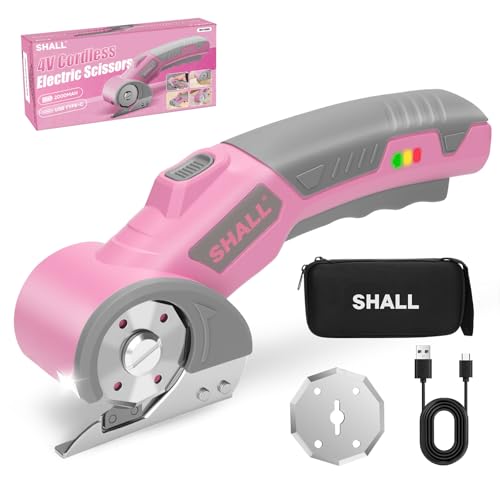
SHALL’s cordless scissors flip the script on what fabric cutters look like. Instead of a flat-bed machine, this is a handheld rotary cutter with a 4V rechargeable battery, a safety lock to prevent accidental starts, and a small LED work light. You hold it like a thick pen and guide it through fabric, cardboard, carpet, or thin plastic.
For a teacher prepping classroom kits or a crafter unpacking boxes of fabric at the kitchen table, no cord means no hunting for an outlet. The 280-rpm rotational speed (the number of times the blade completes a full spin per minute) keeps it well ahead of manual scissors on long straight runs. The trade-off shows up in tight curves, where a hand rotary still gives finer control.
What Helps Most
- Cordless design frees you to work outdoors, at the table, or anywhere an outlet is awkward.
- Safety lock prevents accidental starts in a bag or drawer with other tools.
- LED work light helps on darker fabrics and dim workbenches.
- Replacement blade included, which extends useful life before buying consumables.
Honest Caveats
- Battery runtime limits long cutting sessions, so plan a recharge between big jobs.
- Not the right tool for precise pattern cutting where a stationary die machine would shine.
Best Suited To
Casual crafters, classroom volunteers, and small-business owners who want handheld cutting without dragging a cord across a workbench.
Look Elsewhere When
Quilters focused on accuracy will find the AccuQuilt Go! Me Fabric Cutter a better match for repeatable block shapes.
Hercules leans into industrial heritage with the HRK-100. The 4-inch octagonal blade (a blade with eight cutting edges that rotates to expose a fresh edge as it wears) paired with a built-in sharpening stone is the kind of detail that tells you this tool is built for daily, multi-layer cutting. Five speed settings let you tune the blade to fabric weight rather than brute-forcing through it.
Where the SHALL cordless scissors favor portability, the HRK-100 favors throughput. It runs on standard 110V power, so the workspace needs an outlet nearby, but in return you get continuous runtime and the muscle to chew through several layers of light-to-medium cloth. The carbide-tipped lower blade is a touch owners commonly mention as a relief, since fabric tends to drag rather than jam.
A Strong Showing
- Five-speed control matches the cut to the material, from sheer cotton to synthetic blends.
- Octagonal blade with built-in sharpener extends time between blade replacements.
- Multi-layer capacity shaves time off bolt cutting for production work.
- Carbide-tipped lower blade reduces fabric drag during long runs.
Practical Considerations
- 110V corded design anchors you to a fixed workstation.
- Best results sit in light-to-medium weight cloth; heavy denim or thick canvas may push its limits.
- Bulkier than a handheld rotary, so it wants a dedicated workbench spot.
Right Fit For
Small production studios, upholsterers, and sewing classrooms that need to cut through stacked fabric on a daily basis.
Not Your Match When
Someone focused on apparel and lace will prefer the Consew MB-50 Portable Electric Fabric Cutter, which handles narrow curves more gracefully.
The Big 55500 is AccuQuilt’s electric step up. One button powers an integrated electric drive that pulls the die through the machine, which removes the manual press step from the original 55100H. The trade-off for that automation is a fixed 19 x 11 x 6-inch footprint on your craft table, plus the same die-collection investment as the smaller GO! models.
For a quilter who has been hand-pressing dies for years, the electric drive feels like a quiet upgrade. It still cuts up to six layers at a time, and running two dies side by side speeds up strip work. Compared to the manual Go! Me, this is the pick for someone who has outgrown the hand press but isn’t ready to leave the AccuQuilt ecosystem behind.
Positive Points
- Single-button operation takes the hand press out of the workflow.
- Handles up to six layers of cotton in a single pass.
- Two-die side-by-side layout accelerates strip and border cutting.
- Same die compatibility as the smaller GO! series, so existing collections carry over.
Things To Consider
- Larger footprint than the manual 55100H, so plan craft-room space accordingly.
- Electric drive adds weight, making it less travel-friendly than its manual sibling.
Spec Overview
Made For
High-volume quilters who already own GO! dies and want to trade hand-pressing for push-button speed.
Skip It When
Traveling quilters will be happier with the folding AccuQuilt GO! 55100H, which slips into a class bag more easily.
The 45mm rotary cutter is the classic tool that taught most modern sewers to cut straight lines. The 45mm stainless steel blade (a wheel-shaped blade that rolls along a ruler rather than dragging) handles long fabric cuts with a single stroke, and the safety lock keeps the blade covered when it sits in a drawer. The bundle ships with five replacement blades, which buys you a long runway before another blade purchase shows up.
Compared to the powered machines on this list, the trade-off is real manual effort. For most home sewists, though, that’s a feature rather than a bug, since a manual rotary gives you tactile control over every cut. The ergonomic non-slip handle also matters during marathon cutting sessions where hand fatigue creeps in.
What Earns Its Place
- 45mm blade size handles most quilting cotton and apparel fabric in one stroke.
- Five extra blades extend the kit’s working life out of the box.
- Safety lock keeps the blade covered in storage and transport.
- Ergonomic non-slip handle reduces hand fatigue on long cutting days.
Smaller Trade-Offs
- Manual effort means longer cutting times on big projects than an electric rotary.
- Blade changes require care to avoid nicks, so keep the safety lock engaged when swapping.
Perfect Match For
Beginners and casual home sewists who want a dependable, low-cost rotary that pairs with a quilting ruler and cutting mat.
Where Another Pick Suits Better
If repetitive block shapes dominate your projects, the AccuQuilt Go! Me will cut down on the time spent measuring and re-measuring.
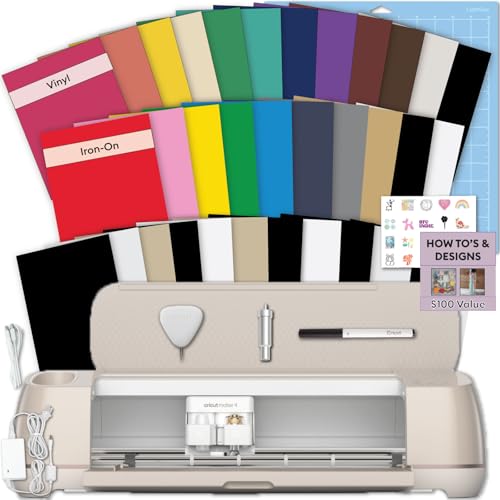
The Cricut Maker 4 starter bundle arrives with everything needed to make stickers, shirts, and vinyl projects on day one. The cutting machine, mat, blade, tools, vinyl sampler, and iron-on (HTV, or heat-transfer vinyl, used to press designs onto fabric with a household iron or heat press) sheet all sit in the box. That’s the real differentiator: the moment you unbox, you can run a project without a separate shopping trip.
Where the Silhouette Cameo 5 Alpha leans toward print-and-cut precision, the Maker 4 leans toward an ecosystem of pre-designed projects and materials. For a beginner who doesn’t want to learn design software from scratch, the Cricut app’s project library is a genuine head start. The catch is a tighter media ecosystem, so most of your consumables will come from one catalog.
The Case For It
- All-in-one bundle removes the guesswork from a first-time setup.
- Project app guides new users through designs without manual design skills.
- Vinyl and iron-on samples included for immediate test cuts.
- Tool kit in the box covers weeding (peeling away excess vinyl from a cut design) and transfer basics.
Room For Improvement
- Material ecosystem is tighter than Silhouette’s open design approach.
- Cuts thinner materials best, so heavy-duty fabric work sits in Cricut’s higher-tier tool range.
Quick Facts
Who Will Love This
Newcomers who want a guided, app-driven entry into craft cutting and appreciate a complete kit rather than buying pieces separately.
A Better Fit Elsewhere
A silhouette user who imports custom SVG files (vector design files that describe shapes mathematically) will find the Silhouette Cameo 5 Alpha more flexible for non-Cricut design libraries.
The Go! Me is AccuQuilt’s smallest die cutter at 8.5 pounds, and that lightweight build is the headline feature. The 6-inch cutting width won’t handle a quilt’s full strip in one pass the way the GO! 55100H does, but for a quilter in a small apartment or a crafter with limited hand strength, the lighter frame is the win.
Same story with the rest of the GO! line: shape variety depends on the dies you own or buy. Where it shines is on a small cutting table where a full-size die press would crowd the space, or in a classroom where a younger quilter can manage the press without adult help. For most apartment sewists, the 6-inch capacity covers block piecing just fine.
A Favorable Mix
- 8.5-pound frame makes it portable between craft room and class.
- 6-inch cutting width fits standard patchwork block sizes.
- Suits quilters with limited hand strength thanks to smoother rolling action.
- Cuts up to six layers of cotton in a single pass.
Some Limits To Know
- Smaller cutting width means more passes for long border strips.
- Die investment is the same ongoing cost as the larger GO! models.
Who Should Grab It
Apartment sewists, classroom quilters, and anyone who wants AccuQuilt accuracy without a heavy machine on the craft table.
Swap It Out When
If cutting long borders and strips in one pass matters, the larger AccuQuilt GO! 55100H will save real time per project.
The Consew MB-50 is built for a specific kind of cutting: narrow curves, sharp corners, and detailed silhouettes in single layers. The 2-inch rotary knife is smaller than the Hercules HRK-100’s 4-inch octagonal blade, but that size is exactly what makes tight lace work and applique shapes possible. The lightweight body keeps the tool agile rather than wrist-heavy.
For apparel makers, lace trimmers, and anyone cutting appliques from delicate cloth, this is the kind of tool that earns its space on the bench. The honest read is that bulk fabric cutting isn’t its strength, so most sewists will pair it with a different tool for yardage and reserve the MB-50 for the detailed work that bigger blades can’t follow.
Everyday Advantages
- 2-inch knife handles narrow curves and sharp corners cleanly.
- Lightweight body reduces wrist fatigue during detail work.
- Cuts cloth, knit fabric, synthetics, leather, lace, and vinyl.
- Portable design fits a small cutting station without dedicated bench space.
Less-Strong Areas
- Best for single or low layer counts, so high-volume yardage cutting needs a larger rotary.
Feature Snapshot
Made For
Apparel makers, lace trimmers, and crafters who need detailed curves rather than long straight runs.
Another Choice May Suit
Someone focused on quilting cotton layers will get more use from the AccuQuilt Go! Me, since die systems handle block piecing more consistently than rotary knives.
BEAMNOVA’s electric rotary is the high-torque end of the handheld spectrum. A 250W motor drives a 4-inch alloy-steel octagonal blade, and the machine handles fabric up to 1.1 inches thick. That last number is the surprise: most rotary cutters advertise multi-layer cotton, not inch-thick stacks.
For upholstery work, canvas projects, or thick wool cutting, that extra power earns its keep. The wear- and corrosion-resistant blade suggests owners won’t be shopping for a replacement every few months. Compared to the Hercules HRK-100’s variable speed control, the BEAMNOVA leans on raw motor strength, which is great for thick materials but less tuned for delicate work.
What Makes Sense
- 250W motor chews through fabric up to 1.1 inches thick.
- 4-inch octagonal alloy-steel blade resists wear and corrosion.
- Long blade life reduces replacement frequency on heavy workloads.
- Clean cuts on canvas, denim, and upholstery materials.
Points To Keep In Mind
- More power than delicate work needs, so lightweight fabrics may catch if you push too fast.
- Bulkier than a manual rotary, so storage needs a shelf rather than a drawer.
Right Fit For
Upholsterers, bag makers, and crafters who regularly cut through thick or layered materials like canvas, denim, or bonded fabrics.
Skip It When
A quilter focused on cotton layers will get cleaner results from the AccuQuilt GO! Big 55500, which uses dies rather than brute force to cut stacks.
What Matters Most Before Choosing a Fabric Cutting Machine
Start with the material that fills most of your cutting time. Cotton quilting fabric and apparel respond well to die systems like the AccuQuilt GO! line, where shape repeatability is the priority. Leather, denim, canvas, and bonded fabrics lean toward powered rotary cutters with high-torque motors, like the BEAMNOVA or Hercules HRK-100. Vinyl, paper, and printable sticker sheets live in the plotter world of the Cricut Maker 4 and Silhouette Cameo 5 Alpha.
Next, weigh workspace against throughput. A die cutter asks for a permanent spot on a craft table and wants you to invest in dies per shape. A handheld rotary slips into a drawer and travels to classes, but trades consistency for flexibility. Electric rotary shears split the difference, giving speed in a portable form factor.
Finally, think about hand and body comfort. Quilters with limited hand strength often find die presses easier on the wrists than extended rotary sessions. Classrooms and shared craft spaces benefit from cordless tools like the SHALL scissors, where the safety lock and absence of a cable both matter. Your typical project length, frequency, and physical comfort each push the final pick in a different direction.
Smart Guidance For Choosing Well
Where Shoppers Go Wrong
The most common mistake is buying for the project you imagine rather than the project you actually make. A vinyl sticker hobby doesn’t justify a die-cutting system, and a serious quilter will outgrow a manual rotary inside a year. Match the tool to your dominant material and your weekly cutting volume before matching it to a feature list.
Another trap is ignoring the consumables. Die systems need dies per shape, plotter machines need mats and blades, and rotary blades need replacement every few months. Budgeting for ongoing supplies matters as much as the machine itself, since a low-cost tool with expensive consumables adds up fast.
When Paying More Pays Off
Higher-tier fabric cutters earn their price through three doors: speed, accuracy, and reduced physical effort. The AccuQuilt GO! Big 55500 trades a heavier footprint for an electric drive that removes the hand press. The Silhouette Cameo 5 Alpha earns its cost with print-and-cut registration that cheaper plotters skip. The BEAMNOVA’s 250W motor reaches fabric thicknesses a standard rotary won’t touch. For anyone cutting in real volume, those upgrades pay back in hours saved and cleaner results.
Frequently Asked Questions
What is the easiest fabric cutting machine for beginners?
For absolute beginners, the Cricut Maker 4 starter kit includes everything needed in one box and walks you through projects in the app. Manual rotary cutters like the 45mm kit are also beginner-friendly, with a simple safety lock and no software to learn.
Can electric fabric cutters handle multiple layers at once?
Yes, but layer capacity depends on the machine. Die cutters like the AccuQuilt GO! line handle up to six layers of cotton. Powered rotary shears like the BEAMNOVA cut through stacks up to 1.1 inches thick, while the Hercules HRK-100 is built for light-to-medium multi-layer work.
Do I need a die cutter or a rotary cutter?
Die cutters excel at repeated shapes such as quilt blocks, where every piece needs to match. Rotary cutters handle freeform curves, long straight cuts, and varied project shapes. Quilters who repeat the same block dozens of times benefit most from a die system, while apparel and craft sewists usually reach for a rotary.
How do I maintain a fabric cutting machine?
Keep blades covered when not in use, change rotary blades when cuts start fraying, and store cutting mats flat rather than rolled. For die cutters, store dies dry and away from humidity to prevent rust on the cutting edges.
Are cordless fabric cutters powerful enough for daily use?
Cordless tools like the SHALL scissors handle short sessions and light-to-medium materials comfortably, with battery runtime as the main limit. For full-day production cutting, a corded electric rotary delivers continuous power without recharge breaks.
Closing Remarks
The right fabric cutter comes down to your dominant material, your cutting volume, and the space you have to work in. Die systems reward quilters who repeat shapes, electric rotories serve studios that push through stacks every day, and plotters like the Cricut and Silhouette cover the sticker-and-shirt crowd. Pick the one that fits the project you’ll actually make this month, and the rest of the tool collection can grow from there.
