
A heat press is the backbone of any custom apparel setup, whether you’re running a small shop or pressing shirts in your garage on weekends. The catch is that platen size, pressure control, and heating consistency vary wildly between models, and the wrong choice shows up as scorched vinyl or faded sublimation prints. This roundup covers full-size presses plus the mats, pillows, and sheets that make every press job cleaner. You’ll find a clear fit for beginners, side hustlers, and anyone upgrading to serious production work.
The Shortlist At A Glance

Fancierstudio FS15x15A Sublimation Heat Press
Topdeep 15×15 8 in 1 Heat Press Machine

PlanetFlame 15×15 Slide Out Heat Press, Purple

ReArt Heat Press Mat 16 x 20

VCHOMY 4 Pack Heat Press Pillow Bundle

TransOurDream PTFE Teflon Sheets 16 x 20

ePhotoInc EPH15BLK Digital T Shirt Heat Press

VEVOR 15×15 High Pressure Heat Press Machine

TOPDEEP 5 in 1 Heat Press Machine 15×15
ePhotoInc 16 X 24 Large Heat Press Machine
More Details On Our Top Picks
The newest Fancierstudio model fixes the biggest complaint about clamshell presses: the lower platen slides forward 5.5 inches when open, so you’re never reaching under a hot upper plate to position a shirt. That single change makes a long evening of pressing orders noticeably safer and faster.
It runs on standard 110V household power, which matters if your workspace is a spare bedroom or garage rather than a commercial shop. Both platens ship with non-stick covers already installed, so stray vinyl or sublimation ink wipes away instead of baking onto bare metal.
Strong Points
- Slide-out bottom platen keeps your hands clear of the heated upper plate during every load
- Non-stick covers on both surfaces mean less scraping and fewer ruined transfers
- Standard US voltage plugs into an ordinary wall outlet with no special wiring
- Industrial-style build holds up to repeated daily sessions better than hobby-grade units
Things To Consider
- Clamshell action applies pressure from one hinge point, so thick items like layered patches may press unevenly compared to swing-away designs
- You’ll want a sturdy table; the machine has real weight and shifting mid-press is a commonly reported annoyance
Who It Suits Best
First-time shirt makers launching a small t-shirt business who want pro features without a steep learning curve.
A Better Fit Elsewhere
Shoppers planning mug and cap work should look at the Topdeep 15×15 8 in 1 Heat Press Machine instead, since its interchangeable attachments cover those blanks natively.
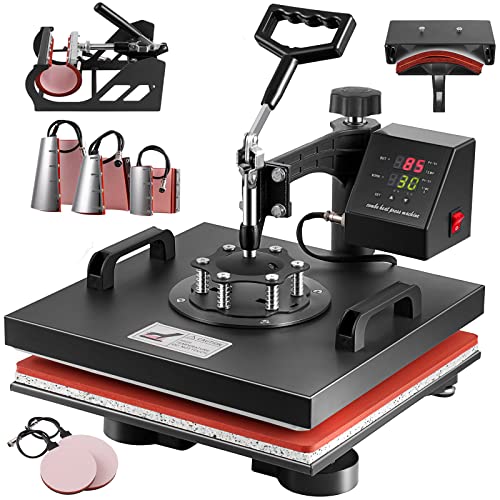
Where the Fancierstudio sticks to flat goods, this Topdeep combo swaps attachments for mugs, caps, and plates, all driven by one digital controller. The swing-away head moves completely clear of the workspace, which gives you unobstructed view while lining up a design.
The heating element is die-cast aluminum with a non-stick coating, a combination that resists scorching and cleans up easily after sticky HTV jobs. Two bonus protective sheets come in the box, so you can start pressing before ordering extras.
What We Like
- Eight functions in one frame turn a single purchase into a full product line of shirts, drinkware, and headwear
- Teflon-coated platen wipes clean and helps prevent scorched fabric on delicate blends
- Swing-away arm removes the hot plate from above your hands entirely
- Included sheets protect garments right out of the box
Worth Noting
- Attachment changes take time, so high-volume single-item runs go slower than a dedicated press would
- The multi-part assembly occupies more bench space than a plain clamshell like the PlanetFlame below
At A Glance
Made For
Craft sellers who want to offer personalized mugs and hats alongside shirts without buying separate machines.
Where Another Pick Suits Better
Anyone pressing only flat items will find the simpler Fancierstudio FS15x15A easier to live with day to day.
This clamshell borrows the drawer concept from pricier machines: pull the lower platen fully out, lay your garment down comfortably, then slide it back under the heated plate. For anyone who has ever singed a knuckle positioning a shirt, the appeal is obvious.
The Teflon-coated surface resists sticking and cleans with a quick wipe, and an adjustable pressure knob lets you dial in lighter pressure for thin polyester or firmer clamping for heavy cotton. It handles HTV, DTF film, and sublimation paper across shirts, tote bags, and ceramic tiles.
Bright Spots
- Full pull-out drawer means comfortable garment placement with zero reach-under risk
- Pressure knob adapts to different material thicknesses without guesswork
- Nonstick plate simplifies cleanup after glitter vinyl, the messiest material most crafters use
- Handles three major transfer methods, so one machine covers most home project lists
Small Caveats
- The purple finish won’t suit every studio aesthetic, though function is unaffected
- Drawer rails are a moving part, so keeping them free of lint and adhesive residue matters for smooth operation over time
Right Fit For
Home crafters working in shared spaces where safety around the hot plate is a genuine concern.
Swap It Out When
Production-focused sellers needing maximum evenness across large prints will get more from the VEVOR 15×15 High Pressure Heat Press Machine’s dual-tube heating.
A good mat is the cheapest upgrade in this entire list. The ReArt pad measures 16 by 20 inches, sized to sit inside a matching press or serve as a stable base for handheld iron-on tools working on larger panels.
Its construction channels moisture away from the garment and directs heat into the transfer itself, which is exactly what you want when pressing onto towels or fleece where trapped steam causes patchy adhesion. Both faces are usable, effectively doubling its working life before replacement.
Plus Points
- Generous 16 x 20 footprint accommodates oversized designs and full-front placements
- Moisture-wicking construction improves adhesion on absorbent fabrics like terry cloth
- Double-sided use stretches the lifespan considerably compared to single-face pads
- Smooth, even surface helps eliminate press marks on delicate materials
Points To Note
- It’s an accessory, not a press, so pair it with one of the machines above rather than expecting standalone results
- Store it flat; owners commonly report that rolled storage leaves memory creases that show through thin vinyl
Quick Facts
Who Will Love This
HTV and iron-on hobbyists using handheld presses or wanting a protective layer inside their main machine.
Consider Something Else When
Pressers dealing with seams, zippers, and raised hardware should grab the VCHOMY pillow bundle instead, since foam fills gaps a flat mat can’t.
Pressing over a zipper, seam, or button pocket is how transfers end up half-stuck. These pillows solve that by filling the gap underneath, raising the print area level with the rest of the garment. The set includes four sizes: 5 x 5, 10 x 10, 5 x 15, and 12 x 15 inches, covering everything from infant onesies to adult hoodies.
Each pillow wears a heat-resistant non-stick wrap with a waterproof face, and the inner foam rebounds to shape after every press rather than compressing flat over weeks of use.
Reasons To Buy
- Four distinct sizes mean one purchase covers baby clothes through adult outerwear
- Non-stick, waterproof shell shrugs off adhesive residue and ink spillover
- Resilient core bounces back after each press instead of developing permanent dents
- Turns impossible jobs, like chest prints over button plackets, into routine ones
Honest Caveats
- Pillows add height inside the press, so you’ll need to reduce pressure slightly and relearn your settings per garment type
- Keep them away from direct platen contact; they’re designed to sit beneath the garment, not on top
Who Should Grab It
Sublimation and HTV workers regularly pressing hoodies, bags, and seamed garments where flat pressing fails.
Reach For A Different Pick When
Flat-panel shirt printers get more everyday value from the TransOurDream PTFE sheet pack reviewed next.
PTFE sheeting, the same slick material used on nonstick cookware, sits between the hot platen and your transfer to stop ink bleed-through and scorching. Four sheets in the 16 x 20 size give you enough rotation that one can cool and be wiped clean while another stays in service.
The high-density stock has a fine, smooth texture and cuts cleanly with scissors, so trimming smaller pieces for pockets and sleeves costs nothing extra. They suit automatic presses with 15 x 15 platens particularly well, with margin to spare on every edge.
Highlights
- Four-sheet pack supports a wash-and-rotate workflow during busy production days
- Oversized dimensions fully cover a 15 x 15 platen with no exposed corners
- Cuts to any shape with ordinary scissors for small-format work
- Compatible across HTV, DTF, sublimation, and general crafts, making it a true all-rounder
Softer Spots
- Adhesive residue builds up on the surface over months; a gentle scrape and wipe restores performance, but plan on eventual replacement
- Sheets are thin by design, so they don’t replace pillows for uneven surfaces
Feature Rundown
Whose Shelf It Belongs On
Daily HTV and DTF printers who burn through protective sheets and want a stocked supply on hand.
Not Your Match When
Beginners still deciding on their first machine should start with the ePhotoInc EPH15BLK press and add sheets later.
Some people just want a press that works the moment the box hits the floor. The EPH15BLK arrives fully assembled, and its LED controller displays both temperature and countdown timer at a glance, removing the two settings beginners fumble most often.
The range runs from room temperature up to 500 degrees Fahrenheit with timing up to 999 seconds, generous enough for every common transfer method including stubborn screen-print transfers. Beyond shirts, it handles bags, mouse pads, jigsaw puzzles, and ceramic tiles, giving new sellers room to experiment.
Upsides
- No assembly required, so your first press can happen within minutes of unboxing
- Combined LED readout for heat and time reduces burnt transfers during the learning phase
- Wide 500-degree ceiling covers demanding applications like heavy screen-print transfers
- Flat-surface versatility extends beyond apparel into puzzles, tiles, and mouse pads
Minor Gripes
- Clamshell hinge design offers less even pressure on thick stacks than the VEVOR’s high-pressure system
- The black housing shows dust and lint readily in a workshop environment
Best Suited To
Total beginners and occasional crafters who value plug-and-play simplicity over expandability.
Another Choice May Suit
Growing shops needing mug and hat capability should step up to the TOPDEEP 5 in 1 Heat Press Machine instead.
Uneven heat is the silent killer of professional-looking prints, and VEVOR attacks it directly with dual-tube fast-heating technology that pushes warmth edge to edge across the platen. Paired with two layers of insulation padding, the result is tighter temperature consistency than single-tube budget presses manage.
The control side uses a silver alloy electrical contact and a high-precision sensor, which translates to readings you can actually trust when following strict sublimation recipes. For sellers whose reputation rests on batch-to-batch consistency, that precision earns its keep quickly.
Standout Traits
- Dual-tube heating delivers noticeably more uniform edge-to-edge temperatures
- High-sensitivity sensor keeps actual platen heat aligned with your setpoint
- Insulation layers protect surrounding components and reduce exterior warmth
- Strong clamping force suits dense transfers and thick garment stacks
Areas To Watch
- Higher clamping force takes adjustment; light-pressure fabrics need a careful hand on the knob until you learn its range
- It’s a single-function flat press, so mug and cap work requires a separate solution
Core Details
The Right Fit
Volume shirt printers and sublimation sellers who need repeatable, recipe-exact results across long production runs.
Look Elsewhere When
Occasional hobbyists will find the simpler ePhotoInc EPH15BLK easier to justify and operate.
This is the middle path in Topdeep’s lineup: the same quality die-cast aluminum platen and non-stick coating as the 8-in-1 model above, trimmed to five functions and a slide-out lower plate. You keep shirt, mug, cap, and plate capability while shedding some cost and complexity.
The slide-out design deserves mention alongside the Fancierstudio’s approach; pulling the bottom plate clear before loading feels far safer than working beneath a suspended heater. Two bonus protective sheets arrive included, mirroring its bigger sibling’s starter kit.
Positives
- Five functions cover the blanks most small sellers actually offer
- Slide-out lower plate makes loading safer and positioning easier
- Die-cast aluminum platen with non-stick coating resists scorching and cleans easily
- Protective sheets included, saving a separate first-week purchase
Trade Offs
- Fewer attachment options than the 8-in-1, notably some plate sizes, limits future product expansion
- Swapping between functions mid-session adds workflow friction versus a dedicated flat press
Who Should Grab It
Hobbyists ready to add mugs and hats to a shirt-focused lineup without paying for rarely used attachments.
Skip It When
Sellers committed exclusively to flat goods will prefer the focused VEVOR 15×15 High Pressure Heat Press Machine.
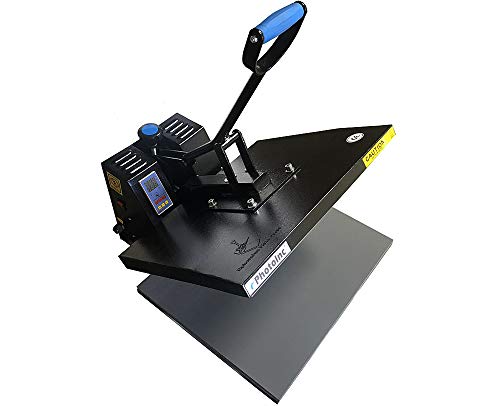
Everything else on this list tops out at 15 inches wide. This industrial-grade unit stretches to 16 by 24, opening up full-back prints, oversized banners, table runners, and blanket-sized blanks that simply don’t fit smaller platens. The upward-opening design also saves counter depth compared to traditional clamshells.
Temperature spans 0 to 500 degrees Fahrenheit, and the package ships at roughly 85 pounds in a 32 x 27 x 18 inch carton, so plan your bench space and have help on delivery day. It’s built for applying letters, numbers, and images across garments, bags, tiles, and similar flat goods.
Best Bits
- 16 x 24 platen accepts blanks no other pick here can accommodate
- Upward-opening motion conserves valuable workbench depth
- Industrial construction suits sustained commercial production schedules
- Full 500-degree range handles demanding screen-print and sublimation transfers
Room For Improvement
- The weight and footprint demand a dedicated, sturdy station; this isn’t a machine you relocate between rooms
- Overkill for hobbyists, since most home projects never approach 24 inches
Built With In Mind
Established production shops and sports-team printers handling jerseys, blankets, and oversized format work daily.
Where A Sibling Pick Shines
Smaller operations should stay with the ePhotoInc EPH15BLK, which shares the brand’s straightforward controls in a far lighter frame.
Choosing Between These Presses Without Regret
Match The Platen To Your Actual Work
Platen size dictates what you can produce. A 15 x 15 plate covers nearly every standard shirt graphic, while the 16 x 24 ePhotoInc exists for full-back prints and oversized textiles. Measure your most ambitious planned design before committing, then buy one size up from that measurement.
Pressure And Heat Consistency Come First
Even heating separates crisp transfers from blotchy ones. Dual-tube systems like the VEVOR’s hold tighter temperature tolerances across the plate edges, which matters enormously for sublimation, where partial heat produces partial color. Adjustable pressure knobs matter equally, since polyester blends and heavy cotton want very different clamping forces.
Think About Your Workflow, Not Just The Specs
Slide-out and swing-away designs protect your hands and speed up loading, a difference you feel after fifty shirts in a row. Multifunction combos trade that speed for versatility. Honest self-assessment here saves money: most hobbyists never touch the mug attachment.
Don’t Forget The Supporting Cast
Sheets, pillows, and mats determine finish quality as much as the machine does. Budget for protection from day one, because a scorched platen or a ruined hoodie costs more than any accessory on this list.
Key Considerations Across These Picks
Traps First Timers Fall Into
The classic error is buying a combo machine for capabilities you’ll never use, then discovering the flat-press experience is compromised by attachment hardware. The second is skipping accessories entirely; pressing directly on a bare platen ruins both garments and equipment. Start with a sheet pack and at least one pillow.
Where The Extra Money Goes
Higher-tier presses spend your money on heating uniformity, sensor accuracy, and stronger frames. Those upgrades pay off once you’re selling, because rejected prints cost real income. Hobbyists pressing a few shirts monthly can happily stay in the entry tier.
Frequently Asked Questions
Is a 15×15 platen big enough for most t-shirt designs?
Yes, the overwhelming majority of front chest and center graphics fit comfortably within 15 x 15 inches. Only full-back prints and oversized formats require stepping up to a 16 x 24 machine.
Do I really need Teflon sheets and pillows?
Sheets prevent ink bleed-through and scorching, and pillows level out seams and zippers. Both are inexpensive insurance against ruined garments and messy platens.
Can these presses run on a normal household outlet?
Models like the Fancierstudio run on standard 110V power found throughout US homes. Larger industrial units draw more current, so verify your circuit before pressing continuously.
Swing-away or clamshell, which is better?
Swing-away designs move the hot plate completely aside, offering safer loading and more even pressure on thick items. Clamshells take less space and cost less, suiting flat, thin garments well.
How do I maintain a heat press over time?
Wipe the platen warm with a suitable cleaner after adhesive-heavy jobs, keep rails and hinges free of lint, and store protective sheets flat. Routine care prevents most commonly reported issues.
Wrap Up
Your best match depends on what you press and how often. Beginners get the friendliest start from the Fancierstudio FS15x15A or the ready-to-use ePhotoInc EPH15BLK, while growing sellers should weigh the Topdeep combos against the precision-focused VEVOR. Round out whichever machine you choose with the TransOurDream sheets and a pillow or two, and you’ll avoid the mistakes that frustrate most newcomers. Take your time, match the tool to your actual workload, and happy pressing.