
Anyone who has ever mounted a poster only to watch it curl off the wall knows why a good foam board matters. These rigid, lightweight sheets hold their shape, take paint and markers well, and cut cleanly with a utility knife. Whether you’re building school projects, trade show signage, or wedding displays, the right sheet saves you from warped corners and smudged surfaces.
The catch is that not all boards are equal. Thickness, surface finish, adhesive backing, and pack size vary widely, and picking wrong means wasted sheets. This guide sorts ten solid options by size, color, and use case so you can match one to your actual project.
Quick Look At Our Top Picks

Navy Penguin 20×30 White Foam Core Board 12 Pack
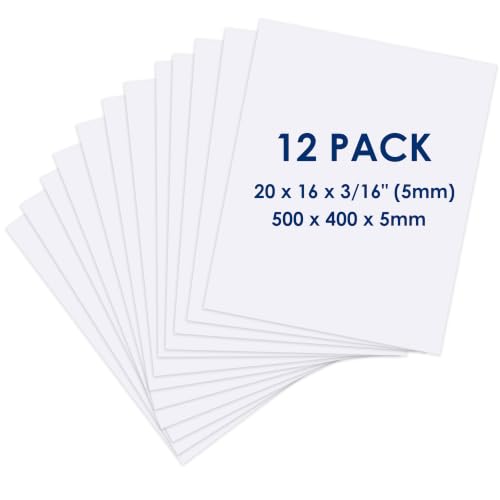
Navy Penguin 16×20 White Foam Core Board 12 Pack

BENECREAT 5 Sheets 3mm White Foam PVC Boards 11.8×7.8inch

UCreate Foam Board, Black-on-Black, 20″ x 30″, 10 Sheets

UCreate Foam Board, White, 20″ x 30″, 10 Sheets

ToLanbbt 12 Pack Black Foam Board, 20 x 30 x 3/16″

UCreate Foam Board, Matte, White, 20″ x 30″, 10 Sheets

Mat Board Center 10 Pack 8×10 Self Adhesive Foam Board

AIKUPNEY Foam Board 24×36 Inch, 3 Pack White
Office Depot Foam Boards, 20in. x 30in., White, Pack of 3
More Details On Our Top Picks
A dozen full-size white sheets in one box changes how you plan a semester of projects. Each board measures 20 by 30 inches at 3/16 inch (5mm) thick, built from polystyrene foam laminated between two paper faces, which is the standard construction for this category.
The smooth white surface takes glue, paint, markers, and screen printing without much fuss, so it works equally well for science fair trioramas and mounted photography. Teachers stocking a supply closet will appreciate having spares when a student’s first attempt goes sideways.
Strong Points
- Twelve sheets per pack covers multiple group projects without reordering
- 5mm core stays rigid enough to stand in easels or prop against walls
- Double-sided paper faces let you decorate both front and back
- Ships in protective packaging designed to prevent dinged edges and corners
Things To Consider
- Storing twelve 30-inch boards flat takes real closet space; leaning them vertically helps
- White-only colorway means layering dark designs over marker bleed can show through
Key Specs
Made For
Teachers, scout leaders, and parents running recurring craft sessions who burn through poster board faster than they can restock.
Where A Sibling Pick Shines
For tighter storage or smaller tabletop work, the Navy Penguin 16×20 version in this list gives you the same build in a more manageable footprint.
This is the smaller sibling of our first pick, trading four inches of width and ten of height for boards you can slide under a bed or behind a bookcase. The 16-by-20 format matches common photo and frame sizes, which makes it handy for mounting prints without trimming.
You still get twelve sheets at the same 3/16-inch thickness, so the rigidity and cutting behavior carry over. Apartment dwellers and hobbyists working at a desk will find the mid-size format far less awkward than wrestling full poster sheets.
What We Like
- Size aligns with standard 16×20 frames for quick photo mounting
- Same smooth, media-friendly surface as its larger sibling
- Stores flat in shallow drawers or under furniture
Minor Gripes
- Too small for full-size presentation posters or large signage
- Per-sheet value is weaker than buying the bigger format for large work
Right Fit For
Crafters making framed photo mounts, small signs, and desk-scale dioramas where every inch of storage counts.
Swap It Out When
Full-size school posters call for the Navy Penguin 20×30 pack instead, since trimming down larger sheets wastes material on big layouts.
Not every project needs poster-sized stock. This BENECREAT set skips traditional paper-faced foam core entirely and uses foamed PVC, a denser plastic sheet that resists dents and holds crisp cut edges better than paper laminate.
Each of the five sheets runs about 11.8 by 7.8 inches at 3mm thick, roughly A4 proportions. Model builders and architectural students commonly reach for PVC foam because it sands cleanly and tolerates shaping without crumbling, something paper-faced boards struggle with. The trade-off is flexibility: these sheets bend slightly rather than snapping, which suits curved forms but demands care for perfectly flat panels.
Highlights
- PVC core resists denting far better than paper-faced foam board
- Holds fine detail when cut with a hobby knife for scale models
- High-density build stays rigid despite being remarkably light
- Five-sheet count suits trial-and-error modeling work
Softer Spots
- Small A4-ish size rules out poster and signage duty entirely
- Slight flex may frustrate anyone needing dead-flat mounting surfaces
Who Should Grab It
Miniature painters, railroaders, and design students prototyping small structural forms need exactly this kind of dense, carve-friendly sheet.
Another Choice May Suit
Display and signage work belongs to the UCreate black-on-black boards later in this list, which offer true poster dimensions and a stiffer face.
Most budget foam boards are white with brown kraft backing, and that tan edge betrays them the moment you cut a shape. UCreate’s black-on-black version colors both faces and the core, so cut letters and silhouettes look finished from any angle.
The matte finish also earns its keep with markers, since glossy surfaces tend to smear when ink sits wet. At 3/16 inch thick across ten sheets, this is the pick for dramatic event signage, Halloween displays, and photo backdrops where a clean black silhouette matters. One honest caveat: black shows dust and chalk residue quickly, so plan on wiping boards down before an event.
Upsides
- Color runs through core and both faces, hiding raw cut edges
- Matte surface reduces marker smearing during lettering work
- Acid-free construction supports longer-lasting displays
- Ten sheets cover a full event’s worth of signage
Points To Note
- Dark surfaces attract visible dust; a dry cloth pass before setup keeps them sharp
- Light-colored adhesives and glue sticks can leave pale marks on the black face
Feature Snapshot
Who Will Love This
Event decorators, theater props folks, and teachers staging dramatic bulletin boards get the most mileage from through-color black stock.
Look Elsewhere When
Bright, colorful children’s projects suit the UCreate matte white pack reviewed next, which gives markers and paints a neutral canvas.
This is the no-frills workhorse of the list: plain white, 20 by 30 inches, 3/16 inch thick, ten sheets to a pack. There’s nothing exotic here, and that’s precisely the appeal for classrooms and community centers that go through poster board constantly.
The surface accepts paints, markers, and glued embellishments, and the sheets cut easily with a standard utility knife along a straightedge. Compared with the black-on-black UCreate above, you lose the through-color drama but gain a blank canvas that suits nearly any lesson plan. Owners commonly report these hold up fine for multi-week hallway displays, though heavy paint layers can cause slight curling near the edges.
Reasons To Buy
- Dependable baseline spec for school and office poster work
- Acid-free faces help mounted prints resist yellowing
- Cuts cleanly, so custom shapes and letters come out tidy
Trade Offs
- Kraft-brown core shows on cut edges unless you frame or face them
- Saturated paint coats may pull the surface slightly out of flat
Built With In Mind
Budget-conscious schools, daycares, and volunteer groups stocking shared craft supplies will burn through this pack happily.
Reach For A Different Pick When
Archival mounting jobs deserve the ToLanbbt acid-free black pack further down, whose three-layer build targets longer-term color stability.
Where the UCreate black board wins on finish, this ToLanbbt pack leans into longevity. Every sheet uses acid-free surface paper over a polystyrene core, meaning the boards resist the yellowing and brittleness that ordinary paper develops over months on a wall.
You get twelve sheets at the familiar 20-by-30, 3/16-inch format, two more than UCreate offers. Wedding planners and photographers mounting prints for extended display are the natural audience here, since color stability matters once a board hangs past a weekend. The dual-sided design also means either face works as the show side, handy for reversible booth signage.
Bright Spots
- Acid-free paper slows yellowing for long-running displays
- Three-layer construction adds surface strength over basic boards
- Twelve-sheet count beats most competing black packs
- Both faces present a usable, uniform black surface
Small Caveats
- Like all foam core, repeated moisture exposure can delaminate the paper layers, so keep outdoor use brief and sheltered
- Black stock limits visibility of pencil layout lines; plan guides carefully
At A Glance
Whose Shelf It Belongs On
Wedding coordinators, gallery volunteers, and photographers displaying mounted work for weeks rather than hours.
Consider Something Else When
Short-lived party decor costs less with the UCreate white pack, since archival paper adds little for a one-night event.
Under bright conference-hall lighting, glossy poster board turns into a mirror. This matte-finish variant fixes that specific headache while keeping everything else familiar: white faces, 20 by 30 inches, 3/16-inch thickness, ten sheets per pack.
UCreate also calls out warp and dent resistance on these sheets, which matters for boards traveling in a car trunk to a presentation. In practice, the difference from the standard UCreate white pack is mostly the surface treatment, so choose based on where your board will be read. Presenters working under spotlights or near windows benefit most from the low-glare face.
Plus Points
- Matte face stays readable under direct lighting
- Manufacturer notes warp and dent resistance for transport
- Easy-cut 3/16-inch body handles straightedge knife work well
Worth Noting
- Matte tooth grabs marker ink slightly differently than gloss; test lettering pens on a corner first
- Only ten sheets, so high-volume users may want the twelve-pack alternatives
Who It Suits Best
Students and professionals presenting in bright rooms, plus anyone mounting charts that must stay legible from across a table.
Not Your Match When
Photo mounting without adhesive mess points you toward the Mat Board Center self-adhesive pack coming up next.
Mounting prints usually means spray adhesive, glue sticks, or a trip to a framing shop. This pack sidesteps all three: one face carries a peel-and-stick adhesive layer protected by release paper, so a print goes down flat in seconds.
The cold-mounting approach, meaning pressure alone rather than a heated press, is gentler on photos than dry mounting and needs zero equipment. Each board is 8 by 10 inches at 3/16 inch thick, sized for standard photo prints, and the pack holds ten. Alignment is the skill to practice: once the print touches the tacky surface, repositioning gets difficult, so lower one edge slowly and work outward.
Standout Traits
- Peel-and-stick face eliminates spray adhesive fumes and mess
- Cold mounting avoids heat damage to photos entirely
- 8×10 format matches common print sizes with no trimming
- Rigid 3/16-inch body slips into standard frames
Honest Caveats
- Adhesive grabs fast, so misaligned prints are hard to rescue
- Small format limits use to photos, cards, and small graphics
Details At A Glance
The Right Fit
Hobby photographers and scrapbookers mounting batches of prints at home without investing in dry-mount equipment.
Where Another Pick Suits Better
Large-format artwork needs the AIKUPNEY 24×36 boards next, whose oversized sheets accommodate posters this pack never could.
Step up in size and thickness together. These AIKUPNEY sheets measure 24 by 36 inches, the classic poster-frame dimension, and run 0.23 inch thick, noticeably beefier than the 3/16-inch standard used elsewhere on this list.
That extra depth translates into real support for freestanding displays: science fair boards propped on tables, directional signs on easels, and painted backdrops all stay flatter under their own weight. You give up pack volume, just three sheets, so this suits focused projects rather than bulk classroom supply. Cutting still works with a sharp utility knife, though the thicker core rewards multiple shallow passes over one hard push.
Positives
- Oversized 24×36 face fits standard poster frames untouched
- Thicker 0.23-inch core stands up better unsupported
- Foam body cuts and shapes with basic hand tools
Room For Improvement
- Three-sheet packs run thin for group or classroom demand
- Large sheets need generous flat storage to avoid edge bowing
Feature Rundown
Perfect Match For
Science fair contestants, market vendors, and event organizers building large self-supporting signs and backdrops.
Skip It When
Everyday poster duty costs less with the Office Depot three-pack closing this list, which covers casual needs at standard thickness.
Sometimes you need one board today, not twelve next week. This Office Depot three-pack fills that gap with a familiar office-supply brand behind it, using polystyrene foam laminated between two matte paper faces.
The surface handles markers, glues, embellishments, acrylics, and even spray paint, giving it unusual range for a budget pack. Double-sided and lightweight, each 20-by-30 sheet cuts into custom shapes without special tools. Against the Navy Penguin twelve-pack, you pay more per sheet here, but for a single garage-sale sign or one child’s book report, three boards is honestly enough.
Best Bits
- Accepts spray paint and acrylics alongside everyday markers
- Double-sided faces double your decorating room
- Small pack suits occasional, one-off household projects
Areas To Watch
- Per-sheet cost runs higher than the bulk packs earlier in this list
- Water-based adhesives can wrinkle the paper face; stick to glue sticks or spray
Who Should Grab It
Households tackling occasional posters, yard-sale signage, and last-minute school assignments without wanting leftover inventory.
Another Choice May Suit
Recurring craft programs should step up to the Navy Penguin 20×30 twelve-pack, which spreads cost across far more sheets.
Choosing Between These Foam Boards Without Guesswork
Match The Sheet To The Job
Start with the finished piece, not the product page. A tri-fold science display wants 20×30 stock at standard thickness, while a mounted 8×10 photo is better served by pre-cut, adhesive-backed board. Oversized signage pushes you toward 24×36 sheets with extra-thick cores.
Working environment matters too. Boards displayed under strong lighting benefit from matte finishes, and anything hanging for months deserves acid-free paper to slow yellowing.
Count Your Sheets Honestly
Pack size drives value more than any other variable. Twelve-sheet packs reward teachers and group leaders, but they punish apartment dwellers with nowhere to store the overflow. Estimate your yearly usage, then buy one tier above it, not three.
Think About Edges And Finishing
Standard white boards reveal a brown kraft core wherever you cut, which looks unfinished on shaped letters. Through-color options like black-on-black stock hide those edges completely. Framing, washi tape, or painted edges solve the problem too, but only if you plan for it before cutting.
Handle Adhesives Wisely
Water-heavy glues wrinkle foam board’s paper skin, a frustration owners report often. Glue sticks, spray adhesive, and peel-and-stick faces all avoid the issue. Test any new medium on a corner before committing the whole sheet.
Key Considerations Across These Picks
Wrong Turns To Avoid
The most common slip is buying poster-sized stock for small jobs, then struggling to store the leftovers. Another frequent miss: ordering thin 3/16-inch board for freestanding signs that sag within a week. Check thickness against how the board will actually stand or hang.
The Case For Spending Up
Higher-tier boards earn their price through acid-free paper, denser cores, and through-color construction. Those upgrades matter most for long displays, professional mounting, and cut-out designs. For a one-weekend school poster, basic stock does the same job.
Frequently Asked Questions
Can I cut 20×30 foam board without special tools?
A sharp utility knife and a metal straightedge handle 3/16-inch sheets easily. Score lightly several times rather than forcing one deep cut, and replace blades often for clean edges.
Will spray paint damage foam board?
Most boards accept light spray coats without trouble, since the paper face shields the foam core. Heavy solvent saturation can pit the surface, so apply thin layers.
How long do foam board displays last indoors?
Indoor boards typically hold up for months, especially acid-free versions kept away from humidity and direct sun. Standard paper faces gradually yellow over long periods.
Is foam board recyclable?
Usually not through curbside programs, because the foam core and paper layers are bonded materials. Reuse sheets for craft backing before disposal.
What’s the difference between foam core and PVC foam board?
Foam core sandwiches polystyrene foam between paper faces, while PVC foam board is a solid foamed plastic sheet throughout. PVC cuts crisper details and resists dents better, but costs more per sheet.
Bottom Line
Your best move depends on volume and finish. Bulk buyers get the strongest value from the Navy Penguin twelve-packs, event decorators should lean toward the UCreate black-on-black or ToLanbbt acid-free sets, and photo mounters will wonder how they managed before the Mat Board Center adhesive boards. Match the sheet to the job, store them flat, and every project starts on solid ground.