
A first printer should feel like an invitation, not a weekend of troubleshooting. The machines below cover that whole arc, from a palm-sized starter unit to a four-toolhead workshop machine. Some print in one color and nail the basics, others swap filaments mid-job without wasting spools of plastic. Whatever your desk looks like right now, there’s a fit here.
The Shortlist At A Glance

Bambu Lab A1 3D Printer for Beginners and Kids

FLASHFORGE AD5M CoreXY 3D Printer 220x220x220mm

FLASHFORGE AD5X Multi-Color 3D Printer with IFS

Bambu Lab P1S 3D Printer
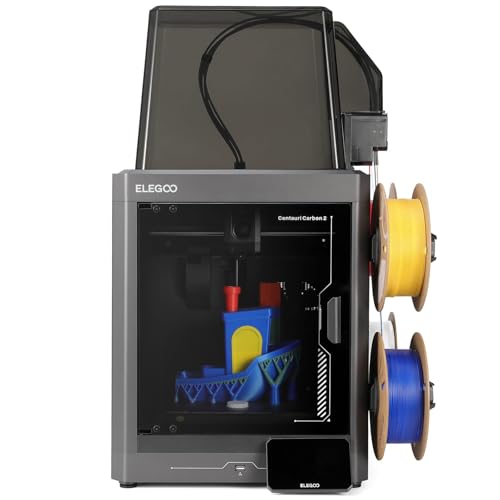
ELEGOO Centauri Carbon 2 Combo Multicolor Printer

Anycubic Kobra X Multicolor 3D Printer Native 4-Color

Bambu Lab A1 mini 3D Printer + LED Lamp Kit

Anycubic Kobra X Multicolor 3D Printer One-Click

Portable Compact FDM 3D Printer with Removable Build Plate

FLASHFORGE Creator 5 4-Toolhead Changer 3D Printer
More Details On Our Top Picks
The A1 is the machine most people picture when they say “my first real printer.” It arrives ready to run, and its open bed design keeps everything visible, which matters when you’re learning what a good first layer actually looks like.
In a family workspace, that visibility doubles as a teaching tool. Kids can watch a model grow while you handle the slicing, and the setup asks very little of you before the first print starts.
Strong Points
- Ships ready to use, so your first evening goes to printing rather than wrenching
- Open-frame layout makes every layer visible, handy for spotting problems early
- Approachable enough that younger makers can join in under supervision
- Optional protection plans add coverage for drops, spills, and breakdowns beyond the manufacturer’s own terms
- Claims support runs around the clock if setup questions come up late at night
Things To Consider
- An open frame means drafts and cold rooms can affect results more than on enclosed rivals like the P1S
- Owners commonly report keeping spare build-surface sheets on hand, since adhesion surfaces wear with heavy use
Who It Suits Best
First-time hobbyists and families who want a dependable machine that teaches as it prints.
Where Another Pick Suits Better
Makers chasing raw speed will get more from the FLASHFORGE AD5M’s CoreXY motion system.
CoreXY is worth defining here: instead of moving the heavy bed around, two motors drive the print head along fixed rails, which lets the machine move fast without shaking your prints apart. The AD5M leans into that design with speeds up to 600mm/s and calibration that runs itself before every job.
For anyone churning through batch prints or functional parts, that combination of pace and low fuss is the whole appeal. The quick-swap nozzle also means a clogged tip costs minutes, not an afternoon.
Highlights
- One-click fully automatic calibration removes the leveling ritual entirely
- All-metal CoreXY frame holds precision steady at high travel speeds
- Quick-swap nozzle design makes routine maintenance genuinely quick
- 220 x 220 x 220mm volume fits helmets-in-progress, cosplay parts, and decently sized functional pieces
Minor Gripes
- Single-color only, so multicolor fans should look toward the AD5X sibling
- High-speed settings reward quality filament; bargain spools may show it
At A Glance
Made For
Makers who value throughput and tidy maintenance over color variety.
Consider Something Else When
Hobbyists wanting four-color prints straight away will prefer the FLASHFORGE AD5X with its IFS unit.
Where the AD5M above stops at one color, the AD5X adds FlashForge’s IFS filament system to feed four colors into the same fast CoreXY body. Logos, signage, and character models stop being paint projects and become print projects.
The hot end reaches 300°C, which opens the door to tougher engineering plastics alongside everyday PLA. In our view, that temperature headroom is the quiet reason this machine ages well as your skills grow.
Upsides
- Four-color printing handled automatically by the IFS feeder
- 300°C nozzle ceiling supports higher-temp materials beyond basic PLA
- Automatic bed leveling keeps first layers consistent between sessions
Softer Spots
- Multicolor jobs generate purge waste during swaps, so expect some filament loss per transition
- The added IFS hardware takes extra desk space next to the printer itself
Quick Facts
Right Fit For
Designers and hobbyists who want color variety plus room to try advanced filaments later.
Not Your Match When
Anyone needing more than four colors natively will find the Anycubic Kobra X’s expandable palette more flexible.
The P1S takes the friendly Bambu formula from the A1 and wraps it in a fully enclosed shell. That enclosure does two practical things: it stabilizes temperatures around the print, and it quiets the machine down in shared living space.
With acceleration rated at 20,000 mm/s² and top speeds of 500mm/s, it finishes big prints noticeably faster than entry-level bedslingers. Pair it with a Bambu AMS unit and the palette stretches to sixteen colors, though note the AMS is a separate purchase.
Bright Spots
- Enclosed body improves consistency on temperature-sensitive materials
- 500mm/s top speed with 20,000 mm/s² acceleration shortens long builds considerably
- AMS compatibility scales the palette up to sixteen colors when you add the unit
- Ready-to-use setup means minimal assembly before your first successful print
- Enclosure also helps contain fumes and noise in apartments and offices
Points To Note
- The AMS color system is sold separately, so budget for it if multicolor is the goal
- Enclosed frames need occasional door-and-panel cleaning to keep optics and vents clear
Feature Snapshot
Who Will Love This
Intermediate printers ready for ABS-style materials and serious multicolor ambition.
Reach For A Different Pick When
Tight budgets and open-desk learners are better served by the smaller Bambu Lab A1 mini kit.
ELEGOO’s Centauri Carbon 2 Combo pairs the printer with its CANVAS color system, which switches between four filaments on the fly and watches for tangles or empty spools while it works. That last part sounds minor until a ten-hour overnight job survives because the system caught a snag at hour three.
Material range is the other headline here. The combo handles everything from basic PLA up through engineering-grade stock, thanks to tighter process and temperature control than typical hobby machines attempt.
Reasons To Buy
- CANVAS delivers instant four-color switching with smart filament detection
- Auto refill and tangle detection protect long unattended prints
- Wide material window spans beginner PLA to engineering-grade polymers
- Combo packaging means color capability on day one, no separate module hunt
Small Caveats
- The CANVAS unit adds bulk beside the printer, worth measuring your shelf first
- Engineering-grade materials demand dry storage; owners commonly add filament dry boxes
- Four colors is generous but capped, unlike the Kobra X’s expandable path
Details At A Glance
Whose Shelf It Belongs On
Tinkerers who bounce between PLA toys and stronger functional parts in the same week.
Another Choice May Suit
Pure beginners still finding their feet will find the simpler Bambu Lab A1 less intimidating.
Most multicolor printers sell you a starting point; the Kobra X sells you a growth path. Four colors come native, and adding up to four ACE 2 Pro units stretches the palette to nineteen, which approaches painted-model territory straight off the bed.
Anycubic also attacks the classic multicolor tax, wasted filament from purging between shades. Their approach cuts that overhead substantially, meaning fewer half-empty spools haunting your storage bin.
Plus Points
- Native four-color output with expansion to nineteen via ACE 2 Pro units
- Reduced purging saves both time and filament on color-heavy jobs
- Easy setup gets newcomers printing without a steep first day
Trade Offs
- Expansion units are additional purchases, and older ACE Pro modules don’t pair with this machine
- Nineteen-color setups occupy serious shelf space once fully kitted
Best Suited To
Artists and figurine makers who want their color options to grow with their skills.
Skip It When
Single-material functional printing is the goal; the FLASHFORGE AD5M spends less on features you won’t touch.
This bundle answers a question most starter kits ignore: what do you actually print first? The included LED lamp kit turns compatible printed models into working decorative lights, giving beginners a finished, giftable project within days rather than a shelf of gray test cubes.
The A1 mini itself carries the same automatic calibration philosophy as its bigger sibling, just shrunk for desks, dorm rooms, and crowded shelves. Automatic calibration runs quietly in the background, so there’s little to learn before the first successful print.
What We Like
- Lamp kit bundles a satisfying first project into the box
- Automatic calibration removes manual bed fiddling from day one
- Compact footprint suits dorms, apartments, and shared desks
- Beginner-focused software flow keeps the learning curve gentle
Worth Noting
- Smaller build volume limits large props and batch production compared with the full-size A1
The Right Fit
Students, gift-makers, and anyone whose available desk space is measured in inches.
Where A Sibling Pick Shines
Larger cosplay and functional parts call for the full-size Bambu Lab A1 instead.
This Kobra X variant shares the expandable nineteen-color platform with the earlier listing but leads with one-click printing and broader material flexibility. The difference that matters is the adaptive extrusion force compensator, a mechanism that adjusts grip pressure automatically as filament stiffness changes.
Why that matters: flexible TPU, the rubbery filament used for phone grips and gaskets, has always been awkward on standard feeders. Here the transition from rigid PLA to soft TPU happens without manual re-tuning, which is where many hobby machines stumble.
Standout Traits
- Adaptive extrusion force handles TPU and PLA without manual adjustment
- Palette expands to nineteen colors with up to four ACE 2 Pro units
- One-click workflow trims friction for busy households
- Multi-material projects move from concept to print with fewer failed feeds
Areas To Watch
- Flexible filaments store poorly in humid rooms; a dry box is a common companion purchase
- Full color expansion requires buying the ACE 2 Pro units separately
Core Details
Who Should Grab It
Makers mixing rigid parts with flexible ones, from phone cases to custom gaskets.
Swap It Out When
Production-scale multicolor output calls for the FLASHFORGE Creator 5’s four independent toolheads.
Not everyone wants to commit serious money before knowing whether 3D printing sticks. This compact unit exists precisely for that moment, with a 100 x 100 x 100mm build volume that’s honest about being a learner’s canvas rather than a production floor.
The package is thoughtfully complete: 10 meters of PLA, a TF card, tools, and a Type-C power adapter all ship together, and video walkthroughs cover assembly through first print. The removable plate pops off for easy part removal, which saves beginners from scraping their first creations loose.
Positives
- Everything needed for a first print arrives in one modest package
- Removable build plate simplifies getting finished parts off cleanly
- Step-by-step videos reduce the usual first-timer confusion
Honest Caveats
- The 100mm cube volume rules out anything larger than trinkets and small tools
- Modular self-assembly is required, so patience during setup pays off
- Slower and simpler than the FLASHFORGE AD5M in every performance metric
Built With In Mind
Kids, students, and cautious gift-givers testing the hobby before upgrading.
Look Elsewhere When
Serious hobbyists outgrow this quickly; the Bambu Lab A1 is the natural next step.
Every other multicolor machine on this list shares one nozzle and swaps filament inside it. The Creator 5 refuses that compromise entirely, carrying four independent toolheads that swap in about seven seconds with intelligent preheating already handled.
Because each color lives on its own nozzle, there’s no cross-contamination, no clog-prone purging, and a near-zero waste profile that single-nozzle systems can’t match. Supports also come off cleaner, since dissimilar materials can be assigned to dedicated heads. For a small studio selling prints, that waste math compounds fast.
Best Bits
- Four independent toolheads eliminate color mixing and shared-nozzle clogs
- Seven-second FlashSwap keeps multi-color jobs moving briskly
- Near-zero waste system protects filament budgets on long production runs
- CoreXY motion with 600mm/s capability and automatic calibration
- Clean support removal reduces post-processing time per part
Room For Improvement
- Four-toolhead complexity means more components to maintain over time
- Footprint and cost position it well above hobby-tier picks like the A1
Spec Overview
Who It’s Made For
Small-batch sellers and power users whose multicolor output justifies professional hardware.
A Better Fit Elsewhere
Hobbyists testing the multicolor waters spend far less with the ELEGOO Centauri Carbon 2 Combo.
What Matters Most Before Choosing a 3d Fdm Printer
Match the Machine to Your Space
Measure honestly before ordering. Enclosed machines like the P1S want clearance for doors and panels, while the A1 mini squeezes onto a crowded dorm desk. Ventilation counts too: open frames breathe freely, enclosures contain odors better in shared rooms.
Decide How Much Color You Actually Need
Multicolor sounds exciting until you price the ecosystem. Single-nozzle systems lose filament to purging on every shade change, while toolhead designs like the Creator 5 avoid that waste at a higher entry cost. Start with four colors unless your projects genuinely demand nineteen.
Think About Materials, Not Just Prints
PLA covers most hobby work, but flexible TPU and engineering-grade polymers need hotter nozzles and gentler feeding. The Kobra X’s adaptive extrusion and the AD5X’s 300°C ceiling exist for exactly those ambitions. Buying that headroom early beats replacing a machine later.
Factor In the Ongoing Routine
Every FDM printer needs occasional nozzle changes, plate cleaning, and filament storage care. Quick-swap designs and removable plates shrink that chore list. Choose hardware that respects your patience level, not just your wishlist.
Key Considerations Across These Picks
Traps First Timers Fall Into
Overspending on features you’ll never touch is the classic error, as is ignoring build volume until the first oversized project fails. Skipping filament storage planning is another quiet budget drain. Match specs to your actual project list, not aspirational ones.
The Case For Spending Up
Higher-tier machines buy speed, enclosure benefits, and smarter automation. Auto-calibration alone saves hours of frustration across a year of printing. Pay more when output volume or material ambition justifies it; stay modest while you’re still learning what you enjoy making.
Frequently Asked Questions
Do FDM printers need a lot of assembly?
Most modern picks here arrive largely pre-built, with the Bambu units essentially ready out of the box. Smaller budget models like the portable pick require modular assembly guided by video tutorials.
What does CoreXY mean in plain language?
It’s a motion design where the print head moves on fixed rails while the bed stays put. That stability allows much faster printing without sacrificing detail.
Is multicolor printing wasteful?
On single-nozzle machines, yes, since filament gets purged during every color change. Toolhead-based systems such as the Creator 5 dramatically cut that waste.
Can beginners print flexible TPU filament?
Standard feeders struggle with it, but machines with adaptive extrusion force handle TPU without manual tuning. The Kobra X variant listed here is built for that transition.
How much desk space should I reserve?
Plan for the printer plus its color system, since units like the IFS and CANVAS sit alongside the main body. Measure width, depth, and ventilation clearance before ordering.
Closing Thoughts
Your best first printer is the one matching your space, budget, and patience, not the one with the longest spec sheet. Start simple with the A1 or A1 mini, step up to the P1S or AD5M as ambition grows, and save the Creator 5 for when printing becomes a craft or a business. Whichever you choose, clear a shelf, order some filament, and enjoy watching ideas take shape layer by layer.