
PLA melts on a hot dashboard and fades on a sunny porch, which is why anyone printing brackets, garden tools, or car mounts eventually switches to ASA. This roundup walks through ten weather-resistant spools that hold their shape through sun, rain, and temperature swings, so your parts survive the seasons instead of the week.
The Shortlist At A Glance

FLASHFORGE ASA Filament 1.75mm Iron Grey 1kg Spool

OVERTURE ASA Filament 1.75mm UV & Weather Resistant 1kg Black
iSANMATE ASA Filament 1.75mm Black 1KG

SUNLU 3D Printer ASA Filament 1.75mm 1KG Black

ELEGOO ASA 3D Printer Filament 1.75mm Deep Black 1KG

iSANGHU ASA Filament 1.75mm White 1kg Spool

ANYCUBIC ASA Filament 1.75mm 1KG Black

Creality ASA Filament 1.75mm 1kg Spool
Siraya Tech Fibreheart ASA-GF Filament Black 1kg

Filaxix ASA Filament 1.75mm Grey 1KG
More Details On Our Top Picks
ASA itself deserves a quick definition here: it’s an acrylonitrile styrene acrylate, essentially ABS with the styrene swapped for acrylic, which is what gives it its famous resistance to sunlight. The FLASHFORGE spool leans into that strength with a stated dimensional accuracy of plus or minus 0.02mm, tight enough that parts like camera housings or antenna mounts come off the bed fitting where they should.
The iron grey color also hides dust and scuffs better than brighter shades, a small thing you’ll appreciate once parts live outside for months.
Strong Points
- UV stability means a mailbox flag or sensor bracket keeps its shape season after season instead of shrinking and warping.
- Heat resistance near 93°C suits parts sitting in direct sun, where PLA would slump by lunchtime.
- The 0.02mm tolerance helps functional assemblies mate cleanly without post-print sanding.
- A full kilogram gives you roughly a summer’s worth of replacement clips and mounts.
Things To Consider
- ASA wants an enclosed or at least draft-free print chamber; open-frame printers may show layer splitting on tall parts.
- Like most ASA, it benefits from drying before long print sessions, since absorbed moisture shows up as surface bubbles.
Who It Suits Best
Makers with an enclosed printer who need dimensionally precise, sun-exposed functional parts.
Where A Sibling Pick Shines
Shoppers wanting easier, clog-resistant feeding on any machine will get along better with the OVERTURE ASA below.
OVERTURE has built its reputation on formulation consistency, and this black ASA carries the brand’s patented clog-free blend. In practice that matters most during long overnight prints of larger outdoor pieces, where a mid-spool jam ruins hours of work. The material targets both UV protection and thermal stability, so a printed hose splitter can sit in full sun without fading or softening.
Compared with the FLASHFORGE above, you trade published tolerance figures for a smoother, more forgiving feed experience, which many hobbyists value more on everyday machines.
What We Like
- The clog-free formula reduces failed starts, a real time saver when you’re reprinting a broken gate latch at 10pm.
- Weather and heat resistance together make it dependable for parts that cycle between hot afternoons and cool nights.
- Black hides UV-related discoloration better than lighter filaments over years outdoors.
Worth Noting
- Only one colorway is listed here, so matching existing hardware means painting afterward.
- Owners commonly report ASA in general prefers a drybox or sealed bag between projects.
At A Glance
Made For
Busy hobbyists who print functional replacements regularly and want minimal fiddling between jobs.
Swap It Out When
Anyone needing a specific non-black color for visible exterior work should look at the iSANGHU white spool further down.
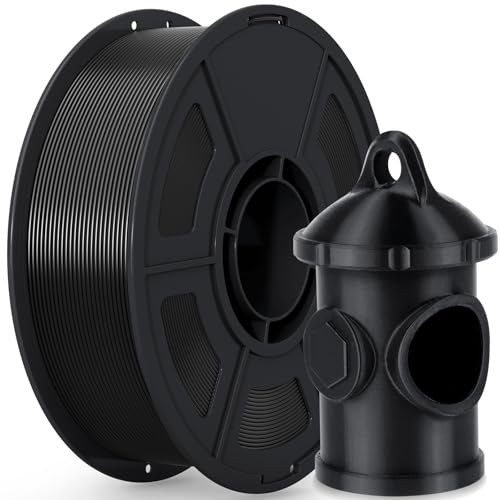
Workshops running more than one printer brand tend to care about compatibility first, and that’s the iSANMATE pitch. The manufacturer states it works across most consumer and industrial machines, so the same spool can move between a budget bed-slinger and an enclosed core-XY without surprises. Its profile covers UV, weather, mechanical, and thermal resistance, covering the four ways outdoor parts usually fail.
Where the OVERTURE leans on feed reliability, this one emphasizes versatility across hardware, which suits tinkerers with mixed fleets.
Highlights
- Wide machine compatibility makes it a safe shared-spool choice for classrooms or shared maker spaces.
- The stated 0.02mm dimensional accuracy supports snap-fit parts like battery holders and clips.
- Combined UV and weather shielding keeps garden markers and tool handles legible and intact through a season.
- Kilogram sizing keeps cost per part reasonable for high-turnover replacement printing.
Small Caveats
- Black-only listing again limits color matching for decorative outdoor work.
- As with any ASA, ventilation during printing is worth arranging, since the material emits more odor than PLA.
Right Fit For
Multi-printer households and school labs that need one dependable outdoor filament for every machine.
Another Choice May Suit
Single-printer owners chasing maximum heat headroom will find the ELEGOO spool’s higher deflection figure more compelling.
SUNLU approaches ASA from the usability angle. The company describes the material as tougher than both PLA and ABS, with good layer adhesion and a no-clog, no-bubble, no-tangle reputation. For someone stepping up from PLA for the first time, that combination lowers the learning curve considerably; your first ASA benchy is far more likely to succeed.
The spool design is the quiet standout here. SUNLU ships it on a third-generation white reel with a multi-hole pattern meant to help the filament dry fully, and the dimensions are updated to fit AMS and AMS Lite units. Multi-material system owners know how picky those loaders are about spool geometry, so that detail saves real frustration.
Bright Spots
- Stronger-than-ABS toughness suits parts that take knocks, like wheel chocks or ladder feet.
- Good layer adhesion translates to fewer delaminated prints on tall outdoor enclosures.
- The ventilated spool design helps keep moisture out between print sessions.
- Direct AMS and AMS Lite fitment removes the need for spool adapters or rewinding.
Points To Note
- No published dimensional-tolerance figure appears in the listing, so ultra-tight fits may need test prints first.
- Single-color availability applies here too, consistent with most of this list.
Who Will Love This
First-time ASA users and multi-material system owners who want plug-and-play spool handling.
Reach For A Different Pick When
Precision-driven users printing press-fit components may prefer the tighter 0.02mm claims of the ANYCUBIC spool coming up.
Heat deflection temperature, the point where a part starts to deform under load, is the number that separates good outdoor filament from great, and ELEGOO publishes a strong one here: up to 99°C. A phone mount on a windshield or a black dashboard clip in a parked car faces exactly that kind of soak, and this spool is built for it.
ELEGOO also highlights water resistance alongside the heat performance, useful for pond equipment, boat accessories, and anything near sprinklers. Compared with the SUNLU’s beginner-friendly angle, this is the step up for demanding thermal environments.
Reasons To Buy
- The 99°C heat deflection figure gives real headroom for dark-colored parts baking in summer sun.
- Resistance to fading and yellowing keeps deep black parts looking new rather than chalky grey.
- Water resistance extends usefulness to splash-zone applications around pools and boats.
- Mechanical performance holds steady through prolonged exposure, per the manufacturer’s engineering notes.
Honest Caveats
- Deep black shows dust and hard-water spots more than lighter colors, so occasional wiping keeps parts presentable.
- Higher-performance ASA generally rewards careful tuning; expect a few calibration prints before dialing in settings.
Quick Facts
Who Should Grab It
Automotive and electronics enthusiasts printing parts that sit in enclosed, sun-heated spaces.
Not Your Match When
Lighter-colored outdoor decor projects fit the iSANGHU white filament better, both aesthetically and thermally.
Nearly every other spool on this list comes in black, which is practical but dull on a porch. The iSANGHU arrives in white, and the manufacturer backs the color with a bold claim: weathering and UV resistance roughly ten times stronger than standard ABS. Whether you’re printing planter labels, fence caps, or window clips, the bright finish stays bright instead of yellowing into beige.
The listing also points toward marine-adjacent use, mentioning rain, cold, and seawater exposure among its intended environments. Coastal makers printing dock hardware or kayak accessories have few options this well suited.
Plus Points
- White reflects sunlight rather than absorbing it, giving printed parts a thermal edge in full sun.
- The claimed UV advantage over ABS addresses the exact failure mode that ruins cheap outdoor prints.
- Color retention means decorative pieces still look intentional after months outside.
- Saltwater and rain resistance widens the use case to docks, boats, and poolside gear.
Softer Spots
- White shows algae and dirt readily in damp shaded spots, so expect occasional cleaning.
- The listing omits a published dimensional-tolerance number, worth knowing for precision fits.
Whose Shelf It Belongs On
Gardeners, coastal dwellers, and anyone printing visible white or light-colored exterior parts.
Look Elsewhere When
Structural brackets under heavy load suit the Creality HP ASA better, thanks to its impact-focused formulation.
ANYCUBIC positions this spool as an all-rounder: sunlight, water, and aging resistance in one kilogram of black ASA, with the same 0.02mm dimensional accuracy the FLASHFORGE leads with. The suggested applications lean domestic, plant pots, plant tools, and car accessories, which honestly describes what most people actually print with weatherproof filament.
Against the iSANMATE earlier in the list, the profiles look similar on paper; the difference is emphasis. ANYCUBIC stresses aging resistance specifically, meaning parts shouldn’t turn brittle after a year on a balcony, a common complaint with lesser materials.
Standout Traits
- Aging resistance keeps planters and tool handles from going brittle after seasons of temperature cycling.
- The 0.02mm tolerance supports threaded inserts and snap-fit garden hardware.
- Water and UV shielding together cover rain-soaked and sun-baked use equally.
Minor Gripes
- Black-only, like much of this category, so painted finishes remain the route for colorful work.
- ASA’s tendency to warp without an enclosure is something first-timers should plan for; a cardboard windbreak helps more than you’d expect.
Best Suited To
Balcony and backyard printers making planters, garden fixtures, and everyday car accessories.
Consider Something Else When
Users needing maximum stiffness under load will get more from the glass-filled Siraya Tech option near the end of this list.
Creality brands this one HP ASA, and the emphasis falls squarely on toughness and impact strength rather than cosmetics. Parts printed from it are pitched at structural duty: mounting brackets, camera arms, trailer accessories, anything that takes a knock. The manufacturer also calls out corrosion resistance alongside UV protection, which matters for metal-contact assemblies left outside.
One honest note on tolerances: the stated accuracy is plus or minus 0.03mm, slightly looser than the 0.02mm claims from FLASHFORGE and ANYCUBIC. For structural work that difference is irrelevant; for precision fits, it’s worth remembering.
Upsides
- High impact strength absorbs bumps and drops that would crack standard ABS parts.
- Corrosion resistance pairs well with printed parts bolted to steel frames or fences.
- Printed models reportedly hold their appearance through extended direct sunlight.
- Creality’s ecosystem support means settings guides are easy to find for their own printers.
Areas To Watch
- The 0.03mm tolerance is adequate but not the tightest here, so shim-test critical fits first.
- Impact-oriented formulations can be slightly less rigid; very thin parts may flex more than expected.
Feature Snapshot
The Right Fit
Makers printing structural brackets, vehicle mounts, and hardware that must survive rough handling.
Where Another Pick Suits Better
Appearance-first projects with fine detail belong with the FLASHFORGE iron grey spool and its tighter tolerance.
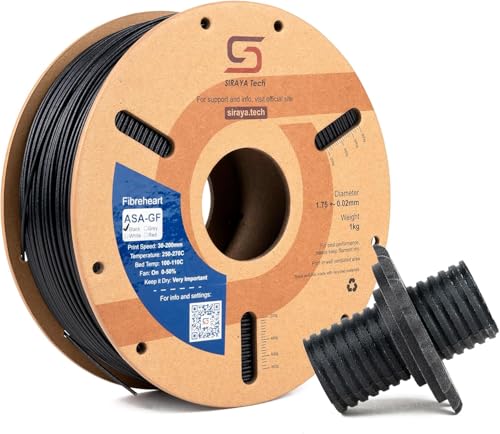
This is the specialist of the group. Siraya Tech reinforces its ASA with 10% chopped glass fiber, which raises stiffness, strength, and impact resistance well past plain ASA. Glass-filled filament also tends to hide layer lines and give parts a matte, molded-plastic finish, a nice side effect for visible hardware.
The trade-off is hardware: glass fiber is abrasive, so a hardened steel nozzle is strongly recommended, and brass nozzles will wear quickly. Owners commonly report that fiber-filled materials also benefit from slower print speeds. Pay that attention and you get parts that feel closer to injection-molded than printed.
Positives
- 10% glass fiber content delivers noticeably higher rigidity for drone frames, jigs, and machine brackets.
- Improved impact resistance handles drops and vibration that plain ASA gradually fatigues under.
- UV and aging resistance keeps both color and physical properties stable outdoors.
- The matte fiber finish masks layer lines on display-worthy parts.
Trade Offs
- A hardened nozzle is effectively required, adding setup cost if your printer ships with brass.
- Fiber-filled spools generally print slower, stretching job times on large models.
Core Details
Built With In Mind
Experienced printers with hardened nozzles who need stiff, durable, vibration-resistant outdoor components.
Skip It When
Beginners on stock hardware will have a far smoother start with the SUNLU spool designed for easy adhesion.
Filaxix rounds out the list with a grey spool that hits the fundamentals: heat resistance up to 100°C, high toughness, and resistance to environmental stress cracking, the slow failure mode where constant outdoor strain eventually splits a part. That last attribute doesn’t get much marketing attention, yet it’s often what kills cheap prints left clamped under tension for a year.
The grey color splits the difference between the blacks and the iSANGHU white, hiding grime reasonably while staying visible against soil and gravel. Dimensional accuracy sits at plus or minus 0.03mm, in line with the Creality offering.
Best Bits
- The 100°C heat ceiling covers engine-bay-adjacent and dashboard-adjacent placements.
- Environmental stress cracking resistance extends service life for clamped and bolted parts.
- Grey tones mask outdoor grime better than pure black or white alternatives.
- Toughness and impact resistance support genuinely functional, load-bearing prints.
Room For Improvement
- The 0.03mm tolerance won’t satisfy press-fit perfectionists without test iterations.
- Brand recognition is lower than names like ELEGOO or Creality, so community setting profiles are scarcer; expect some tuning from scratch.
Details At A Glance
Perfect Match For
Budget-aware makers who want proven ASA chemistry and don’t mind dialing in their own profiles.
Consider Something Else When
Shoppers who value established community support will feel more comfortable with the ANYCUBIC spool and its broader user base.
What Matters Most Before Choosing
Match The Material To The Exposure
A part on a shaded north wall faces a different life than one bolted to a sunny rooftop. Full-sun locations demand strong UV stability, while coastal setups add salt spray to the equation. Read the manufacturer’s environment claims closely and match them to where your part will actually live, not where you hope it might.
Check Your Printer Before The Spool
ASA needs higher nozzle temperatures than PLA and dislikes drafts. An enclosed or semi-enclosed chamber dramatically improves first-print success rates, and a hardened steel nozzle becomes necessary the moment you consider glass-filled options like the Siraya Tech. Buying filament your machine can’t handle comfortably wastes money twice.
Tolerance Versus Toughness
Tight dimensional accuracy, meaning the filament’s diameter stays close to its stated 1.75mm, produces predictable extrusion and clean fits. Impact-focused formulations sometimes accept slightly looser tolerances in exchange for durability. Decide which your project needs before comparing spec sheets.
Plan For Moisture Management
Every ASA spool on this list performs best dry. A sealed container with desiccant between print sessions prevents the bubbling and stringing that humid storage causes, and it costs almost nothing to set up.
Key Considerations Across These Picks
Traps First Timers Fall Into
The most common mistake is treating ASA like PLA and skipping the enclosure, then blaming the filament for warped corners. Another frequent misstep is ignoring moisture; a spool left open for weeks will bubble no matter its quality. Finally, choosing black by default limits projects that deserve lighter colors.
What Separates Premium From Basic
Higher-tier spools justify themselves through published numbers: heat deflection ratings, tighter diameter tolerances, and engineered additives like glass fiber. Those figures translate directly into hotter, harsher placements and longer service life. Basic spools remain perfectly capable for planters and garden markers, so pay up only when your parts face genuine stress.
Frequently Asked Questions
Why choose ASA over ABS for outdoor prints?
ASA resists UV light, so it won’t fade, yellow, or grow brittle the way ABS does in sunlight. Both handle heat well, but only ASA is truly built for long-term weather exposure.
Do I need an enclosed printer for these filaments?
An enclosure isn’t strictly required, but it greatly reduces warping and layer separation on larger parts. Even a simple cardboard draft shield improves results noticeably.
How should I store ASA filament between uses?
Keep the spool sealed in a bag or drybox with desiccant, since absorbed moisture causes bubbles and weak layers. Drying a damp spool at low temperature restores printability.
Are glass-filled filaments harder on printers?
Yes, the glass fibers abrade brass nozzles quickly, so a hardened steel nozzle is recommended. Print speeds are typically reduced slightly as well.
Can I paint parts printed with ASA?
ASA accepts paint well, especially after light sanding, and its UV stability keeps the underlying part sound. Use paints rated for plastics and outdoor exposure for lasting results.
Closing Thoughts
Outdoor printing rewards a little planning more than a big budget. Start by matching the filament to your harshest realistic condition, whether that’s rooftop sun, coastal salt air, or a hot car interior, then confirm your printer can handle the material comfortably. Any of the ten spools here will outlast PLA by seasons; the right one simply depends on where your parts will spend their lives. Happy printing.