
You’ve printed your first benchy, fixed a clog or two, and now you want a machine that keeps pace with your ambitions. That’s the stage where slow bedslingers and fiddly manual leveling start feeling like training wheels. The ten printers below are aimed squarely at that middle ground: fast CoreXY frames, multi-color systems, auto calibration, and build volumes big enough for real projects. Some lean toward speed, some toward color, and one toward sheer size, so you can match the machine to what you actually make.
The Shortlist At A Glance
ELEGOO Centauri Carbon 3D Printer (256mm)

Snapmaker U1 4-Toolhead 3D Printer

Creality K2 Plus Combo 3D Printer

Creality K2 Combo (A) 3D Printer
Creality K2 Pro Combo (A) 3D Printer

Entina Tina2C Mini 3D Printer
Creality K1C 3D Printer

Anycubic Kobra X Multicolor 3D Printer

Creality Ender 5 Max 3D Printer

Anycubic Kobra X Multicolor 3D Printer (One-Click)
More Details On Our Top Picks
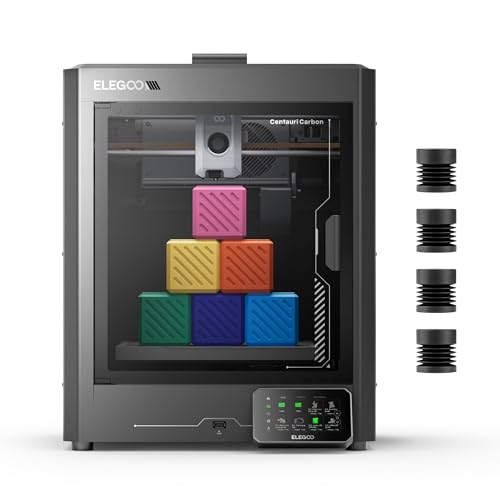
The Centauri Carbon arrives assembled and pre-calibrated, which means your first evening goes to printing instead of wrenching. Its CoreXY motion system, where the print head moves on both horizontal axes while the bed only drops, lets it hit 500mm/s without the wobble you’d get from a bedslinger at that pace.
The 320°C nozzle opens the door to tougher filaments beyond basic PLA, and the built-in camera lets you check on a long job from another room. For an intermediate user stepping up from a budget machine, this is the least complicated jump on the list.
Strong Points
- Ships ready to print, so setup takes minutes rather than a weekend
- 500mm/s CoreXY speeds turn overnight jobs into after-dinner ones
- 320°C nozzle handles higher-temp filaments like ABS-style materials
- Auto calibration removes the manual leveling ritual entirely
- Integrated camera adds remote monitoring for unattended runs
Things To Consider
- The enclosed carbon body adds weight, so plan its spot before it lands; owners commonly note it’s a two-person lift to reposition
Key Specs
Who It Suits Best
Makers moving up from a starter printer who want speed and reliability without a build-it-yourself project.
Where A Sibling Pick Shines
Anyone chasing true multi-color work will get more from the Snapmaker U1’s four-toolhead system.
Most multi-color printers swap filaments through one nozzle, purging between every change and burning time and plastic. The U1 skips that entirely with four independent toolheads, each preloaded and preheated, swapped in about five seconds via the SnapSwap changer. Compared with the single-nozzle systems later in this list, that’s a fundamentally different approach.
In practice, that means a four-color figurine prints closer to single-color speed, and you’re not watching meters of support material flush out. The locking mechanism on each head is designed to hold alignment, which matters because even slight offsets ruin color boundaries.
What We Like
- Four dedicated toolheads mean no purge waste between colors
- Roughly five-second swaps keep multi-color jobs genuinely fast
- Preloaded, preheated heads reduce failed color transitions
Minor Gripes
- Four hotends mean four sets of nozzles to maintain and stock spares for
- You may find the footprint larger than expected once all heads are mounted
Made For
Designers and figure painters who want clean multi-color results without babysitting filament swaps.
Swap It Out When
Shoppers who want expandable color beyond four units should look at the Anycubic Kobra X instead.
This is the flagship of Creality’s K2 line, pairing a 600mm/s CoreXY frame with the company’s CFS filament system. The CFS, short for Creality Filament System, stores spools in sealed boxes, reads RFID tags to identify color and material automatically, and handles switching and feeding on its own. Hook up to four units and you can print sixteen colors without touching a paintbrush afterward.
The roughly 350mm cube build volume dwarfs the K2 Combo below it, so cosplay parts and batch production fit without splitting models. Dual AI cameras watch for spaghetti failures and first-layer problems, which is real peace of mind on twelve-hour jobs.
Highlights
- Expandable to sixteen colors with multiple CFS units
- RFID spool reading automates filament identification
- Very large build volume suits oversized one-piece prints
- Dual AI cameras catch failures before they waste a spool
- Full auto-leveling means zero manual bed fussing
Points To Note
- Extra CFS units are separate purchases, so full color capacity costs more over time
- The combined system demands serious desk or shelf space in smaller rooms
Right Fit For
Serious hobbyists and small studios who want maximum color and volume in one ecosystem.
Consider Something Else When
Tighter budgets and standard 260mm needs are better served by the Creality K2 Combo (A).
Think of this as the K2 Plus’s more compact sibling: same 600mm/s speed, same CFS multicolor support, same next-gen direct drive extruder, just trimmed to a 260mm cube. It ships 95 percent pre-assembled, so you’re tightening a few bolts rather than building a kit, and a smart AI camera plus auto leveling handle the quality checks a beginner would otherwise miss.
A quiet mode makes it livable in a shared apartment or home office, something owners of older Creality machines often wish they had. The combo includes one CFS unit, giving you four colors out of the box with room to grow.
Upsides
- Four colors included via the bundled CFS unit
- 95 percent pre-assembly shortens first-print day considerably
- Silent mode keeps late-night printing neighbor-friendly
- Direct drive extruder feeds flexible filaments more reliably
Softer Spots
- Sealed filament storage isn’t part of this package, so humid climates call for dry boxes
Who Will Love This
Apartment makers who want multicolor capability and high speed in a modest footprint.
Not Your Match When
Prints larger than 260mm per side point you toward the Creality K2 Pro Combo (A).
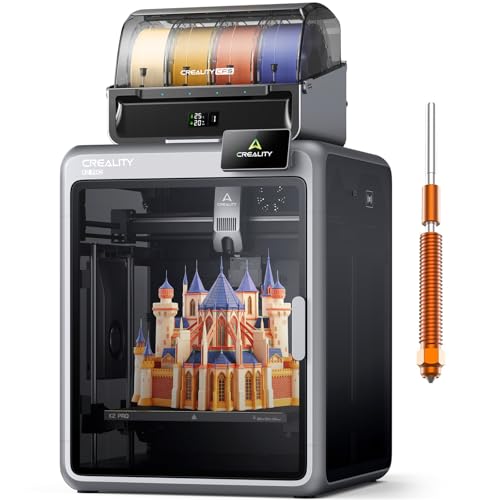
The Pro sits between the K2 and K2 Plus in size at 300mm per axis, but it adds the feature neither sibling has: active chamber heating. A warmed enclosure keeps materials like ABS and ASA from warping and shrinking mid-print, which is the difference between a usable bracket and a curled coaster.
It shares the CFS smart filament system with the rest of the family, including automatic filament identification, intelligent feeding, and moisture-proof storage. Dual AI cameras and 600mm/s speed round out a spec sheet aimed at people printing functional parts, not just toys.
Bright Spots
- Active chamber heating tames warp-prone engineering filaments
- Moisture-proof CFS storage protects filament between sessions
- 300mm cube fits most functional prints without splitting
- Dual AI cameras monitor both failure types automatically
Small Caveats
- Chamber heating draws meaningful power, worth checking your circuit before long ABS runs
- Owners commonly report the full combo stack needs a dedicated corner, not a desktop corner
At A Glance
Whose Shelf It Belongs On
Intermediate-to-advanced users printing durable, outdoor-grade, or mechanical parts regularly.
Another Choice May Suit
PLA-only hobbyists don’t need the heated chamber and save money with the Creality K2 Combo (A).
Honest framing first: this mini printer targets kids and absolute beginners, not intermediate users buying for themselves. It earns its place here as the machine you hand to a curious teenager or use as a low-stakes second unit. Guided setup through the Poloprint Cloud app gets a first print going in as little as eight minutes, and WiFi control means you queue models from a phone.
The app also carries a library of thousands of ready-made models plus creative DIY modules pitched at STEM learning, so there’s content on day one. Auto leveling removes the trickiest step for small hands.
Plus Points
- App-guided setup has beginners printing within minutes
- WiFi and app control suit phone-first younger users
- Built-in model library eliminates slicing homework early on
Trade Offs
- Small build volume limits you to trinkets and school-project scale parts
- Speed and filament range trail every other pick here by a wide margin
Who Should Grab It
Parents equipping a STEM-curious kid, or anyone wanting a safe, simple secondary printer.
Reach For A Different Pick When
Growing skills demand more; the ELEGOO Centauri Carbon is the natural next rung up.
The K1C is the refinement of Creality’s popular K1 line, keeping the compact CoreXY layout while pushing to 600mm/s and accelerations up to 20,000mm/s². Acceleration, briefly, is how quickly the head reaches full speed; high values matter more than raw top speed for small detailed parts, since most prints never reach maximum velocity anyway.
Vibration resistance keeps those speeds from smearing corners, and the quick-swap tri-metal hotend with a clog-resistant extruder addresses the maintenance chore intermediate users know too well. No multicolor system here, unlike the K2 siblings, but for pure single-material throughput it’s hard to argue with.
Reasons To Buy
- 600mm/s with strong acceleration finishes small batches fast
- Clog-resistant quick-swap hotend cuts downtime dramatically
- Auto leveling and a compact frame make it desk-friendly
- Refined K1 platform benefits from a mature parts ecosystem
Worth Noting
- Single-color only; adding color later means a different machine, not an add-on
Quick Facts
Best Suited To
Hobbyists printing functional single-color parts in volume who value speed over color.
Look Elsewhere When
Multicolor ambition points to the Creality K2 Combo (A), which adds CFS support.
Anycubic took a different route to color than Snapmaker: the Kobra X ships with four colors native, then scales to nineteen by daisy-chaining up to four ACE 2 Pro units. Where the Snapmaker U1 solves purging with extra toolheads, the Kobra X attacks it with smarter flushing, cutting the hours and filament that traditional single-nozzle color changes waste.
Setup is pitched as genuinely easy, and the adaptive extrusion force compensator handles flexible TPU alongside rigid PLA without manual retuning. Note the compatibility detail: ACE 2 Pro units are required, since earlier ACE Pro boxes won’t pair with this machine.
Standout Traits
- Nineteen-color ceiling gives artists a broad palette
- Reduced purging saves both time and filament on color jobs
- Adaptive force compensation smooths flexible-material printing
- Four colors work natively before any expansion purchase
Areas To Watch
- Expansion requires the newer ACE 2 Pro specifically, so existing ACE Pro owners can’t reuse hardware
- Single-nozzle design still flushes between shades, just less wastefully
The Right Fit
Artistic makers who want a wide color palette without committing to a four-head mechanism.
Skip It When
Purge-free printing is the priority; the Snapmaker U1’s toolhead design avoids flushing altogether.
Everything else on this list tops out around 300mm per side; the Ender 5 Max gives you a 400mm cube. That’s the difference between printing half a helmet and printing the whole thing, or running eight medium parts in a single batch overnight. Designers and small print farms are the obvious audience.
Speed doesn’t suffer either, with 700mm/s making it the fastest nominal machine here. A 64-point auto-leveling mesh maps the large bed carefully, since flatness gets harder to guarantee as plates grow, and the dual-gear extruder grips filament firmly across long, heavy prints. Multi-printer control over WLAN lets you supervise several units from one screen.
Positives
- 400mm cube fits full-size props and big batch runs
- 700mm/s top speed keeps large prints tractable
- 64-point leveling compensates for wide-bed variation
- All-metal frame stays rigid during long jobs
- WLAN control manages multiple printers centrally
Honest Caveats
- Measure your room first; owners commonly report this machine dominates a desk
- Big beds consume more filament per failed print, so slice carefully
Details At A Glance
Who It Suits Best
Prop makers, prototype shops, and anyone batching parts who has the floor space to spare.
Where Another Pick Suits Better
Desk-bound users should stay with the Creality K1C, which delivers similar speed in a smaller shell.
This variant of the Kobra X emphasizes the same core hardware with the workflow simplified to essentially one click. Under the hood it matches the Easy Setup version reviewed above: four native colors, expansion to nineteen via ACE 2 Pro units, and adaptive extrusion force compensation spanning rigid PLA down to soft 68D TPU.
The pitch is friction removal. Hard-to-soft material transitions happen without manual adjustment, and the streamlined start process suits anyone who’d rather spend evenings printing than tuning profiles. In our view, choose between the two Kobra X listings purely on which bundle and configuration matches your shelf and spare-part plans.
Best Bits
- One-click workflow minimizes setup friction day to day
- Same nineteen-color expansion path as the sibling listing
- Handles PLA through flexible TPU without retuning
Room For Improvement
- Confirm which ACE generation ships compatible before buying expansion units separately
Built With In Mind
Busy households and casual creators who want colorful results with minimal tinkering.
A Better Fit Elsewhere
Hands-on users who enjoy configuration will extract more from the Creality K2 Plus Combo.
What Matters Most Before Choosing 3d Printers For Intermediate Users
Motion System First
CoreXY designs move the head on both horizontal axes, letting machines like the K1C and Centauri Carbon sustain 500 to 700mm/s cleanly. Bedslingers at similar speeds smear corners. For an intermediate user, CoreXY is usually the single biggest quality-of-life upgrade.
Color Now or Color Later
Single-nozzle multicolor systems purge filament between changes, wasting time and plastic. Toolhead designs like the Snapmaker U1 avoid purging entirely, while CFS and ACE ecosystems let you expand gradually. Decide your color ceiling before purchasing, since retrofit paths differ sharply between brands.
Volume Versus Footprint
The Ender 5 Max’s 400mm cube transforms what you can make, but it owns a room. Be honest about your available space and typical part sizes; most functional prints fit comfortably inside 300mm.
Filament Ambitions
Planning ABS, ASA, or nylon calls for a heated chamber like the K2 Pro’s. Sticking with PLA and PETG frees budget for speed or color features instead.
Key Considerations Across These Picks
Traps First Timers Fall Into
Overbuying build volume is the classic error; a giant bed prints small parts just as slowly as a small one. Also check expansion compatibility before assuming accessories carry across model generations, as the Kobra X’s ACE 2 Pro requirement shows.
What Separates Premium From Basic
Higher-tier machines buy automation: heated chambers, RFID filament reading, AI cameras, and sealed storage. Those features pay off fastest for anyone running long or unattended prints, where a single failure costs more than the upgrade gap.
Frequently Asked Questions
Is CoreXY really necessary for an intermediate user?
Not strictly, but it’s the easiest path to high speed with clean surface quality. Most machines on this list use it for good reason.
How much does multicolor printing waste on purging?
Single-nozzle systems can flush significant filament per change depending on color contrast. Toolhead designs like the Snapmaker U1 eliminate that waste almost entirely.
Can these printers handle flexible filament?
Several can, notably the Kobra X with its adaptive extrusion compensation and the K2 series’ direct drive extruders. Check each model’s supported hardness range before loading TPU.
Do I still need to level the bed manually?
No. Every pick here includes automatic bed leveling, from single-point probes to the Ender 5 Max’s 64-point mesh scan.
Is a bigger build volume always better?
Only when your projects demand it. Larger beds cost space, power, and more filament lost per failed print.
Closing Thoughts
You’ve outgrown the beginner tier, and any machine above will reward that progress. Match the pick to your actual projects: speed with the K1C, color with the Snapmaker U1 or Kobra X, scale with the Ender 5 Max, and balanced growth with the Centauri Carbon. Whichever direction you take, the frustrating days of manual leveling and failed first layers are behind you. Happy printing.