
Pouring medium is the difference between a muddy, cracked canvas and those glossy cells you see all over social media. The right one thins your acrylics to a honey-like flow without weakening color or adhesion, and the wrong one leaves you sanding off a brittle film. Whether you’re setting up a weekend craft table, stocking a classroom, or chasing gallery-worthy pours, this list covers both standalone mediums and pre-mixed paint kits so you can match the product to how you actually work.
The Shortlist At A Glance

Nicpro Pouring Medium for Acrylic Paint 69oz/2040ml

Nicpro Pouring Medium for Acrylic Paint 8.45oz/250ml

Nicpro 14 Colors 8.45oz Acrylic Pour Paint Supplies Kit

DecoArt Pouring Medium 16 Fl Oz
Acrylic Pouring Paint Set, 30 Vibrant Colors
Funto Acrylic Pouring Paint Set, 36 Bottles

Liquitex Professional Gloss Pouring Medium 16-oz

Pouring Masters 32 Oz Pearlescent Effects Medium
Nicpro 18 Colors Metallic Acrylic Pour Paint Kit

DecoArt Pouring Medium, 64 Fl Oz
More Details On Our Top Picks
Volume changes how you pour. At 69 ounces, this Nicpro bottle covers dozens of canvases before you think about reordering, which matters in a classroom or workshop where six people are mixing cups at once. The built-in pump dispenses measured amounts straight into your mixing cup, so you’re not tipping a heavy jug over wet paper towels.
Mixed into acrylic paint, it thins the viscosity so colors flow and level instead of sitting in thick ridges. In our view, that pump alone saves more mess than any technique trick.
Strong Points
- The 2040ml supply handles bulk projects without constant refills mid-session.
- Pump top means one-handed dispensing and far fewer sticky drips down the bottle.
- Thins paint to a smooth, flowing consistency suitable for tilt and dirty-pour techniques.
- Economical per ounce compared with buying several small bottles.
Things To Consider
- A full jug is heavy to store on a high shelf; keep it at waist height.
- Pump nozzles can clog with dried medium, so wipe the spout after each session.
Key Specs
Who Should Grab It
Teachers, workshop hosts, and prolific pourers who burn through medium fast will get the most from this size.
Swap It Out When
Casual hobbyists trying one canvas a month should start with the smaller Nicpro 8.45oz bottle instead of committing to two liters.
This is the same flow-improving formula as the big Nicpro jug above, shrunk to a friendly 250ml bottle. For anyone still figuring out their paint-to-medium ratio, a smaller volume removes the pressure of a large investment while you experiment.
Stirred into acrylics, it lowers viscosity so the paint spreads in thin, even sheets, and the dried layer stays transparent rather than clouding your colors. Owners commonly report it keeps hues from muddying when layers meet, though results vary with how heavily you load each cup.
What We Like
- Small footprint fits a crowded craft drawer or a travel art kit.
- Lets beginners practice ratios cheaply before scaling up.
- Dries clear, so your mixed colors read true on the finished canvas.
Minor Gripes
- One bottle covers only a handful of medium canvases, so frequent pourers will outgrow it quickly.
- No pump or measuring aid; you’ll eyeball pours or use your own cup.
Right Fit For
Newcomers testing whether acrylic pouring becomes a habit, plus parents assembling a low-cost kids’ craft afternoon.
Where A Sibling Pick Shines
Anyone past the trial stage gets better value from the Nicpro 69oz version, whose pump and bulk volume suit regular sessions.
Some people don’t want to mix anything; they want to open a box and pour. This kit skips the measuring step entirely because the pouring medium ratio is already blended into every 8.45oz bottle. You get twelve classic shades plus metallic gold and silver, alongside a genuinely complete tool set: canvas boards, wood slices, strainers, pipettes, gloves, cups, sticks, a palette knife, dotting pen, zigzag tool, disposable tablecloth, and even instructions.
For a first pour night, that’s the whole shopping list handled. The honest caveat is flexibility, since pre-mixed paint locks you into its consistency rather than letting you tune it like the standalone Nicpro mediums do.
Bright Spots
- Ready-to-pour formula means zero ratio guesswork on day one.
- Large 8.45oz bottles give real coverage, unlike sample-size kits.
- Every tool from strainers to a drop cloth arrives in the box.
- Metallic gold and silver add depth without extra purchases.
Small Caveats
- You can’t adjust thickness the way you can with separate medium and paint.
- Fourteen fixed colors limit custom blending until you buy supplements.
Made For
Complete beginners, gift recipients, and craft-night hosts who want a single purchase that covers an entire activity.
Another Choice May Suit
Artists who already own paints and want control over flow should pick the plain Nicpro 8.45oz pouring medium instead.
DecoArt’s 16-ounce bottle sits in the sweet spot between trial sizes and bulk jugs, and the formula has earned a loyal following among home crafters. Its headline trait is cell creation: mixed with acrylics, it encourages those organic lacy patterns that make a pour look intentional rather than accidental.
The manufacturer also specifies a flexible cured film, which resists the cracking and crazing that plague thicker pours, and a non-yellowing finish that keeps whites white. It’s made in the USA and pairs naturally with DecoArt’s own acrylic lines, though it works with other brands too. Compared with Liquitex’s glossier professional option later in this list, this one leans practical rather than premium.
Plus Points
- Encourages pronounced cell effects without extra silicone additives.
- Flexible film helps large pours survive drying without surface cracks.
- Non-yellowing formula protects light colors over time.
- 16 oz lasts a casual crafter months of weekend sessions.
Points To Note
- Cell behavior depends on paint brand and humidity, so expect some experimentation.
- Finish is less glossy than dedicated professional-grade mediums.
At A Glance
Who Will Love This
Hobby painters working on canvas and wood panels who want dependable cells without a professional price tag.
Look Elsewhere When
Studio artists chasing a high-gloss archival finish will prefer the Liquitex Professional gloss medium reviewed below.
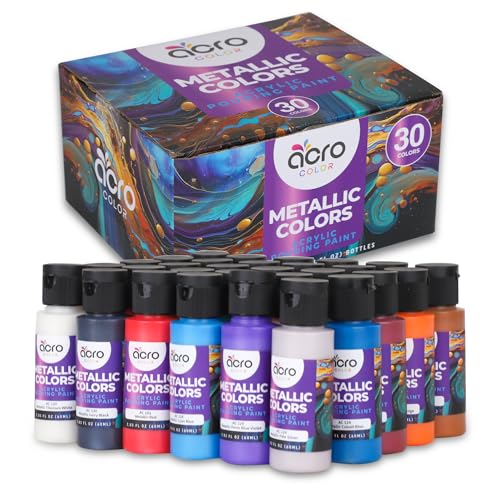
Where the Nicpro kit offers fourteen colors, this Acro Color set doubles the palette to thirty, folding metallics, neons, and pastels into one shelf-friendly lineup. Each bottle holds 2 ounces, pre-mixed and ready to pour straight onto canvas, paper, wood, or whatever flat surface you’ve covered.
The breadth is the appeal here. Pastels and neons rarely ship together, and having both lets you build soft dreamy gradients one week and electric abstract pieces the next. The trade-off shows up in bottle size: 2 ounces goes quickly on larger canvases, so prolific pourers may find themselves reordering sooner than they’d like.
Standout Traits
- Thirty shades spanning metallic, neon, and pastel families.
- Pre-mixed consistency removes all measuring from the process.
- Works across canvas, paper, and mixed surfaces.
- Compact 2oz bottles store neatly in a small art cart.
Softer Spots
- Small bottles run out fast on big-format pours.
- With no separate medium included, you can’t thin the paint further for specialty techniques.
Whose Shelf It Belongs On
Color-driven hobbyists and journal artists who value variety over volume will reach for this set constantly.
Reach For A Different Pick When
Heavy users should compare the Funto 36-bottle set, which adds silicone oil and more generous supplies for bigger projects.
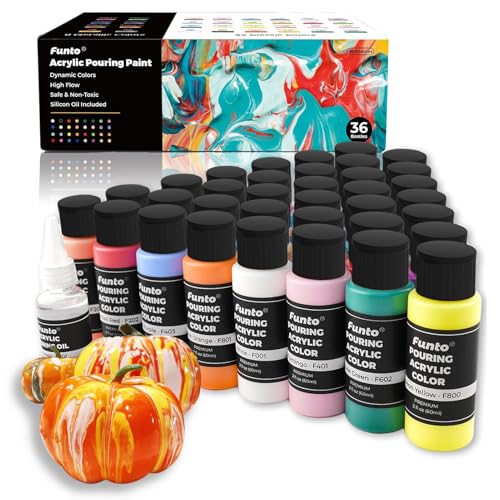
This Funto set answers the question most beginners ask about a month in: how do I get more cells? Silicone oil ships in the box, and a few drops in your cup create those separated, cell-like rings inside the pour. Thirty-six pre-mixed bottles cover neon, metallic, pastel, and classic families, with three whites and two blacks included since neutrals disappear fastest.
The paints are described as nontoxic, which matters for family crafting sessions. Surfaces aren’t limited to canvas either; the set suits glass, tile, wood, and painted rocks, making it a favorite for garden-rock painting groups. Just shake each bottle thoroughly before pouring, as pigment settles during storage.
Reasons To Buy
- Included silicone oil unlocks cell effects without a separate purchase.
- Thirty-six colors with extra white and black for mixing balance.
- Nontoxic formulation suits households crafting with kids.
- Adheres well to glass, tile, rocks, and wood beyond canvas.
Worth Noting
- Pigment settles between uses, so thorough shaking before every pour is essential.
- Pre-mixed consistency limits tuning for advanced techniques.
Quick Facts
Who It Suits Best
Families, rock-painting groups, and multi-surface crafters get the widest use from this bundle.
Not Your Match When
Purists who want to control their own medium-to-paint ratio should stick with the standalone DecoArt or Liquitex mediums.
Liquitex is the name serious acrylic painters reach for, and this gloss medium explains why. It’s engineered to build a smooth, seamless paint body when poured or dripped, increasing flow while eliminating crazing, the fine web of cracks that ruins an otherwise clean pour. The cured finish is glossy and flexible, giving finished pieces that wet-look sheen galleries favor.
The manufacturer suggests starting around five percent color to ninety-five percent medium using Soft Body acrylics, then adjusting to taste, and it also plays well with acrylic ink and heavier bodied paints. Compared with DecoArt’s hobby-leaning formula, this one costs more per ounce but rewards you with a more refined, consistent film.
Highlights
- High-gloss dried surface gives pours a polished, professional look.
- Resists crazing even on thick applications.
- Compatible with Soft Body, Heavy Body, and ink formats.
- Clear ratio guidance takes guesswork out of mixing.
Honest Caveats
- Higher cost per ounce than hobby-brand alternatives.
- Very dilute color loads mean vibrant pieces need more paint than you’d expect.
Details At A Glance
Who Will Love This
Experienced artists selling or exhibiting work, where finish quality directly affects perceived value.
Consider Something Else When
Budget-conscious beginners practicing technique will find the DecoArt 16 oz delivers satisfying results at friendlier cost.
Most mediums change how paint moves; this one changes how it looks. The pearlescent formulation carries shimmering, iridescent particles into your mix, so even a simple two-color pour picks up a subtle metallic glow as it dries. Nothing else on this shortlist bakes that effect into the medium itself.
The quart-size bottle supports multiple fluid art sessions across canvas, wood, and similar surfaces, and the base function matches conventional mediums by improving flow and consistency. One thing worth considering: the shimmer reads differently depending on your underlying paint colors, so test a small cup before committing a whole canvas.
Upsides
- Built-in pearlescent shimmer adds depth without glitter glue or powders.
- 32 oz volume supports many projects before restocking.
- Improves paint flow and leveling like a standard medium.
Trade Offs
- The pearl effect won’t suit every artistic style, particularly muted or matte palettes.
- Shimmer intensity varies with the colors layered over it.
Best Suited To
Decorative artists making statement pieces, coasters, and gift art where a touch of luminosity sells the design.
Skip It When
Minimalists after a pure matte or high-gloss clear finish should choose the Liquitex gloss medium instead.
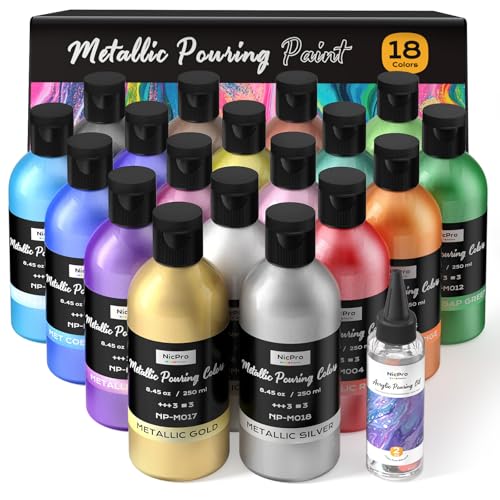
If the earlier Nicpro kit felt too rainbow-bright, this sibling goes moody and luxe. All eighteen 8.45oz bottles carry metallic pigment: fifteen classic metallic shades spanning black, red, blue, orange, green, and violet, plus pearl white, metallic gold, and metallic silver for highlights. Like the fourteen-color kit, everything arrives pre-mixed at a pour-ready ratio, formulated for tilting, swiping, and puddle pours.
Metallic pigments behave differently under a topcoat, catching light at angles flat colors never do, which makes this kit popular for jewel-toned abstract work. The trade-off is tonal range; without true brights or pastels, some compositions can feel heavy unless you lean on the pearl white.
Positives
- Full metallic palette creates rich, light-catching pours.
- Generous 8.45oz bottles outlast typical sample kits.
- Pre-mixed ratio suits flip cup, swipe, and puddle techniques immediately.
Areas To Watch
- No non-metallic brights or pastels restrict lighter compositions.
- Metallic pigment can settle, so stir each bottle before use.
The Right Fit
Intermediate pourers building dramatic, dark-background gallery pieces will find this palette hard to beat.
Another Choice May Suit
Anyone wanting broader everyday color variety should pick the original Nicpro 14-color kit with its classic shades.
Everything said about the 16-ounce DecoArt applies here, scaled up fourfold. Same cell-friendly formula, same flexible non-yellowing film, same compatibility with Americana and DecoArt Media Fluid Acrylics, just in a half-gallon jug aimed at people who pour weekly. Per ounce, this is where the brand’s economics get interesting for committed hobbyists.
The formula thins paint to an ideal flowing consistency without slowing drying time, shifting color, or weakening adhesion, according to the maker. Storage is the main consideration: a half gallon needs shelf space and a tightly closed cap between sessions to prevent skinning around the neck.
Reasons To Buy
- Half-gallon supply suits near-daily pouring habits.
- Proven cell formation and crack resistance across surfaces.
- Doesn’t alter paint color or adhesion, keeping mixes predictable.
- Better long-run economy than repeated small bottles.
Small Caveats
- Overkill for occasional crafters who won’t finish it before it ages.
- Jug format demands careful cap sealing to avoid dried buildup.
Core Details
Who Will Love This
Dedicated home studios and art teachers running recurring pouring units will appreciate the bulk format.
Where Another Pick Suits Better
Light users should stay with the 16 oz DecoArt bottle and upgrade only once the habit sticks.
What Matters Most Before Choosing Acrylic Paint Pouring Mediums
Match The Format To Your Workflow
Standalone mediums give you full control over paint choice and consistency, which experienced artists tend to prefer. Pre-mixed kits skip the math entirely and suit beginners, classrooms, and anyone who values speed over tunability. Decide honestly how often you’ll pour before picking a side.
Volume And Cost Per Session
A 2oz bottle covers a few small canvases, while a 64oz jug supports months of weekly work. Frequent pourers save money and interruptions with bulk sizes, provided storage space exists. Occasional crafters waste less with smaller bottles that stay fresh.
Finish And Film Quality
Gloss, matte, and pearlescent finishes dry very differently, and flexible films resist the cracking that ruins thick pours. Non-yellowing formulas matter most for whites and pastels. Check what finish the medium promises before assuming it matches your vision.
Surface Compatibility
Canvas behaves predictably, but glass, tile, wood, and rocks each interact with paint differently. Kits listing multiple surfaces usually include adhesion-friendly formulations. Plan your surfaces first, then filter products accordingly.
Key Considerations Across These Picks
Traps First Timers Fall Into
The most common mistake is buying a huge jug before confirming you enjoy the hobby, then watching it thicken on a shelf. Another is skipping the shake or stir on pre-mixed paints, since settled pigment produces streaky pours. Start modest, learn your ratios, then scale up.
What Separates Premium From Basic
Higher-tier mediums like Liquitex invest in film chemistry: gloss retention, flexibility, and resistance to crazing over years. Hobby formulas deliver solid results for practice pieces. Paying more pays off once your work leaves the practice canvas and heads for walls or buyers’ hands, so to speak, or rather for gifts and sales.
Frequently Asked Questions
Can I use pouring medium with any acrylic paint?
Most fluid and soft-body acrylics mix well with standard pouring mediums. Heavily gel-based paints may need extra thinning to reach a pourable consistency.
Why did my pour crack as it dried?
Cracking, called crazing, usually comes from applying the layer too thickly or using a medium without a flexible film. Thinner applications and a quality medium reduce the risk considerably.
Do I need silicone oil for cells?
No, some mediums encourage cells on their own, as with DecoArt’s formula. Silicone oil amplifies the effect and is worth adding only once you understand your base results.
How long does a poured painting take to dry?
Thin pours often feel dry within a day, while thick ones can take several days to cure fully. Humidity and room temperature extend those timelines.
Is pre-mixed pour paint good for beginners?
Yes, it removes ratio guesswork and lets newcomers focus on technique. Most developing artists eventually add a standalone medium for greater control.
Closing Thoughts
Choosing among these ten comes down to honesty about your own habits. Casual crafters thrive with the DecoArt 16 oz or a pre-mixed Nicpro kit, while committed studios justify the Liquitex gloss or the 64 oz bulk jug. Whatever you pick, start with a small test canvas, learn how your chosen medium behaves, and let the results guide your next purchase. Happy pouring.
