
Gelli printing lives or dies by the paint you pull it with. Too thick and the brayer skids, too runny and your stencil detail vanishes before the paper ever touches the plate. Anyone who has ruined a good pull with a chalky craft paint knows the frustration well. This roundup sorts ten options that behave on a gel plate, from budget bulk bottles to artist-grade tubes, so you can match paint to the way you actually print.
The Shortlist At A Glance

milo Acrylic Paint Set, 8 Primary Colors, 8 oz Bottles

U.S. Art Supply Clear Acrylic Medium Matte Gel, 200ml Tube

Nicpro 20 Colors Iridescent Acrylic Paint, 8.45oz Bulk Metallic Paint
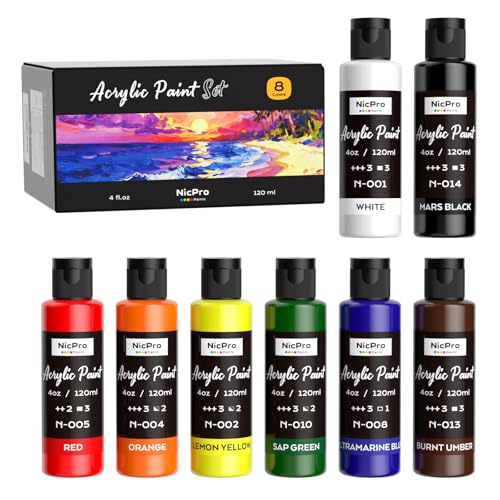
Nicpro 8 Primary Colors Acrylic Paint Set (4 oz)

MEEDEN Soft Body Acrylic Paints Set, Matte Finish 24 Colors x 60ml

Winsor & Newton Galeria Acrylic Paint, 20 x 12ml Tube Set

Amsterdam Standard Series Acrylic Paint Set, General, 0.6 oz, 12 Ct

Artme Metallic Acrylic Paint Set, 24 Metallic Colors in 2 oz Bottles

Liquitex Heavy Body Acrylic Paint Set, 6 x 22ml

Verdeart Acrylic Paint Set, 24 Colors 2 oz with 10 Brushes
More Details On Our Top Picks
Eight big bottles of primaries is exactly how most gelli printers want to start. Red, yellow, phthalo blue, phthalo green, orange, burnt sienna, black, and white cover every mix you’ll need on the plate, and the semi-gloss sheen releases cleanly onto paper.
The 8 oz pour bottles matter more than they first appear. Brayering a full gel plate eats paint fast, and small tubes run dry mid-session. With this set you can load generously without wincing, which changes how freely you experiment.
Strong Points
- Large 8 oz bottles keep long printing sessions going without constant refills
- Tight-sealing caps help leftover paint stay usable between sessions
- Primary-plus-earth palette mixes into nearly any secondary shade you want
- High pigment load supports fade-resistant finished prints
Things To Consider
- Pour bottles need a careful hand near the plate; overpouring wastes paint quickly
- No pre-mixed secondaries means beginners lean on mixing skills early
Who It Suits Best
Printmakers who mix their own colors and burn through volume will get the most from these generous bottles.
Where Another Pick Suits Better
Shoppers wanting ready-made variety straight from the bottle should look at the MEEDEN Soft Body set instead.
This one isn’t paint at all, and that’s the point. A gel medium is a clear acrylic binder you blend into color to stretch it, slow it down, or make it translucent. On a gelli plate that translates to softer ghost layers and glazes that don’t muddy your stencils.
The matte finish matters here because glossy mediums can leave shine patches that photograph unevenly in scans of your prints. At 200ml in a squeeze tube, it’s an easy add-on alongside any paint pick above, and many owners report it extends pricey artist paint considerably.
What We Like
- Clears to transparency when dry, so layered prints stay readable
- Thickens thin paint into something a brayer can actually grip
- Squeeze tube keeps the opening clean and controllable
Worth Noting
- You still need paint to pair it with, so it’s rarely a standalone purchase
- Matte drying means finished pieces won’t have any gloss depth
At A Glance
Made For
Printmakers working with artist-grade tubes who want every drop to go further.
Consider Something Else When
Complete newcomers should start with the Verdeart kit, which bundles paint and tools together instead.
Iridescent paint shifts hue depending on the light and viewing angle, and pulled through a gelli plate that effect becomes genuinely striking. Twenty shades in oversized 8.45 oz bottles give you plenty of metallic surface area to play with, far more than typical craft-size containers.
The bundled paint knife and color wheel are thoughtful extras for a set aimed at decorative work. Fair warning though: shimmer reads best as an accent layer over a solid base pull rather than your whole composition, since heavy metallic coverage can flatten contrast.
Highlights
- Color-shifting pigments create prints that change as viewers move past them
- Bulk bottle sizes suit large plates and repeated pulls
- Included knife helps scoop and spread thick metallic paint evenly
Trade Offs
- Metallic particles may need slightly thicker application to show their shift
- All-shimmer palette limits subtle, muted layering options
Right Fit For
Artists making statement pieces, journal covers, and gift prints where visual drama is the goal.
Not Your Match When
Subtle botanical or monochrome printing calls for the Winsor & Newton Galeria set’s broader tonal range.
Where the milo set goes big, this Nicpro kit stays compact. Eight 4 oz squeeze bottles cover white, Mars black, red, lemon yellow, pink, blue, green, and violet, and squeezing directly onto the plate edge beats pouring for control every time.
The bonus color wheel earns its place in a beginner’s stack, taking guesswork out of mixing complements for contrast layers. Pigment quality sits a step below dedicated artist lines, but for casual weekend sessions and practice pulls, most users find the payoff plenty vivid.
Upsides
- Squeeze bottles give precise placement with less waste than open pours
- Includes pink and violet, handy for warm-toned layered compositions
- Color wheel simplifies learning to mix on the fly
Minor Gripes
- 4 oz bottles empty faster under daily printing than the milo 8 oz format
- Hobby-grade formulation may need a gel medium for extended blending time
Who Should Grab It
Weekend hobbyists and students who want a tidy, low-commitment primary setup.
Look Elsewhere When
High-volume printers should step up to the milo set’s larger bottles to avoid constant restocking.
Soft body describes paint with a creamier, lower-viscosity consistency than heavy body formulas, and it happens to be ideal for gelli work. It spreads into a thin, even film under a brayer without fighting back, which is exactly what clean pulls demand.
Twenty-four matte shades spanning white, black, yellow, red, blues, green, orange, and purple mean less mixing and more printing. The matte surface also takes pencil and pen mark-making beautifully once dry, a real plus for mixed media journals. Compared to the milo primaries, you trade raw volume for ready-made range.
Bright Spots
- Soft body consistency levels out smoothly under a brayer
- 24 ready shades cut mixing time during multi-layer sessions
- Matte finish accepts post-print drawing and writing cleanly
- 60ml bottles balance quantity against shelf footprint
Softer Spots
- Thin layers can dry on the plate quickly in warm rooms, so pace your pulls
- Matte-only finish offers no gloss option within the set
Quick Facts
Best Suited To
Journal artists and layering enthusiasts building multi-color ghost prints in one sitting.
A Better Fit Elsewhere
Printmakers chasing thick impasto-style texture will prefer the Liquitex Heavy Body set further down.
Winsor & Newton carries serious studio credibility, and Galeria is the brand’s student-to-intermediate line: buttery, free-flowing, and consistent from tube to tube. Twenty 12ml tubes give you a genuine spectrum rather than a bare-bones starter trio.
On the plate, that silky flow translates to smooth brayer coverage and forgiving blends. The honest trade-off is size; 12ml tubes vanish quickly if you print large or daily. Treat this as your quality-first set for finished pieces, and lean on a bulk option like milo for practice runs.
Reasons To Buy
- Artist-brand consistency means predictable color from batch to batch
- Buttery flow spreads thinly without streaking under a brayer
- 20-tube range covers subtle tonal shifts other sets skip
- Tubes seal tightly and store neatly in a drawer
Small Caveats
- 12ml tubes deplete fast under heavy gelli use
- Per-volume cost runs higher than bulk bottle alternatives
Perfect Match For
Intermediate artists producing gallery-bound or gift-quality prints where color fidelity counts.
Skip It When
Budget-focused beginners practicing technique belong with the Verdeart starter kit instead.
Royal Talens has made art supplies since 1905, and Amsterdam Standard is the line that put Dutch acrylics on student desks worldwide. Twelve numbered colors arrive in 0.6 oz tubes, built on a full acrylic resin binder with lightfast pigments.
Two details stand out for printmakers. The dried film stays flexible, so prints destined for bookbinding or collage won’t crack, and the alkali-resistant formula handles wall and mural surfaces too. Thin layers dry in roughly half an hour, quick enough to keep a session moving but worth remembering when you’re stacking layers.
Plus Points
- Flexible dried film resists cracking in bound or folded work
- Lightfast pigments help finished prints hold their color over time
- Adheres to canvas, paper, wood, stone, and cement alike
- Numbered color codes make reordering your favorites simple
Points To Note
- Small 0.6 oz tubes suit detail work more than full-plate coverage
- About 30-minute thin-layer drying requires some patience between pulls
Feature Snapshot
The Right Fit
Mixed media artists whose prints end up glued, folded, or mounted will value that flexible film.
Swap It Out When
Volume printing favors the milo set’s 8 oz bottles over these petite tubes.
Next to the Nicpro iridescent set, this ARTME kit takes a different route to shine: twenty-four flat metallic shades rather than angle-shifting ones. Classic gold, silver, black, and white sit alongside bolder reds, blues, oranges, and greens, all in 2 oz bottles.
The thicker consistency is the interesting part for gelli work. It holds spatula and brayer marks, so textured pulls come through with visible character. Owners commonly report the coverage feels rich straight from the bottle, though that same thickness means a light touch with water helps on detailed stencils.
Standout Traits
- Thick body retains tool marks for textured, dimensional prints
- 24 metallic shades span classic and fashion-forward tones
- Rich pigment gives strong one-coat coverage on most papers
Honest Caveats
- Heavy consistency can bridge fine stencil gaps without thinning
- No matte or standard finishes included for contrast layers
Whose Shelf It Belongs On
Card makers and holiday-craft printers who want luminous accents with minimal fuss.
Another Choice May Suit
Angle-dependent shimmer effects are better served by the Nicpro iridescent set.
Liquitex invented the modern acrylic tube, and its Heavy Body line remains the benchmark for thick, buttery paint. Six vibrant 22ml tubes deliver a high pigment load, meaning deeper saturated color per pass than most budget sets can manage.
On a gel plate, that density shines in bold single-color pulls and mark-making, where strokes stay crisp instead of leveling out. The trade-off is the opposite of the MEEDEN soft body approach: heavy body resists spreading thin, so expect to work it harder with the brayer or pair it with a gel medium for delicate layers.
Best Bits
- High pigment load produces richly saturated pulls in fewer passes
- Thick consistency keeps brush and knife marks intact
- Extended open-working time allows slower blending on the plate
- Trusted artist-grade formulation suits archival-minded work
Areas To Watch
- Only six colors, so mixing carries the workload
- Heavy body needs effort or medium to reach thin film coverage
Core Details
Built With In Mind
Confident printmakers after maximum color punch in bold, graphic compositions.
Reach For A Different Pick When
Delicate layered ghost prints are easier with the MEEDEN soft body set.
Everything arrives in one box here: 24 highly pigmented 2 oz colors, ten brushes, and a palette. For someone assembling a first gelli station, that removes the guesswork of pairing paints with tools entirely.
The creamy formula blends and layers smoothly, giving true, consistent shades for detail work once your prints come off the plate. Compared to the Nicpro 4 oz primaries, you gain breadth of color and lose individual bottle size, a fair swap for exploratory early sessions.
Positives
- Complete kit means painting the day it arrives, no extra shopping
- 24 distinct shades support varied compositions without mixing
- Creamy texture layers cleanly for detail and touch-up work
Room For Improvement
- Brush quality is serviceable rather than professional grade
- 2 oz bottles suit occasional use better than daily production
Details At A Glance
Who Will Love This
First-time printmakers and gift shoppers wanting a self-contained starting point.
Where A Sibling Pick Shines
Established artists needing richer pigment should compare the Liquitex Heavy Body set.
Choosing Acrylic Paints For Gelli Printing Without Regret
Consistency Comes First
Paint body determines everything on a gel plate. Soft body spreads into thin, even films that transfer crisply, while heavy body holds texture but demands more brayer pressure. Match the body to your style: layered journal work favors soft, graphic single-color pulls favor heavy.
Volume Versus Variety
Brayering consumes paint faster than brushwork ever will. Bulk bottles like milo’s 8 oz format keep long sessions affordable, while multi-color sets such as MEEDEN’s 24 shades reduce mixing interruptions. Decide whether your bottleneck is quantity or range before committing.
Finish And Drying Behavior
Matte finishes accept pen and pencil overprints beautifully, and satin or semi-gloss surfaces release from the plate with a slight sheen. Faster-drying formulas keep momentum in cool rooms but punish slow workers in summer heat, so consider your workspace climate.
Extras That Earn Their Keep
Color wheels, paint knives, and bundled brushes sound like padding until you actually need them. Beginners benefit most from kits with tools included, while experienced printers usually prefer putting that budget toward larger paint volumes instead.
Key Considerations Across These Picks
Traps First Timers Fall Into
The most common mistake is buying tiny tubes for a hobby that drinks paint. A 12ml tube may last two sessions on a large plate. The second trap is ignoring finish; glossy craft paint often photographs with hot spots. Read labels for body type and sheen before adding anything to your cart.
The Case For Spending Up
Artist-grade lines like Liquitex and Winsor & Newton charge more for higher pigment loads and batch-to-batch consistency. That translates to stronger color with less paint per pull and predictable results across orders. Casual hobbyists can skip the upgrade; anyone selling prints will feel the difference immediately.
Frequently Asked Questions
What paint consistency works best on a gelli plate?
Soft body acrylics spread thinnest and transfer most reliably for beginners. Heavy body works well too, provided you apply it with a firm, even brayer pass.
Can I use cheap craft acrylics for gelli printing?
You can, though weaker pigment often means patchy coverage and faded prints. Budget sets with high pigment claims, like several listed above, close much of that gap.
How much paint should I put on the plate?
A pea-sized amount spread with a brayer usually coats a standard plate evenly. Overloading causes squishy edges and blurred stencil detail.
Do metallic and iridescent paints release well from gel plates?
Yes, and they often produce striking effects because the shimmer sits on the surface. Apply them slightly thicker than standard colors to see the full shift.
How do I keep acrylic paint from drying on my plate too fast?
Work in a cool room and pace your layers, rebrayering before each pull. Blending in a gel medium also extends working time noticeably.
Wrap Up
Your best match depends on how you print. Mixers burning through volume will love the milo bottles, layering fans should reach for MEEDEN’s soft body range, and quality-driven artists have solid reasons to pick Galeria or Liquitex. Start with one set that fits your habits, learn its behavior on the plate, and expand from there. Happy pulling.
