
Foam and plastic are a tricky pair. Most glues either melt the foam or peel right off the plastic, and anyone who has watched an RC wing come apart mid-flight knows the cost of picking wrong. This list covers ten adhesives built for that exact job, from hobby-shop favorites to construction-grade options.
The Shortlist At A Glance

Beacon Foam-Tac Powerful Glue 2-Ounce

RH Adhesives S-18 All-Purpose Adhesive 4 oz
BEACON Foam-Tac Minis .17-Ounce 3-Pack

Ceoighe 4 OZ Foam Glue with Brush Cap

Bob Smith Industries BSI-105 Plastic-Cure 0.5 oz

Hzutloer 4OZ Clear Foam Adhesive with Brush
Liquid Nails 10 oz Latex Foamboard Adhesive

kuailaya 120ml Foam Glue with Brush Cap
Mshunya Transparent Flexible Foam Glue

PHIXBEAR 0.79″ Double Sided Foam Tape 9.84Ft
More Details On Our Top Picks
This is the bottle most foam-plane pilots keep within arm’s reach. The formula is engineered around EPP, EPO, and Depron foams, so it grips those closed-cell surfaces instead of dissolving them, and it also handles balsa, carbon fiber, and 3D-printed parts. Drying happens fast, which matters when you’re holding a control horn in place at the flying field.
The current version adds UV blockers to the mix. In plain terms, that means sun exposure won’t yellow or weaken the bond line over a season of outdoor flying, something older formulas were known to struggle with.
Strong Points
- Safe on delicate EPP, EPO, and Depron foam without melting the structure
- Waterproof bond holds up through damp mornings and dewy grass landings
- UV blockers keep outdoor joints from yellowing or degrading
- Works across balsa, carbon fiber, and printed parts, so one bottle covers most builds
- Fast set time keeps repair sessions short between flights
Things To Consider
- The two-ounce bottle goes quickly on full airframe builds, so frequent builders may want a spare on hand
- Cap threads can gum up if you don’t wipe the nozzle after each session
Key Specs
Who It Suits Best
RC builders who assemble and repair foam aircraft regularly and want one trusted bottle for the whole hangar.
A Better Fit Elsewhere
Shoppers doing large upholstery or headliner jobs will get more coverage from the RH Adhesives S-18 below.
Contact cement works differently from hobby glue: you coat both surfaces, let them tack up, then press them together for an instant, aggressive grab. That makes S-18 a natural fit for headliners, upholstery panels, and any job where clamping isn’t practical.
Where this one earns its spot is water resistance. Marine applications are explicitly part of its design brief, and the cured film resists oil and aging, so a boat cabin or car interior won’t slowly undo your work. It also bridges porous and non-porous materials, including rubber-to-metal joints with SBR rubber and neoprene.
Highlights
- Bonds both porous and non-porous surfaces in a single product
- Strong water resistance suits boat cabins and damp interiors
- Cured film offers solid peel strength plus oil resistance
- Handles rubber-to-metal and plastic-to-other-material joins reliably
Worth Noting
- As a solvent-based cement, ventilation matters during application, especially indoors
- Contact-cement technique takes practice; misaligned pieces are hard to reposition once they touch
- Not formulated specifically for fragile foams like Depron, where a dedicated foam glue is safer
Made For
DIYers tackling automotive headliners, upholstery, or marine projects where moisture and temperature swings are part of life.
Consider Something Else When
Delicate RC foam work calls for Beacon Foam-Tac instead, since it’s tuned for EPP and EPO rather than heavy fabric and metal.
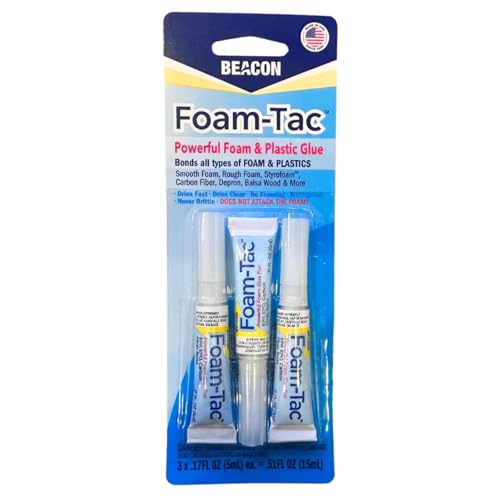
Same chemistry as the full-size Foam-Tac above, shrunk into three pocket-size tubes. Each .17-ounce mini slips into a flight box or jacket pocket, which solves a real problem: big bottles left at home mean crashed wings stay broken until you get back to the bench.
The formula carries the same credentials, compatibility with EPP, EPO, Depron, balsa, carbon fiber, and printed parts, plus UV blockers and an added adhesion promoter for stronger, longer-lasting joints. Pilots commonly reach for it on motor mounts, servo attachment, and control hardware, not just emergency wing patches.
Reasons To Buy
- Three tiny tubes spread across different bags mean a repair option is always nearby
- Adhesion promoter boosts joint strength beyond standard foam glues
- UV blockers protect bonds used outdoors season after season
- Small openings waste less glue on quick touch-ups than a wide-mouth bottle
Small Caveats
- Tiny volume runs out fast on anything bigger than a patch job
- Per-ounce value trails the full 2-ounce bottle if you build at home mostly
Right Fit For
Flying-field regulars who want backup glue stashed in a transmitter case or tool pouch.
Swap It Out When
Home workshop builders burning through glue weekly should stick with the full-size Beacon Foam-Tac bottle for better economy.
A four-ounce bottle aimed squarely at RC airplane assembly and repair, with a brush built into the cap. That detail sounds minor until you’ve tried squeezing a thin bead along a fuselage seam by hand; the brush lets you paint glue exactly where it belongs and nowhere else.
Compatibility covers the usual suspects, EPP, EPO, EPS, balsa wood, and carbon fiber, so it slots into most foam-aircraft workflows without a second thought. For newer builders assembling their first kit, the forgiving application style removes one common source of messy joints.
What We Like
- Cap-integrated brush gives precise placement on seams and small parts
- Four ounces is generous compared with typical hobby-sized bottles
- Foam-safe across EPP, EPO, EPS, balsa, and carbon fiber
- Suits both fresh assembly and mid-season crash repairs
Points To Note
- Brush caps need cleaning after use or the bristles stiffen between sessions
- Set speed may feel slower than instant cyanoacrylates for impatient builders
Quick Facts
Who Should Grab It
First-time RC kit builders who want plenty of volume and mess-free application while learning the ropes.
Reach For A Different Pick When
Modelers needing instant grab on tiny parts will prefer the Bob Smith Industries Plastic-Cure reviewed next.
Cyanoacrylate, better known as CA or super glue, usually comes with two complaints: harsh fumes and a nozzle that floods everything. Plastic-Cure answers both. It’s odorless, which makes indoor winter bench sessions far more pleasant, and the brush-on top turns a runny liquid into something you can paint onto a joint with real control.
It’s positioned primarily for plastic model assembly, though the foam-safe rating widens its usefulness to mixed-media builds. A half-ounce doesn’t sound like much, but CA goes a long way, and owners commonly report a single bottle lasting through many small projects.
Plus Points
- Odorless formula makes indoor use comfortable without strong fumes
- Brush applicator beats squeeze nozzles for accuracy on small parts
- Clear cure keeps visible joints looking tidy on display models
- Doubles for nail wraps and false nails, a handy household crossover
Honest Caveats
- Half-ounce size suits detail work, not large surface bonding
- CA bonds skin fast, so gloves or careful handling are wise
- Brush tip can harden if the cap isn’t sealed tightly after each use
Whose Shelf It Belongs On
Scale-model builders and crafters working indoors who want CA strength without the eye-watering smell.
Not Your Match When
Large-area foam sheet lamination is better served by the Liquid Nails latex adhesive further down this list.
Where the Ceoighe bottle leans toward RC planes, this one leans toward the craft table. Its material list reads like a crafter’s supply drawer: EVA sponge, rubber, pearl cotton, plastic sheets, and light wood. The clear finish helps too, since dried glue lines disappear against white foam board and pastel EVA.
Bond strength is the headline claim here. Joints are rated to handle meaningful tensile and compressive loads, which translates to costume pieces and school dioramas that survive being carried, dropped, and handled. The included brush supports thin, even coats on broad surfaces.
Bright Spots
- Clear drying keeps craft joints invisible on light-colored materials
- High bonding strength stands up to pulling and pressing forces
- Waterproof once cured, handy for outdoor decorations
- Brush included for smooth coverage on wide foam sheets
Softer Spots
- Full cure takes patience; handling pieces too soon can weaken the joint
- Brush storage requires wiping the neck clean to prevent crusting
Details At A Glance
Who Will Love This
Cosplay makers, teachers, and weekend DIYers bonding soft foams to plastic sheeting on visible projects.
Another Choice May Suit
RC-focused builders should look back at the Ceoighe brush-cap glue, which targets airplane foams more directly.
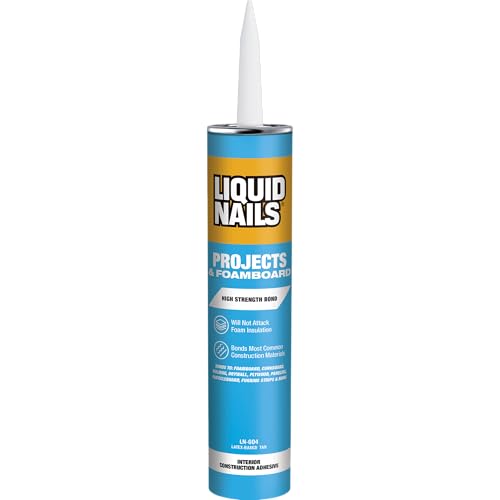
Most construction adhesives eat rigid polystyrene foam alive. This latex-based tube is formulated specifically not to, gripping foam insulation board without melting or warping it. Anyone insulating a basement, mounting foamboard art, or building stage props knows why that distinction matters.
The SBR latex base brings two indoor-friendly perks: low odor and water cleanup. Spills wipe away with a damp cloth instead of demanding solvents, and there’s no solvent smell lingering in a finished room. Beyond foam, it bonds wood, drywall, and common panel materials, making it a genuinely useful tube to keep in the utility drawer.
Standout Traits
- Bonds rigid polystyrene foam without attacking the material
- Low-odor latex suits occupied living spaces and enclosed rooms
- Water cleanup simplifies mistakes and tool rinsing
- Ten-ounce tube covers large panels economically
- Also grips wood, drywall, and panels for general interior jobs
Room For Improvement
- Requires a caulk gun, a small extra purchase for first-timers
- Latex formula isn’t intended for submerged or constantly wet locations
- Cure time is slower than hobby CA glues, so bracing panels helps
Who It’s Built With In Mind
Homeowners and DIY renovators installing foam insulation boards or mounting lightweight panels indoors.
Look Elsewhere When
Precision hobby work on RC foams belongs with Beacon Foam-Tac, not a construction tube meant for broad surfaces.
The pitch here is simple: ordinary glue destroys foam, this one doesn’t. The formula is designed to avoid dissolving or soaking deep into foam cells, which protects the structure of styrofoam and similar soft materials during bonding. That alone disqualifies most desk-drawer glue sticks from serious foam work.
Speed is the second selling point. Grip develops quickly after application, so pieces hold position without long clamping waits, useful for kids’ projects and classroom settings where attention spans are short. At roughly 120ml, the bottle sits comfortably between the mini tubes and the four-ounce hobby bottles elsewhere on this list.
Positives
- Foam-safe formula won’t dissolve or collapse delicate cell structures
- Fast initial grip cuts down clamping and holding time
- Brush cap allows accurate positioning on small craft parts
- Mid-size volume balances value against shelf life
Minor Gripes
- Less widely documented long-term durability than established hobby brands
- Brush needs prompt cleaning or it dries stiff between uses
The Right Fit
Parents, teachers, and casual crafters who need dependable foam bonding without hobby-shop complexity.
Where A Sibling Pick Shines
Heavier-duty craft loads benefit from the Hzutloer clear adhesive, whose high-strength rating suits structural costume pieces.
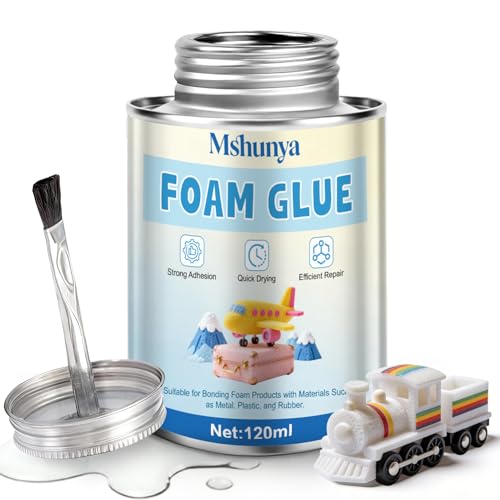
Flexibility is the trait that separates this pick from its stiffer cousins. Rigid glue lines crack when foam bends; a flexible cured film moves with the material, which matters on cushions, padding, and anything that gets squeezed repeatedly. The transparent finish keeps those moving joints visually clean too.
The formulation penetrates surface texture on both porous and non-porous materials, building holding power through mechanical grip rather than surface tack alone. Like the kuailaya option above, it’s designed to leave fragile honeycomb structures intact instead of dissolving or shrinking them.
Upsides
- Flexible cure accommodates bending and compression without cracking
- Deep penetration into surface texture strengthens the mechanical bond
- Transparent finish hides glue lines on visible projects
- Waterproof and quick-drying for faster project turnaround
Trade Offs
- Flexibility trades off some rigidity for load-bearing structural joints
- Application details like brush inclusion aren’t specified, so plan your own applicator
Who Should Grab It
Crafters bonding foam to plastic in projects that flex, such as padding, gaskets, and wearable pieces.
Skip It When
Strictly rigid assemblies with heavy loads are a better match for the RH Adhesives S-18 contact cement.
Sometimes the answer isn’t glue at all. This double-sided foam tape skips curing time, drips, and fumes entirely: cut a strip, press both sides, done. The 0.79-inch width and just under ten feet of length cover picture hanging, car trim, and décor mounting without touching a single tube.
The sealed foam core blocks water vapor, so bathrooms, kitchens, and covered outdoor spots are fair game, and the adhesive tolerates heat extremes that would soften lesser tapes. One honest note: tape holds best on smooth, clean surfaces, and removal can leave residue on painted walls depending on the paint finish.
Best Bits
- Instant mounting with zero drying or clamping time
- Sealed foam core isolates moisture in wet environments
- Heat-resistant adhesive suits cars and sunny windowsills
- Nearly ten feet of tape stretches across many small jobs
- Conforms to uneven gaps thanks to the compressible foam layer
Areas To Watch
- Surface prep matters; dusty or textured walls reduce holding power noticeably
- Peeling it off delicate paint can pull finish, so test a corner first
Core Details
Perfect Match For
Renters and decorators mounting lightweight items cleanly, plus drivers securing interior trim pieces.
Where Another Pick Suits Better
Structural foam-to-plastic bonds under stress call for a liquid adhesive like Beacon Foam-Tac instead of tape.
Choosing Between These Bonds Without Regret
Match The Adhesive To The Foam
Not all foam behaves the same. Closed-cell types like EPP and EPO shrug off most chemicals, while open-cell and polystyrene foams dissolve on contact with aggressive solvents. Always confirm the label names your specific foam before committing a whole project to one bottle.
Think About Where The Bond Lives
An indoor craft joint and an outdoor RC wing face very different conditions. Sunlight, moisture, and temperature swings break down ordinary glue lines within months. Formulas with UV blockers or explicit waterproof ratings earn their keep the moment weather enters the picture.
Application Style Shapes Your Results
Brush caps reward precision work on seams and small parts, while contact cements demand coating both surfaces and committing immediately. Tubes suit broad panels. Choosing an applicator that matches your dexterity and workspace prevents most messy outcomes.
Volume Versus Shelf Life
Bigger bottles save money per ounce but only if you’ll finish them before the contents thicken. Occasional users often do better with minis or mid-size bottles that stay fresh until the next project rolls around.
Key Considerations Across These Picks
Traps First Timers Fall Into
The classic error is grabbing a general-purpose super glue for foam and watching it melt the piece. The second is skipping surface prep; dust and release agents sabotage even good adhesives. Test on scrap first, always.
The Case For Spending Up
Higher-tier formulas add stabilizers like UV blockers, adhesion promoters, and refined foam-safe chemistry. Those extras cost more per ounce but prevent cracked joints and repeat purchases, which matters most for outdoor or load-bearing work.
Frequently Asked Questions
Will regular super glue melt foam?
Standard cyanoacrylates can attack some foams, particularly polystyrene varieties, causing melting or crumbling. Foam-safe versions like the Bob Smith Industries Plastic-Cure are formulated to avoid that reaction.
Can I use these adhesives outdoors?
Several picks handle outdoor conditions well, including Beacon Foam-Tac with its UV blockers and the PHIXBEAR tape. Check each product’s stated resistance before exposing a bond to weather permanently.
How do I remove excess glue from foam?
Work gently with a fingernail or plastic scraper once fully cured, since solvents can damage the foam underneath. Prevention through careful application beats cleanup every time.
Is double-sided tape as strong as liquid glue?
For smooth, clean surfaces and moderate loads, quality foam tape performs admirably and installs instantly. Structural joints under constant stress still favor a penetrating liquid adhesive.
How long do these bonds take to fully cure?
CA glues set in seconds, while latex construction adhesives and craft glues typically need hours to reach full strength. Follow the manufacturer’s guidance before loading a fresh joint.
Wrap Up
Picking the right adhesive comes down to three questions: what foam, what environment, and how precise the application needs to be. Match those answers to the profiles above and you’ll land on the right bottle or roll without guesswork. Start with a small test joint on scrap material, give it a proper cure, and your foam-to-plastic projects will hold together far longer than the glue aisle suggests.
