
Whether you paint miniatures at a desk, decorate cakes in a small kitchen, or run a nail studio from home, the compressor matters more than the brush. A noisy, pulsing air supply ruins fine lines and tests your patience. This roundup sorts ten well-regarded options by real working conditions: noise, duty cycle, portability, and how much setup you want to handle on day one.
The Shortlist At A Glance

Timbertech AS18-2K Basic Start Kit

Master Airbrush TC-326T Cool Runner II

Master Airbrush Cool Runner II System Kit

Timbertech AS186 Mini Compressor with 3L Tank

Gaahleri Ambition Series GTS-06 Kit
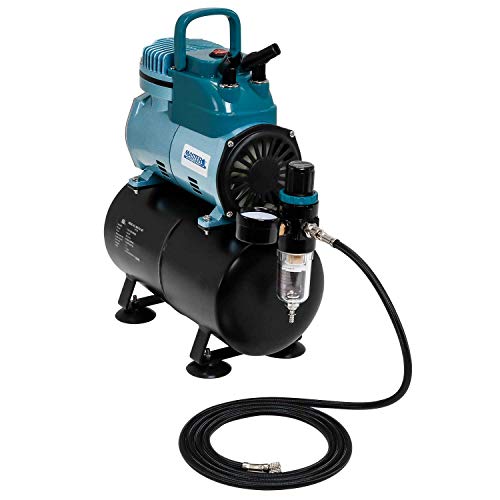
Master Airbrush Model TC-40T Kit

Master Model C16-B Black Mini Compressor

I-BEAUTEE Rechargeable Cordless Airbrush Kit

PointZero 1/5 HP Quiet Portable Compressor

TIMBERTECH AS18-2 Basic Mini Compressor
More Details On Our Top Picks
Most starter kits make you shop twice: once for the compressor, again for the hose, brushes, and cleaning supplies. The Timbertech AS18-2K bundles all of it, including test paints, so your first session can happen the day the box arrives. The oil-less piston runs around 47 dB, quiet enough for an apartment evening or a shared craft room.
The included double-action gravity-feed brush uses a 0.30 mm nozzle, a versatile size for model detail work, nail art, and cake decorating alike. Auto start near 3 bar and auto stop near 4 bar keep pressure steady without constant fiddling.
Strong Points
- Everything arrives in one box, so there’s no second shopping trip before you can spray
- Roughly 47 dB operation means conversations nearby stay possible
- Auto start/stop cycling protects the motor during breaks between coats
- Carry handle makes moving it between rooms or classes simple
Things To Consider
- Gravity-feed cups hold small paint volumes, so large coverage jobs mean frequent refills
- Owners commonly report draining the water trap after each session prevents moisture spitting later
Key Specs
Who Should Grab It
First-time airbrushers who want a complete, ready-to-spray setup without piecing together parts.
Where A Sibling Pick Shines
Artists who already own brushes will get more value from the standalone Timbertech AS186 with its 3-liter tank.
Long painting sessions are where cheap compressors quit. The TC-326T pairs a 1/5 HP single piston with two built-in cooling fans, letting it run noticeably longer before heat becomes a problem. Its 3-liter storage tank is the real difference-maker: the tank holds pressurized air so the motor cycles off while you spray, which means steadier pressure and far less pulsing at the tip.
For anyone painting a full squad of miniatures or working through automotive graphics over an afternoon, that combination of cooling and stored air changes the experience. A regulator with water trap and a brush holder round out the package.
What We Like
- Dual cooling fans extend continuous run time compared with basic single-fan units
- The 3-liter tank delivers pulse-free output even mid-session
- Motor rests between fills, reducing wear over years of use
- Included holder keeps a loaded brush upright between passes
Trade Offs
- Larger footprint than tankless minis, so it claims permanent desk space
- Compressor only; you’ll supply your own airbrushes and hose setup preferences
Made For
Dedicated hobbyists and semi-pros who spray for hours at a stretch and want hardware that keeps up.
Consider Something Else When
Beginners wanting brushes bundled in should look at the Master Airbrush Cool Runner II system kit instead.
Where the TC-326T covers the air side only, this system kit adds three of Master’s most popular brushes: a 0.3 mm gravity feed for detail, plus 0.35 mm and 0.8 mm siphon-feed guns for broader coverage. Siphon feed simply means the brush draws paint from a bottle below it, which suits base coating and larger surfaces where refilling constantly gets old.
The same dual-fan cooled 1/5 HP compressor powers everything, and a quick-start guide plus resource access card help newcomers past the usual early frustration. In our view, this is the most complete turnkey package on the list for someone exploring several crafts at once.
Highlights
- Three nozzle sizes cover fine lines through broad coverage without extra purchases
- Dual-fan cooling supports extended sessions like its sibling TC-326T
- Learning materials shorten the trial-and-error phase considerably
- Holder keeps multiple brushes organized on the bench
Minor Gripes
- Siphon-feed brushes need thorough cleaning after thick paints to avoid clogs, a chore owners mention often
- More components mean more setup time than a single-brush kit
Right Fit For
Multi-craft creators splitting time between models, canvas, and crafts who want one kit to serve them all.
Swap It Out When
Detail-only miniature painters may prefer the Gaahleri GTS-06 for its tighter focus on precision control.
The AS186 answers a question every precision painter eventually asks: why does my line wobble? The answer is usually pulsing air, and the 3-liter receiver tank here absorbs those pulses so output stays constant. Add oil-free piston construction, roughly 47 dB noise, and a carry handle, and you get a compact unit that behaves like a much bigger machine.
It pairs with any brush using 0.2 to 0.8 mm nozzles, though brushes come separately. Auto start around 3 bar and stop around 4 bar give the motor rest periods that owners say help longevity.
Upsides
- Tank-smoothed airflow produces cleaner thin lines and softer gradients
- Oil-free design removes lubrication maintenance entirely
- Wide 0.2-0.8 mm nozzle compatibility covers nearly every hobby brush
- Light enough with its handle to relocate between work areas
Softer Spots
- No airbrush included, so budget for one if you’re starting fresh
- Between refill cycles the motor pauses, which some find noticeable in very long sessions
At A Glance
Who Will Love This
Scale modelers and figure painters chasing clean highlights who already own a quality brush.
Another Choice May Suit
Complete beginners should pick the Timbertech AS18-2K kit, which adds brushes, hose, and test paints.
Desk space is a genuine constraint for many scale builders, and the Gaahleri Serenair mini compressor was designed around that reality. The whole setup, brush and compressor together, occupies a fraction of the bench that a tanked unit like the Timbertech AS186 demands. Despite the small body, it includes adjustable air control, which matters when you’re switching between priming a hull and painting a cockpit canopy.
You may find the smaller motor better matched to detail sessions than marathon base-coating runs, but for the precision work most miniature painters actually do, it fits comfortably.
Bright Spots
- Very compact footprint leaves room for paints, tools, and the model itself
- Air control adjustment lets you dial output per task
- Brush and compressor ship together as a matched pair
Points To Note
- Mini compressors generally suit shorter or moderate sessions better than all-day runs
- One brush means less flexibility than multi-brush kits until you expand
Whose Shelf It Belongs On
Apartment-based scale modelers and detail-focused hobbyists working at a dedicated desk.
Look Elsewhere When
Artists needing three nozzle options out of the box will prefer the Master Cool Runner II system kit.
The TC-40T sits between Master’s big tanked unit and its bare-bones minis. You still get an air storage tank for steady pressure, plus a regulator with gauge and water trap filter, but the overall package stays more modest. Two brush holders and a six-foot braided hose with standard 1/8-inch ends mean fewer accessory purchases down the line.
A built-in cooling fan and extended duty cycle let it handle serious workloads, though not quite as long as the dual-fan TC-326T. For an intermediate artist upgrading from a starter kit, that middle ground often lands just right.
Plus Points
- Tank-backed output keeps pressure consistent through detailed passes
- Six-foot braided hose gives real freedom of movement at the bench
- Two holders accommodate a detail brush and a coverage brush side by side
- Water trap filter helps prevent moisture spots on finishes
Small Caveats
- Single cooling fan means shorter continuous runs than the dual-fan TC-326T
- Airbrushes sold separately, unlike the bundled system kits
Quick Facts
Who It Suits Best
Intermediate hobbyists stepping up from a basic kit who want tank stability without the largest unit’s bulk.
Not Your Match When
Marathon painters should spend up to the Master TC-326T for its dual-fan cooling advantage.
Not everyone needs industrial stamina. The C16-B is a palm-sized 12V DC mini compressor that plugs into a standard wall adapter, and it exists purely for light, occasional spraying: a quick nail session, a small craft project, a test stencil. The six-foot braided hose gives you enough reach to work comfortably away from the outlet.
The honest read is that this is a gateway machine. It won’t match the duty cycle of the PointZero or the smoothness of a tanked unit, but for dipping a toe into airbrushing without commitment, few options cost less or take up less space.
Reasons To Buy
- Tiny footprint stores in a drawer between uses
- Simple plug-in operation with no settings to learn
- Braided six-foot hose allows comfortable working distance
Honest Caveats
- Light-duty motor isn’t intended for extended continuous spraying
- No regulator or tank, so pressure control depends on your trigger technique
- Users commonly report it suits thin, well-reduced paints best
The Right Fit
Casual crafters and curious beginners testing whether airbrushing fits their workflow.
Reach For A Different Pick When
Anyone planning regular model painting will outgrow it quickly; the Timbertech AS18-2 is the sturdier step.
Mobile beauty professionals live a different life than bench hobbyists. Between client visits, a wall outlet isn’t always available, and that’s exactly the gap this rechargeable handheld fills. The trigger-style grip lets you pull back to spray and release to stop, which reduces hand fatigue across a full day of appointments compared with button-style pens.
Stated stable pressure and fine atomization suit nail art, brows, and touch-up tattoo work. Compared with the corded Master C16-B, you trade raw power for total location freedom, and for on-location artists that trade usually makes sense.
Standout Traits
- Cordless battery power works anywhere, from salons to client homes
- Trigger action feels natural during long application sessions
- Fine atomization handles delicate cosmetic and nail detailing
- Handheld format slips into a kit bag easily
Worth Noting
- Battery runtime limits back-to-back heavy spraying versus corded units
- Small cup capacity means refills during larger coverage tasks
Core Details
Perfect Match For
Freelance makeup artists, barbers, and nail techs who travel between clients and need untethered spraying.
Where Another Pick Suits Better
Bench-bound model painters get steadier results from the PointZero 1/5 HP compressor’s mains-powered consistency.
Shared living spaces change the calculus entirely. At roughly 55 dB thanks to a precision-forged piston, the PointZero stays considerate of housemates and neighbors while still delivering about 1.0 CFM of airflow from its 1/5 HP motor. That’s real working volume, not toy territory.
On-demand operation is the smart part: it runs until pressure reaches approximately 58 psi, then shuts off and waits. You spray on stored pressure rather than constant motor drone, similar in feel to a tanked unit like the Timbertech AS186 but in a lighter, tankless body. A regulator, gauge, and water trap come fitted.
Positives
- Approximately 55 dB operation respects apartments and shared studios
- Auto shutoff near 58 psi gives tank-like steady spray without the tank weight
- Regulator, gauge, and water trap arrive pre-installed
- Forged piston design targets low-noise, long-life running
Areas To Watch
- Without a tank, very high-volume spraying brings the motor back on sooner
- Brushes and hose are separate purchases
Best Suited To
Apartment dwellers and evening painters who refuse to compromise on airflow quality.
Skip It When
Artists wanting bundled brushes should choose the Master Cool Runner II system kit for a fuller package.
Sometimes the right answer is the simplest one. The AS18-2 is Timbertech’s no-frills 1/6 HP mini: plug it in, attach your brush, and spray. Auto stop at 4 bar handles the pressure management for you, and the oil-free piston needs nothing beyond occasional wiping down. Adjustable output pressure lets you shift between soft gradients and crisper lines as the job demands.
It skips the tank found on the AS186, so expect slight pulsing at the finest settings, something detail-obsessed painters notice. For hobby painting, tattoos practice, and cake work, most people find it plenty.
Best Bits
- Truly simple operation with automatic shutoff doing the thinking
- Adjustable pressure adapts to different effects and media
- Oil-free motor means essentially zero routine maintenance
- Handles thin lines and gradual blends capably for its class
Room For Improvement
- No storage tank, so ultra-fine work may reveal minor pulsing
- Brush, hose, and accessories purchased separately
Details At A Glance
Built With In Mind
Hobby painters and decorators who value straightforward, set-and-forget equipment over maximum spec sheets.
A Better Fit Elsewhere
Precision modelers bothered by pulsing should step up to the Timbertech AS186 with its smoothing 3-liter tank.
What Matters Most Before Choosing Airbrush Compressors
Noise And Where You Work
Decibels decide whether you can paint at 10 p.m. in an apartment. Units around 47 dB, like the Timbertech models, blend into household background sound, while anything louder starts competing with conversation. Measure honestly against your space: a garage workshop tolerates far more than a bedroom corner.
Tanks, Duty Cycle, And Session Length
A receiver tank stores compressed air so the motor rests while you spray, producing smoother pressure and cooler running. Tankless minis weigh less and cost less but ask the motor to work continuously. Match the choice to your typical session: thirty minutes of nail art differs enormously from an afternoon of base-coating an army.
Pressure Control And Moisture Management
A regulator with a gauge lets you dial exact output, and a water trap catches condensation before it speckles your finish. Both matter more as your work gets finer. Skipping them saves little and costs you redo time.
Bundled Versus Standalone
Kits with brushes, hoses, and guides remove guesswork for newcomers, while standalone compressors let experienced artists pair the air source with brushes they already trust. Decide which camp you’re in before comparing prices.
Key Considerations Across These Picks
Wrong Turns To Avoid
The classic mistake is buying a light-duty mini for heavy workloads, then replacing it within months. The other common slip is ignoring moisture control, then wondering why finishes show tiny dimples. Check nozzle compatibility too, since some compressors favor specific brush ranges.
The Case For Spending Up
Higher-tier units buy cooling fans, tanks, and quieter pistons, which translate directly into longer sessions and cleaner results. Casual users rarely need that headroom, but anyone spraying weekly or professionally recovers the difference in saved frustration quickly.
Frequently Asked Questions
Do I need a tank on my airbrush compressor?
A tank smooths pressure pulses and lets the motor rest, which helps fine detail work. Tankless units remain fine for casual, short sessions.
How loud is quiet enough for apartment use?
Models around 47 dB, such as the Timbertech units here, stay unobtrusive indoors. Anything approaching normal conversation volume may bother close neighbors.
Can one compressor run different airbrushes?
Yes, provided nozzle sizes fall within the compressor’s supported range. The Timbertech AS186, for example, accommodates 0.2 to 0.8 mm brushes.
Are cordless airbrush kits powerful enough?
For cosmetics, nails, and light craft work, absolutely. Extended or high-volume spraying still favors corded compressors with larger motors.
What maintenance does an oil-free compressor need?
Mainly draining the water trap after sessions and keeping vents dust-free. Oil-free pistons remove lubrication chores entirely.
Bottom Line
Your workspace and session length should drive this decision more than any spec sheet. Beginners get the smoothest start from the Timbertech AS18-2K, marathon painters from the Master TC-326T, and apartment artists from the PointZero. Whichever direction you lean, matching the machine to your actual habits beats chasing specifications every time.
