
Aniline dyes sink into wood instead of sitting on top of it, which is why furniture restorers and cabinet makers keep reaching for them over ordinary stains. The catch is that the category is crowded with solvent powders, alcohol concentrates, water-based liquids, and touch-up kits that all behave differently. This roundup sorts through ten options so you can match the right dye to your project, your workspace, and your finishing routine.
The Shortlist At A Glance

DWIL Water Based Wood Stain (Teak, 8.5oz)

Transol Powdered Solvent Wood Dye Kit (25g)
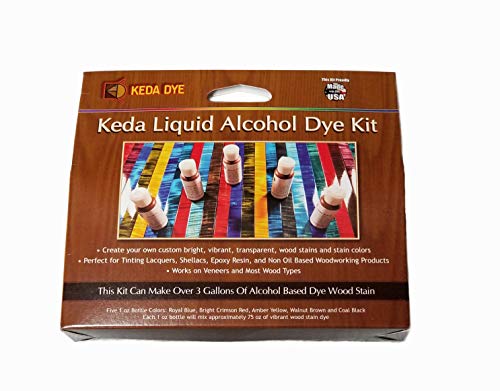
Keda Vibrant Liquid Alcohol Wood Dye Kit

Keda Walnut Brown Alcohol-Based Liquid Dye

Jacquard Basic Dye Set (.5oz, 8-Pack)

Rustins Wood Dye Dark Oak 250ml
Boncart Water-Based Wood Stain (Teak)

spot. Dark Brown Wood Stain Repair Kit

Transol Powdered Solvent Wood Dye Kit (50g)

General Finishes Water Based Dye (Light Brown)
More Details On Our Top Picks
Water-based color is the gentlest entry point into aniline-style staining, and this teak shade from DWIL is built around that idea. A single coat is designed to deliver a matte finish that lets grain texture show through, which matters when you’re reviving a tired dresser top rather than hiding it under pigment.
The low-odor profile makes it realistic for apartment dwellers or anyone working in a shared garage where solvent fumes aren’t welcome. Cleanup is soap and water, so a Saturday afternoon project doesn’t turn into a ventilation headache.
Strong Points
- One-coat application saves time on larger pieces like cabinets or paneling.
- Low odor means you can stain indoors without clearing the house out.
- Matte result keeps the natural feel of the wood rather than a plasticky sheen.
- Works on both interior and exterior furniture, from patio chairs to doors.
Things To Consider
- Water-based formulas can raise grain slightly on some species, so a light sand between coats is worth planning for.
- An 8.5oz bottle covers smaller projects; big tabletops may need more than one.
Who It Suits Best
Beginners refreshing indoor furniture who want forgiving application and minimal fumes.
A Better Fit Elsewhere
Shoppers needing deep, translucent penetration on raw hardwood will get richer results from the Keda Vibrant Liquid Alcohol Wood Dye Kit.
Powder dyes are the traditionalist’s route: you dissolve them yourself in alcohol or another solvent, which gives you total control over strength. Transol ships five colors here, yellow, red, brown, blue, and black, each in its own resealable bag at 5 grams apiece.
That resealable packaging matters more than it sounds. Powder absorbs moisture and clumps, so being able to close each bag properly extends shelf life between projects. Blending the primaries lets you dial in custom tones that off-the-shelf stains never quite hit.
What We Like
- Five intermixable colors open up nearly unlimited custom shades.
- Resealable bags keep unused powder dry and usable for future jobs.
- You control concentration, so one kit serves both subtle washes and deep tones.
Minor Gripes
- You’ll need to supply your own solvent and mix carefully; undissolved powder leaves specks.
- Solvent handling means decent ventilation is non-negotiable in a small shop.
Right Fit For
Tinkerers who enjoy mixing their own colors and want maximum flexibility per dollar spent.
Where A Sibling Pick Shines
Heavier users burning through dye regularly should step up to the Transol Powdered Solvent Wood Dye Kit (50g) for double the supply.
This is the kit serious woodworkers point beginners toward once they out of craft-store stains. Five one-ounce liquid concentrates arrive ready to dilute, and the manufacturer states the full set yields up to 2.5 gallons of dye stain when mixed with denatured alcohol or lacquer thinner. That’s a lot of finishing capacity from bottles that fit in a drawer.
The versatility is the real story. These dyes tint not just wood but also lacquer, shellac, epoxy, and polycrylic, so you can color-match a repair filler to the surrounding finish. Compared with the Transol powders earlier in this list, you skip the dissolving step entirely, though you trade some shelf-stability for convenience.
Highlights
- Up to 2.5 gallons of finished stain from five small bottles.
- Doubles as a tint for shellac, epoxy, and water-based topcoats.
- Mixes readily with alcohol, acetone, or lacquer thinner depending on your workflow.
- Vivid organic pigments penetrate deeply for translucent, grain-showing color.
Small Caveats
- Alcohol-based mixes flash off fast, so work quickly on large panels to avoid lap marks.
- Concentrate strength takes practice; test on scrap before committing to a showpiece.
Quick Facts
Made For
Intermediate DIYers and furniture restorers who want pro-level transparency and huge yield from a compact kit.
Swap It Out When
Anyone needing just one dependable dark tone will find the Keda Walnut Brown Alcohol-Based Liquid Dye simpler than managing five colors.
Walnut brown is the workhorse tone of American furniture, and this single-color concentrate exists precisely because so many restorations call for it. One ounce stretches into two quarts of finished dye stain, which comfortably handles a dining set or a run of cabinet doors.
Like its five-color sibling reviewed above, it plays nicely with lacquers, shellac, epoxy, and both solvent and water-based sealers. That cross-compatibility means you can tint a patching compound to disappear into an existing walnut finish, something pigment-heavy stains struggle to do.
Upsides
- Each ounce yields up to two quarts of usable stain.
- Intermixable with other Keda shades for fine-tuned browns.
- Tints shellac, epoxy, and polycrylic for invisible repairs.
- Alcohol carrier evaporates cleanly without blotching on most hardwoods.
Points To Note
- Fast-evaporating solvents demand quick, confident brushwork on wide surfaces.
- Store the bottle tightly sealed; solvent dyes thicken when left open.
At A Glance
Whose Shelf It Belongs On
Restorers matching existing walnut furniture or building new pieces in classic dark tones.
Consider Something Else When
First-timers wanting room to experiment across several hues will get more mileage from the full Keda Vibrant Liquid Alcohol Wood Dye Kit.
Jacquard built its reputation on fabric dye, and this basic cationic dye set carries that heritage into a compact eight-shade package. Each half-ounce jar holds bright powder formulated for materials that normally resist coloring, which explains why mixed-media artists reach for it beyond pure woodworking.
In a wood context, treat this as an experimental palette rather than a production stain. The vivid hues suit small decorative pieces, turned bowls destined for display, or craft projects where bold color is the point. At half-ounce portions, the commitment per color stays low while you learn how basic dyes behave.
Bright Spots
- Eight distinct shades give a genuine playground for color testing.
- Half-ounce jars keep cost and waste down during experimentation.
- Strong performance on hard-to-dye surfaces expands creative options.
Softer Spots
- Powder form requires careful dissolving; clumps show up as spots on smooth wood.
- Not positioned as a dedicated wood stain, so results vary by species and prep.
Who Should Grab It
Crafters and mixed-media makers exploring dyed accents on small wooden objects.
Another Choice May Suit
Woodworkers after reliable furniture coverage will be better served by the Rustins Wood Dye Dark Oak 250ml further down this list.
Rustins has long been a fixture in British workshops, and this 250ml dark oak dye shows why. It’s a solvent-based penetrating stain engineered to dry fast without raising the grain, which eliminates the most annoying step in water-based workflows: re-sanding fuzzy raised fibers before topcoating.
The brand offers eleven true natural wood shades across the range, and they’re formulated to intermix, so dark oak can be nudged warmer or cooler by blending with a neighboring tone. Interior and exterior use are both sanctioned, making it practical for garden benches as well as interior trim.
Reasons To Buy
- No grain raise means less sanding between dye and finish.
- Fast-drying formula keeps multi-step projects moving in one session.
- Eleven-shade system allows precise custom blending.
- Suitable indoors and out, from furniture to exterior joinery.
Worth Noting
- Solvent base calls for good airflow and careful brush cleanup.
- Dark oak runs deep; lighter woods may need thinning for a subtler wash.
Details At A Glance
Best Suited To
Traditionalists refinishing oak furniture or exterior joinery who value speed and a flat, grain-honest result.
Reach For A Different Pick When
Low-fume indoor work matters most; the DWIL Water Based Wood Stain (Teak, 8.5oz) handles enclosed spaces far more comfortably.
Boncart’s teak stain occupies very similar territory to the DWIL pick near the top of this list, with a water-based, high-concentration formula aimed at raw or lightly colored wood. Where it tries to differentiate is longevity: the manufacturer emphasizes fade resistance, which matters for pieces living near sunny windows.
Application targets uniform color distribution, and owners commonly report that thin, even coats beat heavy flooding on pale species like pine. The 8.45 fl oz bottle suits medium projects such as nightstands, shelving, or a set of picture frames.
Plus Points
- Fade-resistant pigment keeps window-side furniture looking fresh longer.
- High concentration delivers strong permeation into bare wood.
- Even coloring reduces blotching on absorbent species.
Trade Offs
- Designed for unpainted or light raw wood; already-dark pieces won’t take much change.
- Single-bottle sizing means repurchasing for bigger builds.
The Right Fit
Home decorators updating light pine or unfinished plywood pieces in bright rooms.
Look Elsewhere When
You want a proven one-coat matte workflow; the DWIL Water Based Wood Stain (Teak, 8.5oz) remains the smoother first pick for that scenario.
Most dye kits assume you’re starting from bare wood. This four-bottle kit from spot. assumes the opposite: your walnut table already has scratches, and you need color that sinks into damaged areas instead of sitting on top like a marker would. Provincial, dark walnut, ebony, and red mahogany cover the common dark-finish family.
The precision brushes are the reason this earns a slot. Touch-up work lives or dies on placement, and a fine tip lets you feather color along a scratch line rather than blobbing it. Four fluid ounces total sounds modest until you remember repairs use drops, not cups.
Standout Traits
- Penetrating formula blends into grain rather than coating it.
- Four mixable dark tones match most existing furniture finishes.
- Brush-on bottles give surgical control on scratches and worn edges.
- Rated for interior and exterior wood, so deck furniture qualifies too.
Areas To Watch
- Total volume suits repairs only; full refinishing needs a larger-format dye.
- Color matching takes patience; blend gradually and test in a hidden spot first.
Core Details
Perfect Match For
Homeowners maintaining dark-stained furniture, cabinetry, and doors against everyday wear.
Where Another Pick Suits Better
Full-piece refinishing calls for the General Finishes Water Based Dye (Light Brown), whose quart format handles broad surfaces efficiently.
Same five-color lineup as the 25-gram Transol kit covered earlier, doubled to 10 grams per shade. The logic is straightforward: anyone who has gone through a small powder kit knows the frustration of running out mid-blend, especially with black and brown, the two shades every custom mix leans on hardest.
Everything else carries over. Colors ship in individual resealable bags, dissolve into solvent-based solutions, and combine freely for bespoke tones. In our view, the larger kit only makes sense once you’ve confirmed powder dye fits your workflow; start small otherwise.
Positives
- Double quantity supports multiple large projects or frequent use.
- Five intermixable primaries enable precise custom shading.
- Resealable storage protects powder between sessions.
Honest Caveats
- Still requires your own solvent, mixing vessels, and patient stirring.
- Overkill volume for occasional crafters who stain once or twice a year.
Feature Rundown
Built With In Mind
Regular refinishers and small-shop woodworkers producing dyed pieces week after week.
Not Your Match When
Occasional users should stick with the 25-gram Transol Powdered Solvent Wood Dye Kit and upgrade only when supply actually runs short.
General Finishes approaches water-based dye from the professional side: a full quart of light brown concentrate engineered to behave like a solvent stain despite its friendlier chemistry. Deep, rich tones are the stated goal, with grain enhancement rather than grain hiding.
Flexibility in application sets it apart from the small-bottle picks above. Foam brush, rag, pad applicator, or sprayer all work, which makes it genuinely viable for built-ins and door runs where brushing alone gets tedious. Cleanup stays water-based, keeping the workshop tolerable.
Best Bits
- Quart size covers substantial projects without constant repurchasing.
- Multiple application methods suit both hand workers and spray setups.
- Solvent-like penetration delivers depth typical of oil-era dyes.
- Rich tones emphasize figure on open-grained species.
Room For Improvement
- Light brown is a specific tone; darker projects may need layering or a different shade.
- Quart volume is more than casual crafters will use before it ages.
Spec Overview
Who Will Love This
Woodworkers tackling cabinetry, millwork, or furniture batches who want pro-grade results with water cleanup.
Skip It When
Small decorative projects fit the Keda Walnut Brown Alcohol-Based Liquid Dye’s ounce-sized economy much better.
Choosing Between Aniline Dyes Without Regret
Match The Base To Your Workspace
Solvent and alcohol dyes penetrate deepest and dry fastest, but they demand ventilation and careful handling. Water-based options trade a little depth for low odor and easy cleanup, which makes them the sensible default for apartments, basements, and homes with kids or pets around.
Think In Yield, Not Bottle Size
A one-ounce concentrate that makes two quarts beats a pint of pre-mixed stain on both cost and storage. Check the manufacturer’s stated yield before comparing containers; dye economics look nothing like paint economics.
Prep Determines Everything
Dyes amplify whatever the surface already looks like, including sanding scratches and glue squeeze-out. Sand progressively to at least 180 grit, wipe away dust, and always test on scrap from the same board. Grain-raising formulas reward a light intermediate sand before topcoat.
Plan Your Topcoat Together
Some dyes tint shellac, epoxy, and polycrylic directly; others don’t play well with oil-based finishes. Confirm compatibility before you commit, because a mismatched topcoat can lift or streak hours of careful coloring work.
Key Considerations Across These Picks
Traps First Timers Fall Into
The biggest mistake is skipping the scrap-board test. Dye reads dramatically differently on oak than on maple, and blotching on pine surprises people every time. Another common slip is buying a huge quantity before confirming the color; start small, then scale up once the shade is locked in.
The Case For Spending Up
Higher-tier concentrates cost more upfront but stretch into gallons of finished stain, dropping the per-project cost sharply. Concentrated formats also store compactly and let you adjust strength batch by batch, which pre-mixed stains simply can’t offer.
Frequently Asked Questions
What makes an aniline dye different from regular wood stain?
Aniline dyes dissolve fully and penetrate the wood fibers themselves, producing transparent color that showcases grain. Pigment-based stains sit partly on the surface, which can obscure the wood’s natural figure.
Can I mix different dye colors together?
Yes, provided both colors share the same base chemistry, such as two alcohol-soluble powders. Mixing across bases, like water-based with solvent-based, usually causes clumping or uneven color.
Do aniline dyes fade in sunlight?
Many traditional dyes are more light-sensitive than pigment stains, so windowside furniture may shift tone over years. A UV-filtering topcoat slows this considerably.
How do I clean up after using solvent-based dyes?
Brushes and rags typically clean up with the same solvent used for mixing, such as denatured alcohol. Work in a ventilated area and let soaked rags dry flat before disposal.
Can I apply a topcoat straight over dye?
Yes, once the dye is fully dry, which solvent types reach quickly. Always confirm your specific topcoat is compatible with the dye’s base before committing to the whole piece.
Bottom Line
Your best choice comes down to workspace and ambition. Low-fume water-based picks like DWIL and General Finishes suit home interiors, while Keda’s concentrates deliver pro-grade depth for restorers. Match the format to your project scale, test on scrap first, and any of these ten will serve you well.
