
One-year-olds don’t color inside lines, they explore. Hand a toddler a crayon and you’ll get scribbles on paper, hands, the table, and occasionally the wall. The right art supplies make that chaos productive instead of stressful: chunky grips that fit small fists, washable formulas that forgive accidents, and surfaces that hold up to enthusiastic pounding. This roundup covers ten options built specifically for that first year of making marks, from finger paint kits to palm-grasp crayons. Each one was chosen for safety-minded materials, toddler-friendly sizing, and how easily it cleans up afterward.
The Lineup, Simplified

Funto Kids Washable Finger Paint Set, 25 PCS

Mr. Pen Finger Paint Paper Pad, 11 x 14 Inches

JUPITEARTH Egg Crayons for Toddler 1-3, 6 Colors
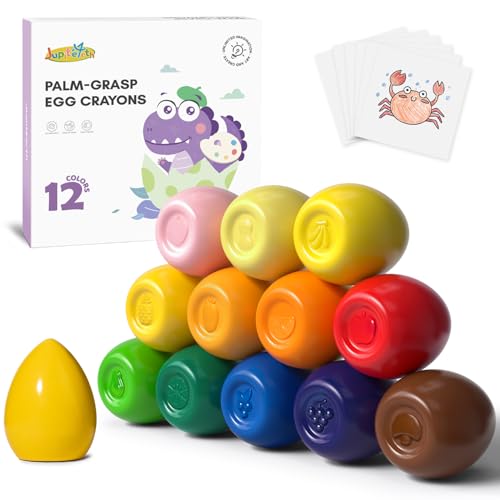
JUPITEARTH 12 Colors Egg Crayons for Toddlers 1-3

My First Coloring Book for Toddlers (Kids 1-3)

MIROLA KIDS Pure Beeswax Crayons, 12 Colors

Momo & Nashi Dot Markers For Toddlers 1-3

Honeysticks My First Paint Brush Set (3 Pack)

READY 2 LEARN Triangle Grip Toddler Paint Brushes

JoyCat 16 Colors Jumbo Crayons for Toddlers 1-3
More Details On Our Top Picks
Most starter art kits hand you paints and nothing else, then you’re hunting for paper mid-meltdown. This 25-piece set bundles washable finger paints with a paper roll, brushes, palette, sponge tools, stamps, roller sponges, and a storage bag, so the whole session lives in one place.
The varied tool shapes matter more than they sound. A one-year-old pressing a sponge stamp learns texture in a way a plain brush can’t teach, and the storage bag keeps pieces from migrating under the couch between sessions.
A Few Highlights
- Everything arrives in one box, so no separate paper or brush purchase is needed before the first session.
- Washable paint formulas mean a painted palm wipes off skin and most clothing without a battle.
- Sponge stamps and rollers introduce texture play that plain brushes can’t offer at this age.
- The included storage bag corrals small parts, which matters once cleanup time comes.
Things To Consider
- Finger paint sessions are inherently messy, so plan for a wipeable surface and a smock regardless of how washable the formula claims to be.
- With 25 pieces in circulation, some smaller items tend to go missing over months of use, based on what owners commonly report.
Key Specs
Made For
Parents starting structured art time with a one- to three-year-old who want a single purchase that covers an entire creative routine.
A Better Fit Elsewhere
Already own paints and just need a surface? The Mr. Pen Finger Paint Paper Pad covers that gap for less fuss.
Regular printer paper buckles and tears the moment wet paint hits it, which ends sessions early. This pad uses heavy-weight white stock sized at 11 by 14 inches, giving a toddler room to spread both arms while still fitting a kitchen table.
The larger format also means one sheet absorbs a longer session. Where the Funto kit bundles everything, this pad solves only the surface problem, and it does that job well with 22 sheets per pad.
Benefits That Matter
- Heavy-weight sheets resist bleeding and tearing under soggy, enthusiastic brushwork.
- The 11 x 14 size gives little artists genuine elbow room compared to standard letter paper.
- Acid-free stock keeps finished artwork from yellowing, so grandparents’ fridge displays last.
- A glued pad tears off cleanly sheet by sheet, no scissors required.
Small Caveats
- This is paper only, so you’ll need paints or crayons separately unless you already own them.
- Twenty-two sheets go quickly with a daily painter, and reordering becomes part of the routine.
Who It Suits Best
Families who already have paints or crayons and keep running out of paper that survives wet media.
Swap It Out When
Starting completely from zero makes more sense with the Funto Kids Washable Finger Paint Set, which includes its own paper roll alongside the paints.
Standard thin crayons frustrate one-year-olds because their whole-hand grip can’t control something narrow. These egg-shaped crayons fix that with an enlarged diameter designed for palm grasping, the fisted hold nearly all young toddlers use naturally.
The six colors come printed with fruit and vegetable patterns, which turns coloring into a quiet naming game during the session. Six colors sounds limiting next to the JoyCat’s sixteen, but for a brand-new artist, fewer choices often mean fewer scattered crayons on the floor.
Where It Delivers
- The wide egg shape fits a whole-hand grip, building early control without coaching.
- An increased diameter reduces choking concerns compared to slim crayon sticks.
- Fruit and veggie patterns double as early vocabulary practice while coloring.
- Smooth surfaces feel comfortable in small, still-clumsy hands.
Points To Note
- Six colors runs out of novelty faster than bigger sets once your child passes the eighteen-month mark.
- Egg crayons have no wrapper to peel, so worn-down nubs eventually need replacing rather than sharpening.
Right Fit For
Twelve- to eighteen-month-olds taking their very first cracks at drawing, especially those still using a full-fist grip.
Where A Sibling Pick Shines
Older toddlers ready for more shades will get longer mileage from the JUPITEARTH 12 Colors Egg Crayons later in this list.
Same egg-shaped concept as the six-color version above, doubled to twelve shades and rated for ages one through four. That wider age window matters: a set bought at twelve months still gets used at three, when your child starts asking for specific colors by name.
The palm-grasp geometry stays identical, with the smooth rounded body encouraging a grip position that later transfers to pencils. Twelve distinct hues also support simple sorting games, matching crayon to picture, which stretches the toy beyond pure coloring.
The Practical Payoff
- Twelve colors cover mixing experiments and naming games that six shades can’t sustain.
- The age-one-to-four rating gives this set a multi-year lifespan most toddler art lacks.
- Rounded bodies promote a grip posture that eases the eventual move to standard pencils.
- Larger diameter design addresses choking worries common with thin crayons.
Honest Caveats
- Twelve loose eggs create more floor-scatter than a boxed set, so a small bin helps.
- Like most toddler crayons, heavy pressure leaves residue on tables, and owners commonly report wiping down surfaces after each session.
Feature Snapshot
Whose Shelf It Belongs On
Toddlers between one and two who’ve outgrown basic scribbling and want real color variety without losing the easy grip.
Another Choice May Suit
Very young one-year-olds still mouthing everything may suit the MIROLA KIDS beeswax crayons better, thanks to their natural wax build.
Every other item here supplies the medium; this book supplies the structure. Jonas Jansen’s coloring book offers 55 large, simple motifs drawn for one- to three-year-olds, printed on a soft cover in a compact 8.5-inch square format that small laps handle comfortably.
The one-sided printing is the detail worth noticing. Wet markers or heavy crayon pressure won’t bleed through onto the next picture, so each page stays presentable even when your toddler goes overboard with a dot marker.
The Value In It
- 55 oversized motifs give simple shapes a one-year-old can actually attempt to fill.
- Single-sided pages prevent show-through, protecting the following picture from marker soak.
- The 8.5 x 8.5 inch format sits easily on a highchair tray or car seat lap.
- Large designs quietly build motor skills without any instruction needed.
Less Ideal Details
- A coloring book pairs with nothing on its own, so budget for crayons or markers separately.
- Fifty-five pages finish eventually, unlike reusable boards, though the price of replacing it stays modest.
Perfect Match For
Quiet-time routines, waiting rooms, and travel days where a calm, contained activity beats open-ended mess.
Reach For A Different Pick When
Open-ended free drawing appeals more to your child, the JoyCat jumbo crayons paired with plain paper offer unlimited freedom.
Material choice separates this set from the JUPITEARTH eggs. These twelve crayons are built from pure natural beeswax with food-grade pigments, aimed squarely at babies past their first birthday who still explore objects with their mouths.
The bundle also includes access to 108 printable coloring pages, which stretches the value well beyond the physical crayons themselves. Beeswax glides differently than paraffin too, laying down saturated color with less pressure, which suits unsteady toddler strokes.
Useful Strengths
- Pure beeswax construction with food-grade pigments offers peace of mind during the mouthing stage.
- Highly saturated color payoff means light pressure still produces bold marks.
- The washable finish simplifies cleanup from skin, tables, and most fabrics.
- Access to 108 printable coloring pages extends the set’s usable life considerably.
What To Weigh
- Beeswax softens in warm cars or sunny windowsills, so storage away from heat preserves the shape.
- Printing 108 pages at home consumes your own ink and paper over time.
Core Details
Who Will Love This
Parents prioritizing natural materials above all else, particularly for children around the one-year mark who still taste-test their toys.
Consider Something Else When
Durability against hard throws matters more than material purity, and the JoyCat jumbo crayons are engineered specifically not to snap.
Dot markers, sometimes called bingo daubers, dispense paint through a round foam tip with one press. No dragging, no strokes, just satisfying circles, which is why they click so early with toddlers who haven’t mastered directional control yet.
This eight-marker set ships with ten printed activity sheets, 150 printable PDF pages, a stencil plate, and two spare foam tips. Compared to the bare-bones Honeysticks brushes below, it’s a full curriculum in a box, blending counting, color recognition, and hand-eye coordination practice into the fun.
Useful Touches
- Jumbo 40ml barrels are sized for small hands and last through many sessions before refills matter.
- Printed plus printable sheets mean the activities start immediately and keep going for months.
- Washable ink forgives the inevitable dots on fingers, faces, and tabletops.
- Spare foam tips extend marker life once the originals wear fuzzy.
Details To Watch
- Markers need recapping tightly after use or the foam tips dry out, a habit younger siblings haven’t learned yet.
- Dot art rewards pressing straight down, so children wanting sweeping strokes will prefer brushes or crayons.
Best Suited To
Parents layering preschool-style learning into play, especially two- to three-year-olds practicing counting and color names.
Not Your Match When
A one-year-old focused purely on sensory finger painting will get more from the Funto finger paint set’s hands-on approach.
Adult paintbrushes are essentially sticks to a one-year-old. Honeysticks redesigned the tool around that reality, with a large chunky wooden handle shaped for small fists and better control than standard slim brushes allow.
Three brushes arrive in the pack, which is the right number in practice: one in use, one drying, one lost under the highchair. There’s real charm in how uncomplicated this set is, no batteries, no refills, just wood and bristles doing their job.
The Case For It
- Oversized wooden handles give small hands genuine leverage and steadier strokes.
- The ergonomic shape supports proper brush control earlier than standard brushes manage.
- Three brushes let you rotate through wash cycles without pausing playtime.
- Rated for ages one and up, matching the earliest painting stage directly.
Room For Improvement
- These are brushes only, so pair them with washable paints like the Funto set includes.
- Wooden handles need thorough drying after washing to avoid swelling or cracking over time.
Who Should Grab It
Families introducing brush painting for the first time, where grip comfort determines whether the experience lands well.
Skip It When
Multiple kids painting side by side need more brushes, and the READY 2 LEARN six-pack covers group settings better.
Where Honeysticks goes chunky-round, READY 2 LEARN goes triangular. The three-sided rubber handle naturally positions little fingers into a tripod-like hold, the same grip pattern occupational therapists encourage for pre-writing skills.
Six brightly colored brushes come in the pack, enough for playdates, daycare-style sharing, or simply surviving the great disappearing-brush phenomenon. A clever bonus: the flat triangle sides stop the brushes rolling off the table between dips.
Notable Gains
- Triangle grips guide fingers toward the pincer positioning used later for pencils.
- Flat sides prevent roll-away losses, saving constant floor retrievals during sessions.
- Six brushes accommodate sibling painting or small group crafts without arguments.
- Thick bristles hold plenty of paint, reducing frustrating mid-stroke reloads.
Factors To Consider
- Rubber handles should be rinsed and dried after each session to keep them hygienic.
- Triangular shaping feels different from round handles, and a few children take a session or two to adjust.
The Right Fit
Playgroups, twins, and craft-heavy households where several children paint at once and grip development is a priority.
Look Elsewhere When
A single child needs just one dependable first brush, and the simpler Honeysticks three-pack keeps things minimal.
Toddler crayons usually die by snapping, dropped from highchair height onto hard floors until only stubs remain. JoyCat attacks that failure mode directly with a high-density formulation engineered to resist breaking even after repeated falls.
You also get sixteen colors here, the widest range in this roundup, wrapped in jumbo triangular barrels that discourage rolling and encourage a correct grip. Against the softer beeswax MIROLA set, these trade natural material for sheer toughness, a trade many households happily make by month eighteen.
What Pays Off
- High-density construction survives drops that shatter ordinary crayons, stretching replacement intervals dramatically.
- Sixteen colors satisfy demanding toddlers who ask for purple specifically.
- Triangular anti-roll barrels stay put on tables and train a proper grip simultaneously.
- Washable pigment cleans off skin and most surfaces with ordinary wiping.
Trade Offs To Consider
- Sixteen crayons mean sixteen potential floor hazards, so a lidded container earns its keep.
- Jumbo tips lay down broad strokes, which limits detailed coloring as fine motor skills mature.
At A Glance
Who It Suits Best
Strong-gripped, high-energy toddlers past the mouthing stage who treat every crayon like a hammer.
Another Choice May Suit
Mouthing-stage one-year-olds belong with the MIROLA KIDS beeswax crayons, whose food-grade pigments suit that phase better.
What Matters Most Before Choosing Art Supplies For 1 Year Old
Safety Comes Before Everything Else
At twelve months, everything travels toward the mouth. Look for non-toxic labeling, food-grade pigments, and chunky diameters that can’t lodge in a small throat, the approach both JUPITEARTH sets take with their enlarged eggs. Washability ranks second for purely practical reasons: paint on a sleeve shouldn’t end the afternoon.
Grip Shape Shapes Everything Downstream
A one-year-old holds tools with the whole fist, so slim adult crayons fail immediately. Palm-grasp eggs, jumbo triangles, and fat brush handles all work with that natural hold instead of against it. Tools that gently steer toward a tripod grip, like the READY 2 LEARN triangles, pay dividends when pencil training starts around age three.
Match The Mess To Your Space
Finger paints demand a wipeable surface and a smock; crayons and dot markers contain themselves far better. Apartment dwellers and winter-bound families often lean toward drier media, while homes with a dedicated craft zone can embrace the full Funto-style paint experience.
Think In Months, Not Sessions
The best toddler art purchases survive developmental leaps. A twelve-color egg set rated to age four outlives a six-color version, and durable crayons outlast fragile ones by whole seasons.
Key Considerations Across These Picks
Traps First Timers Fall Into
The classic error is buying beautiful, precise art sets meant for older children, then watching frustration replace fun. Thin crayons snap, fine-tip markers dry out uncapped, and intricate kits overwhelm. Another slip: skipping the washability check, then discovering paint permanence the hard way on a favorite outfit.
When Paying More Pays Off
Higher-tier items earn their cost through materials and longevity. Beeswax crayons cost more than paraffin but suit mouthing toddlers, and snap-resistant formulations outlast cheap sticks several times over. Spending up makes sense once daily use becomes routine; for occasional weekend crafting, budget options serve perfectly well.
Frequently Asked Questions
What art supplies are safe for a 1 year old?
Choose non-toxic, washable products with large parts that can’t be swallowed, such as jumbo egg crayons or chunky brushes. Always supervise sessions, since supervision remains the primary safety measure at this age.
Can a 1 year old actually use crayons?
Yes, though expect fist-grip scribbles rather than controlled drawing. Palm-grasp crayons with thick diameters are designed precisely for this developmental stage.
Are finger paints messy to clean up?
They’re the messiest option in this category, but washable formulas remove from skin and most fabrics with soap and water. A plastic mat and smock contain most of the chaos.
How many colors does a toddler need?
Six to twelve colors covers the first year of coloring comfortably. Larger sets add naming and sorting games once your child approaches age two.
What’s the best first art supply to buy?
A jumbo crayon set is the simplest entry point: minimal setup, minimal mess, immediate results. Add paints and brushes once the crayon habit sticks.
Closing Thoughts
Start small, expect scribbles, and let the mess be part of the lesson. One good crayon set and a stack of sturdy paper will carry a one-year-old further than any elaborate kit, and you can expand into paints and dot markers as interest grows. Whatever you choose, the goal isn’t gallery-worthy output, it’s a child who associates creating with joy.
