
Twelve is a funny age for art. Kids this age have real opinions about their work, so flimsy crayons and paper pads stop cutting it fast. The right kit keeps them creating instead of frustrated, whether they sketch at the kitchen table or paint on their bedroom floor. This list covers ten options built for that in-between stage, from full painting setups to clever tools like light pads and texture kits.
The Picks In Brief
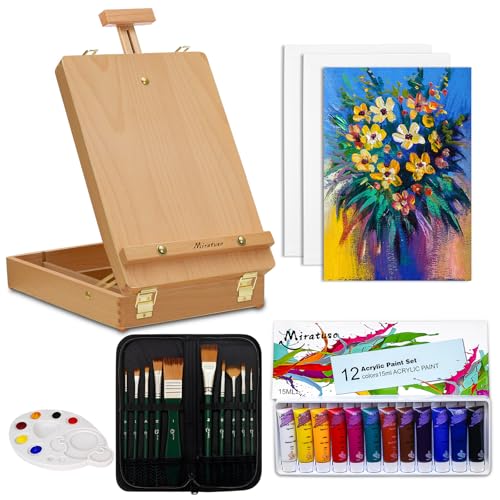
Miratuso 27 Pcs Art Set with Tabletop Easel

PANDAFLY 80 Drawing Set Sketching Kit

YINGWOND Rechargeable A4 LED Light Pad

AKUBLE Glitter Outline Markers, 12 Colors

KALOUR 154PCS Artists Art Supplies Drawing Kit

MMARTE 59pcs Acrylic Paint Set with Easel (Red)

koseibal Acrylic Paint Set with Tabletop Easel

Art for Kids: Drawing (Volume 1)

Shuttle Art 44 Pcs Magic Foam Texture Painting Kit

Heshengping 41pcs Sketching Pencil Set
More On The Choices That Made The List
A kid who has never painted before needs two things: decent tools and a place to put them. This Miratuso set handles both, pairing a beech wood sketchbox easel with twelve acrylic colors, ten brushes, three canvas panels, and a palette. The easel adjusts in height and holds canvas up to about 20.5 inches tall.
In a small bedroom or shared study space, that tabletop footprint matters. Everything packs into one box, so cleanup means closing a lid rather than hunting stray brushes under the bed.
What Stands Out
- The adjustable beech wood easel gives a proper painting angle without hogging floor space.
- Ten brushes cover detail work through broad strokes, so no separate brush purchase is needed.
- Acrylics dry quickly, which suits impatient creators who want finished pieces the same day.
- One self-contained case keeps the whole setup portable between rooms or houses.
Small Caveats
- Twelve paint colors run out faster than you’d expect once painting becomes a daily habit.
- Wooden easels need occasional tightening of joints, something owners commonly mention over time.
Who Should Grab It
A twelve-year-old picking up acrylic painting for the first time who wants a real studio feel in a compact package.
Where A Sibling Pick Shines
Families wanting washable paints and an apron for messier sessions will get more from the MMARTE 59pcs Acrylic Paint Set further down this list.
Some kids outgrow coloring books and start chasing shading, highlights, and metallic accents. This eighty-piece PANDAFLY kit speaks directly to them. It stacks graphite sketching pencils against charcoal, watercolor pencils, oil-based colored pencils, metallic pencils, and white charcoal for highlights, all alongside a three-color sketchbook.
The extras are what make it feel grown-up. A refillable water brush pen turns the watercolor pencils into paint-like washes, while a kneaded eraser lifts graphite gently instead of smearing it. Compared with the Miratuso easel set above, this one trades paint for pure drawing depth.
The Good Stuff
- Watercolor pencils plus a water brush pen let one tool behave like two different mediums.
- White and black charcoal together teach real contrast skills early.
- Metallic and colored charcoal pencils add flair for fantasy and anime-style art, hugely popular at this age.
- A vinyl eraser and kneaded eraser handle both bold corrections and delicate lifting.
Points To Note
- Eighty pieces mean plenty of small items to keep track of between sessions.
- Charcoal smudges easily, so finished pages need a fixative spray or careful storage.
Made For
A tween already serious about drawing who wants to experiment across graphite, charcoal, and water-soluble color without buying five separate sets.
Swap It Out When
Total beginners may find the Heshengping 41pcs Sketching Pencil Set less overwhelming, since it trims the lineup down to core essentials.
A light pad is a slim, glowing panel that shines through paper so kids can trace images or see diamond-painting patterns clearly. What separates this YINGWOND model from cheaper plug-in versions is the battery: roughly two hours of charging buys four to six hours of cordless use.
That freedom changes where art happens. Tracing can move to the couch, the car, or a friend’s house without hunting for an outlet. Six brightness levels help too, since thin paper needs less glow than thick cardstock. The padded zip case with a shoulder strap shows someone actually thought about how kids carry things around.
Useful Strengths
- Cordless operation after a short charge makes it genuinely portable.
- Six brightness settings adapt to different paper weights and room lighting.
- Riser stands improve viewing angles during long diamond-painting sessions.
- The anti-scratch lined case protects the screen in backpacks.
Things To Consider
- It draws rather than teaches, so pair it with a book or tutorial for skill growth.
- Battery capacity fades over years of charging cycles, which is normal for any rechargeable device.
Right Fit For
Kids obsessed with diamond painting, calligraphy, or tracing who want to create anywhere in the house.
Another Choice May Suit
Children still learning fundamentals will benefit more from the structured lessons inside Art for Kids: Drawing later in this list.
These markers do something unusual: each stroke lays down two colored edges with a shimmery silver line running between them. Twelve bright shades cover cards, journal margins, and poster lettering, and the effect looks far fancier than the effort involved.
For a twelve-year-old decorating a notebook or making birthday cards, that instant wow factor counts for a lot. Quick-drying ink helps too, since left-handed writers and impatient artists alike avoid the smear problem that plagues slower gel pens. Unlike the pencil-heavy kits on this list, these are pure fun with zero learning curve.
The Value In It
- The double-line shimmer effect makes ordinary doodles look professionally decorated.
- Fast-drying ink cuts down on smudged pages and frustrated redos.
- Works well on cards, scrapbooks, and journal spreads where sparkle sells the design.
Less Ideal Details
- Markers need caps clicked on tightly or they dry out, a commonly reported issue with glitter pens.
- Twelve colors go quickly on large posters, so heavy users may want a backup set.
Who Will Love This
Crafty tweens who fill journals, design greeting cards, and care more about sparkle than technique.
Reach For A Different Pick When
Kids wanting a bigger creative project should try the Shuttle Art foam texture kit next, which turns marker fun into raised 3D artwork.
Think of this as the whole art store in one case. KALOUR packs 154 pieces spanning graphite, colored, charcoal, watercolor, and metallic pencils, plus pastels, watercolor cakes, six sketchbooks, a tutorial booklet, and coloring paper. Where the PANDAFLY kit focuses on drawing, this one refuses to pick a lane.
That breadth suits a twelve-year-old whose interests shift monthly. One week it’s pastel landscapes, the next it’s watercolor comics, and nothing new needs buying. The included tutorial gives structure, which matters because a pile of supplies without direction often sits untouched.
Features That Help
- Six sketchbooks mean no mid-project scramble for paper.
- Pastels, watercolor cakes, and five pencil types cover nearly every dry and wet medium.
- The bundled tutorial turns raw materials into guided practice.
- Coloring paper adds a low-pressure entry point on low-energy days.
What To Weigh
- At 154 pieces, restocking and organizing take some discipline.
- Jack-of-all-trades sets rarely include pro-grade quantities of any single medium.
Best Suited To
An ambitious young artist sampling multiple mediums who wants one comprehensive kit instead of a growing shelf of partial ones.
Consider Something Else When
A child committed purely to painting will use the MMARTE acrylic set more fully than this drawing-weighted collection.
Paint on skin, paint on sleeves, paint somehow on the dog. The MMARTE set plans for all of it. Its twenty-four acrylic colors wash off skin and clothing, and the bundle adds an apron with sleeves for extra defense. Parents reading this section are nodding already.
The kit itself is generous: a solid beech wood easel requiring no assembly, thirteen brushes including sponge styles, seven canvases across several sizes, a canvas pad, palette, and a carrying case. Next to the slimmer Miratuso set, you trade fewer colors for washability and far more surfaces to paint on.
Standout Benefits
- Washable paints turn accidents into non-events for parents.
- The pre-assembled beech easel works straight out of the case.
- Seven-plus painting surfaces keep sessions going for weeks.
- Sponge brushes invite texture play beyond standard stroke work.
Practical Considerations
- Washable formulas are slightly less pigment-dense than artist-grade acrylics.
- Brushes need prompt rinsing or bristles stiffen permanently.
Who It Suits Best
Households sharing space with enthusiastic, messy painters who want creativity without laundry anxiety.
Not Your Match When
Older teens producing portfolio pieces may prefer the richer pigment load of the koseibal set coming up next.
This is the sensible middle ground of the painting kits here. Eighteen acrylic colors, eight brushes, four stretched canvases, three panels, a multi-function wooden table easel, a plastic palette, and a fifteen-sheet acrylic pad arrive in one box. Nothing is missing, and nothing feels padded out with filler.
Compared with the MMARTE kit, you give up washable paint and the apron but gain stretched canvases suited to display-worthy work. For a twelve-year-old moving from craft painting toward actual compositions, that distinction matters more than it sounds.
Notable Upsides
- Stretched canvases produce hangable results, not just practice sheets.
- The fifteen-sheet pad absorbs plenty of trial-and-error before touching canvas.
- A multi-function easel adjusts for different working positions.
Points To Keep In Mind
- Standard acrylics stain fabric, so old clothes are strongly advised.
- Eighteen colors offer less mixing headroom than larger palettes.
The Right Fit
Families wanting a complete, no-fuss painting kit that balances cost against genuine quality for a developing artist.
Look Elsewhere When
Mess-prone younger users belong with the washable MMARTE set instead, while advanced painters may want the KALOUR kit’s broader range.
Supplies teach technique only by accident. This book does it on purpose. Written for children, it walks through drawing fundamentals step by step, giving a self-taught kid the structure that YouTube tutorials scatter across a hundred videos.
Pair it with any pencil kit on this list, especially the Heshengping set below, and you’ve built a complete home art course for the price of a single lesson. The honest caveat: a book requires patience. Kids who want instant results may shelve it, while those who enjoy following along tend to return to it repeatedly.
Useful Highlights
- Structured lessons build real skills instead of encouraging copying alone.
- Kid-friendly language keeps readers engaged without adult supervision.
- Works with supplies most families already own.
Softer Spots
- Self-motivated pacing means some kids will need gentle encouragement to stick with it.
- As Volume 1, it ends where deeper technique begins.
Whose Shelf It Belongs On
A motivated twelve-year-old who wants to draw better, not just more, and prefers learning independently.
Skip It When
Kids craving hands-on novelty will stay busier with the YINGWOND light pad or the AKUBLE glitter markers.
Flat art loses its pull around this age, and that’s exactly the problem this kit solves. Special puffy texture paper reacts with the included acrylic paint markers to create raised, dimensional designs that literally pop off the page. Twenty-eight sheets of the magic paper come bundled with twelve brush-tip markers featuring automatic ink control.
Two water brushes extend blending options, and everything stores in a transparent bag and box. Compared with the AKUBLE markers earlier, this delivers a bigger sensory payoff per session. The trade-off is consumables: once the texture paper runs out, the effect ends unless refills are purchased.
Where It Excels
- The 3D puff effect feels genuinely novel, not another flat marker set.
- Brush tips with automatic ink control reduce blobs and drips.
- Transparent storage keeps all forty-four pieces visible and accounted for.
Details To Watch
- Texture paper is finite, so plan for eventual refill purchases.
- Results depend on following the activation steps correctly, which takes one or two practice sheets.
Perfect Match For
Tweens who love crafts with a surprise element and want artwork friends can actually touch.
A Better Fit Elsewhere
Kids focused on traditional drawing skills will get longer-term value from the PANDAFLY 80-piece sketching kit.
Shading is where drawings stop looking childish, and shading demands a full range of pencil hardness. This forty-one-piece Heshengping kit delivers fourteen graphite grades running from soft, dark 12B up to crisp 6H, plus twelve watercolor pencils, three charcoal pencils, and blending stumps for smoothing transitions.
The supporting cast rounds it out nicely: a fifty-page three-color sketchbook, a coloring book, erasers, sharpener, art knife, and pencil extender, all in a zip case. Against the sprawling PANDAFLY kit, this one is leaner and easier for a beginner to actually finish exploring.
Benefits That Matter
- Fourteen graphite grades teach tonal control few kids’ sets attempt.
- Blending stumps smooth shadows the way real illustrators work.
- Two books included mean drawing starts immediately, no extra purchases.
Trade Offs To Consider
- Soft 12B leads snap under heavy pressure, so a light hand helps.
- Blending stumps wear down and need occasional sanding to stay pointed.
Who It Suits Best
A tween ready to move beyond outlines into realistic shading, ideally alongside a technique book for guidance.
Another Choice May Suit
Artists wanting metallic and oil-based color variety should step up to the PANDAFLY 80-piece set instead.
What Matters Most Before Choosing Art Supplies For 12 Year Olds
Match The Medium To The Kid
Ask what your child actually reaches for first. A sketcher needs graphite grades and good erasers; a painter needs washable acrylics and enough canvas to fail on. Buying against their natural instinct is how kits end up gathering dust in a closet.
Think About Cleanup Before Excitement
Acrylic stains, charcoal smudges, and glitter migrate. In shared living spaces, washable paints and lidded storage earn their keep fast. A dedicated art corner changes the calculus, but most families share the kitchen table, so plan accordingly.
Consumables Versus Tools
Markers, paint, and texture paper run out; easels, light pads, and books last for years. A balanced gift pairs one durable anchor item with replaceable supplies, so the hobby survives long after the first box empties.
Key Considerations Across These Picks
Wrong Turns To Avoid
The biggest mistake is buying quantity over fit. A 154-piece set overwhelms a casual doodler, while a serious artist outgrows twelve markers in a month. Also skip anything requiring assembly if frustration tolerance runs low, and check that consumables have affordable refills before committing.
When Paying More Pays Off
Higher-tier kits spend money where it shows: smoother pencil cores, denser pigment, sturdier easels, rechargeable batteries instead of disposable ones. For a child drawing weekly, those upgrades translate directly into better results and less waste. For occasional crafters, a simpler set serves just as well.
Frequently Asked Questions
What art supplies suit a 12-year-old best?
Kits matching their current interest work best, whether that’s sketching pencils, acrylic paint, or craft markers. Look for real tools rather than toddler-grade versions, since this age notices quality.
Are acrylic paints safe for kids this age?
Most children’s acrylic sets are formulated to be non-toxic and many are washable. Always check the label and supervise younger siblings, since acrylics aren’t meant for skin painting.
How much should a starter art kit include?
Enough to explore without overwhelming: roughly twenty to sixty pieces covers most beginners well. Bigger sets suit kids already committed to a specific medium.
Do light pads help kids learn to draw?
They build confidence through tracing and support hobbies like diamond painting and calligraphy. Pair one with freehand practice so tracing doesn’t become a crutch.
What’s a good gift combining supplies and instruction?
A pencil or paint kit paired with a technique book covers both halves. The book provides direction while the supplies provide practice material.
Closing Remarks
Every pick here solves a slightly different problem, from mess-proof painting to cordless tracing to structured lessons. Start with your child’s actual habits rather than the biggest box, add one durable anchor piece, and let the consumables follow. The right supplies won’t make an artist overnight, but they’ll keep the pencil moving, and that’s where every artist starts.
