
Five-year-olds don’t need fancy gear, they need materials that forgive messes and reward curiosity. A good kit keeps little hands busy on a rainy afternoon, builds fine motor skills without feeling like homework, and gives you a break from screen time negotiations. The ten options below cover everything from no-mess paint sticks to full craft vaults, so you can match the gift to the kid instead of guessing.
A Fast Comparison Of The Options

OSLINE Rainbow Scratch Paper Art Notebooks Kit
Zefy 3200+ Pcs Arts and Crafts Supplies

How To Draw Anything: 300 Drawings Book For Kids

Crayola Art Set for Kids (125pcs)

Jar Melo Crafts for Kids Ages 4-8, 21-Project Kit

JoyCat 10 Color Changing Markers, Dual Tip

JoyCat Paint with Water Coloring Books (Magical Pony)
Dan&Darci Arts and Crafts Vault

TBC The Best Crafts Paint Sticks, 12 Colors

Crayola Inspiration Art Case Tie-Dye (140ct)
The Picks, Examined More Closely
Scratch art is one of those rare crafts where a five-year-old gets instant results every single time. You scrape the black coating with the wooden stylus and a rainbow layer appears underneath, which means no waiting for glue to dry or paint to set. The notebook format matters more than it sounds: finished pages stay bound together instead of scattering across the fridge and floor.
The kit includes two books measuring 9.8 by 7 inches, five styluses at 5.5 inches long, and four drawing templates for tracing simple shapes. Compared with the open-ended Zefy box later in this list, this one is far more contained, which suits shorter attention spans.
Well-Handled Touches
- Instant rainbow reveal keeps motivation high, even for kids who give up quickly on other crafts.
- Notebook binding means completed artwork stays organized rather than drifting around the house.
- Five styluses included, so siblings or playdates can work side by side without arguments over tools.
- Thick cardboard stock resists tearing when small hands press hard while scraping.
Things To Consider
- Scraping residue flakes onto tables and laps, so a quick wipe-down after each session is part of ownership here.
- Once both books are filled, the fun ends unless you buy refills separately.
Key Specs
Who It Suits Best
Best suited to first-time crafters around ages four to six who want guaranteed, colorful results with minimal setup.
Where A Sibling Pick Shines
Kids ready for open-ended building will get more mileage from the Zefy 3200+ Pcs Arts and Crafts Supplies, which offers hundreds of reusable components.
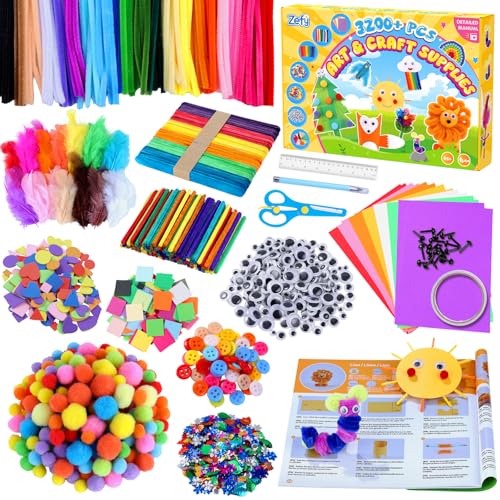
This is the box you reach for when the weather traps everyone indoors. Over 3,200 pieces span tissue paper, sequins, googly eyes, feathers, pipe cleaners, pompoms, foam stickers, popsicle sticks, buttons, and cardstock, plus basics like scissors, tape, a pencil, and a ruler. Unlike the single-activity OSLINE notebooks, this is a supply library your child can raid for months.
The included guide walks through twelve projects with illustrated steps, ranging from simple to more advanced, so it works for solo play and parent-child sessions alike. Everything ships in one large storage box, which keeps the chaos at least theoretically containable.
What Works In Its Favor
- Piece counts are generous across categories, so running out of googly eyes mid-project is unlikely.
- Twelve illustrated tutorials give direction to kids who freeze when facing a blank page.
- Individual wrapping per supply type makes cleanup faster than digging through mixed bins.
- Tools like scissors, tape, and a ruler come included, sparing you a separate shopping trip.
- Broad age range means younger and older siblings can share one kit.
Worth Noting
- With thousands of loose pieces, you’ll want a dedicated shelf spot; owners commonly report the box lid struggles once contents get shuffled.
- Small parts like sequins and matchsticks demand supervision around younger toddlers in the house.
- No paint or markers are included, so coloring projects rely on supplies you already own.
At A Glance
Made For
Made for craft-obsessed kids ages five and up whose families have space for a permanent art station.
Consider Something Else When
For tighter budgets or smaller homes, the TBC The Best Crafts Paint Sticks deliver creative satisfaction without the storage footprint.
Most five-year-olds can scribble, but few know how to turn a circle into a cat. This book from Emma Greene breaks 300 subjects, animals, food, gifts, and everyday objects, into simple step-by-step instructions a kindergartner can follow with minimal help. Practice space sits alongside each lesson, so there’s no hunting for spare paper mid-drawing.
Where the kits in this roundup supply materials, this one supplies skill. Pair it with any crayons or markers you already own and it becomes a quiet-time staple at the kitchen table or in the car.
Benefits That Matter
- Step-by-step format builds real drawing confidence instead of just keeping hands busy.
- 300 subjects mean the book stays fresh long after simpler activity books get abandoned.
- Built-in practice pages keep everything in one place, handy for travel and waiting rooms.
Trade Offs
- You’ll need to supply your own pencils or markers, since nothing comes bundled.
- Kids who prefer free-form creating may find guided lessons feel a bit like schoolwork.
Right Fit For
The right fit is a child who asks “how do I draw a…” constantly and wants answers they can follow alone.
Not Your Match When
Hands-on builders who’d rather cut and glue will have more fun with the Jar Melo 21-Project kit reviewed below.
If you want one purchase that covers coloring, painting, and sculpting, this 125-piece Crayola set does all three. Inside the reusable storage box sit 96 crayons, 12 Ultra-Clean washable markers, six washable paints with four brushes, and four tubs of Model Magic in primary colors. Two giant coloring books add nearly 600 pages of scenes, which is enough material to outlast an entire school year of rainy weekends.
The washable formulation is the quiet hero here. Parents dealing with marker-on-the-wall incidents will appreciate Ultra-Clean ink lifting off skin and most fabrics, and the paints rinse out similarly. Compared with the Dan&Darci vault later on, this set leans toward classic drawing and painting rather than collage crafting.
A Few Strong Suits
- Four media types in one box eliminate the need for separate crayon, paint, and clay purchases.
- Washable markers and paints dramatically lower the stakes of unsupervised creativity.
- Nearly 600 coloring-book pages provide structured activity before free art begins.
- Model Magic introduces sculpting without the crumbly mess of traditional dough.
- Durable storage box doubles as long-term organization for refill supplies.
Minor Gripes
- At 125 pieces, restocking individual items eventually costs more than buying smaller themed kits repeatedly.
- The full box takes up meaningful shelf space, worth measuring for before ordering.
Who Will Love This
Who will love this: five-to-eight-year-olds who bounce between drawing, painting, and molding, and parents who value washable everything.
Look Elsewhere When
Traveling families should look at the Crayola Inspiration Art Case instead, whose compact case is built specifically for portability.
The smartest thing about this Jar Melo kit is how it’s organized. Each of the 21 projects arrives in its own pack with matching pieces grouped together, so your child picks one packet, completes one craft, and nothing else gets scattered. Anyone who has supervised a five-year-old with an open craft bin knows exactly why that matters.
More than 250 pieces cover paper, felt, yarn, pom-poms, pipe cleaners, feathers, bells, wooden shapes, cellophane, stickers, gems, a glue stick, and double-sided tape. It’s less overwhelming than the Zefy supply library but more varied than single-theme kits, hitting a sweet middle ground for this age group.
Strong Points
- Pre-sorted project packs remove setup friction, letting craft time start in seconds.
- 21 distinct activities spread across many weeks of after-school entertainment.
- Unused packets stay sealed and tidy, so the kit never turns into a junk drawer.
- Glue stick and tape included means most projects need nothing extra from your drawers.
Room For Improvement
- Each project is single-use, so once the 21 packs are done, the kit is finished.
- Small embellishments like bells and gems warrant a watchful eye around younger siblings.
Quick Facts
Perfect Match For
A perfect match for kids who thrive on finishing things and parents who dread post-craft cleanup marathons.
Another Choice May Suit
Families wanting reusable, open-ended supplies rather than fixed projects will prefer the Dan&Darci Arts and Crafts Vault.
Color-changing markers turn ordinary drawing into a small magic show. Each dual-tip pen colors normally on one end, then the white tip transforms the marks into different shades when traced over. JoyCat adds a practical twist: the pen barrels themselves display the changed color, so kids can predict the result before committing ink to paper.
Ten pens won’t replace a full art kit, but as a stocking-stuffer-sized addition alongside the Crayola sets in this list, they reliably produce gasps. In our view, they’re best treated as a novelty booster rather than a standalone gift.
Reasons It Performs
- Color-coded barrels let children anticipate transformations, reducing frustration and wasted paper.
- Dual tips offer two functions per pen, doubling the creative options in a compact set.
- The reveal effect holds attention well for kids who tire of standard coloring quickly.
Softer Spots
- White tips dry out faster than regular ends when caps go missing, a common household hazard, so cap discipline pays off.
- Ten colors is a slim palette for serious coloring sessions compared with a 96-count crayon box.
Who Should Grab It
Grab these for surprise-loving five-to-eight-year-olds, especially as an add-on gift paired with a larger set.
Skip It When
Skip them for kids who mainly want volume and variety; the Crayola 125-piece set delivers far more color range.
Paint-with-water books solve the oldest problem in toddler art: paint everywhere. Each page has dried pigment embedded in it, so a wet brush activates the color right on the sheet. No palettes, no squeezing, no spilled cups. The Magical Pony theme bundles paint, brush, and 20 themed pages into one package designed for preschool and homeschool settings.
For a five-year-old, the payoff is independence. They can complete a page start to finish without help, which builds confidence, and cleanup amounts to rinsing one brush. Next to the TBC paint sticks, this is the lowest-mess option in the entire roundup.
A Strong Showing
- Three-in-one design means zero prep and near-zero cleanup, ideal for busy weekdays.
- 20 themed pages give several sittings of content in a bright, engaging pony theme.
- Water activation teaches brush control gently, a genuine precursor to real watercolor skills.
- Compact format travels easily to restaurants, grandparents’ houses, and waiting rooms.
Points To Note
- Pages are single-use, and heavy-handed brushing can soak through, so a protective surface underneath helps.
Built With In Mind
Built with younger or cautious first painters in mind, roughly ages three to six, who want to “do painting” solo.
Swap It Out When
Older kids craving bolder, blendable color will get more from the TBC The Best Crafts Paint Sticks.
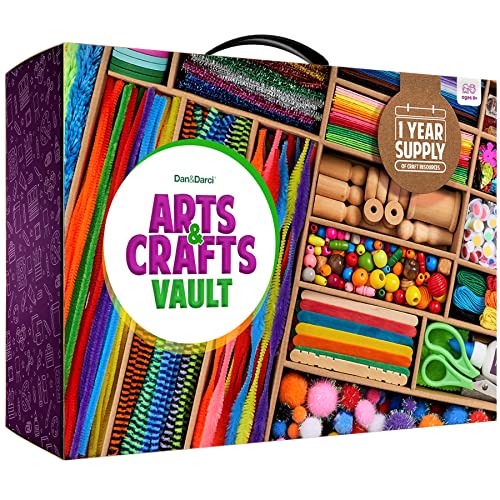
Where the Zefy box wins on raw piece count, the Dan&Darci vault wins on presentation and storage. Its two-drawer case looks like a tiny cabinet of curiosities sitting on a playroom shelf, and kids genuinely enjoy opening the drawers to hunt for supplies. Contents span pipe cleaners, fuzzy sticks, pom poms, wooden discs and beads, plastic beads, felt strips, craft sticks, sequins, sticky gems, googly eyes, feathers, buttons, thread, sewing needles, scissors, glue, and glitter glue.
That’s a genuinely broad palette for collage, beading, and mixed-media projects, and the wide stated age range up to twelve means it grows with your child rather than getting outgrown in a year.
Useful Touches
- Two-drawer case keeps categories separated, making cleanup a sorting game instead of a chore.
- Sewing needles and thread introduce lacing and stitching, skills most craft boxes skip entirely.
- Glitter glue adds sparkle projects without loose-glitter fallout all over the table.
- Wooden beads and discs support jewelry-making, a favorite among five-to-seven-year-olds.
- Broad age suitability makes it a safe gift choice when you’re unsure of exact interests.
Honest Caveats
- Needles and small beads require adult supervision with the youngest users in the recommended range.
- Drawer dividers aren’t foolproof; owners commonly report mixing between compartments once kids dig enthusiastically.
- No paper or coloring books included, so flat drawing projects need separate supplies.
Whose Shelf It Belongs On
It belongs on the shelf of families who craft weekly and want one handsome, durable home for mixed supplies.
Reach For A Different Pick When
Reach for the Jar Melo 21-Project kit instead when your child needs guided, one-and-done activities rather than open supplies.
Tempera paint sticks, for anyone new to them, are solid tempera paint in a twist-up tube, closer in handling to a glue stick than a brush. The beeswax-based formula glides smoothly, dries within minutes, and works on paper, wood, and poster board. Twelve classic colors cover school projects, homemade cards, and everyday doodling without a single drop of spilled liquid paint.
For five-year-olds, the low pressure needed to lay down vivid color is the big win. Small hands get bold results immediately, and washability keeps clothing accidents recoverable. Among everything here, this is the easiest way to say yes to painting on a Tuesday night.
Key Advantages
- Fast-drying formula means finished artwork can be handled and displayed almost immediately.
- Twist-up tubes eliminate brushes, water cups, and the spills that come with them.
- Adheres to wood and posters, expanding projects beyond plain paper.
- Blendable and mixable colors let curious kids experiment with secondary shades.
Small Caveats
- Twist mechanisms can be overwound by eager kids, cracking the stick, so a gentle-twist rule helps them last.
- Twelve colors is a modest range next to the 96 crayons in the Crayola 125-piece set.
Feature Snapshot
The Right Fit
The right fit is any household with a two-to-eight-year-old and a low tolerance for paint mess.
A Better Fit Elsewhere
For true watercolor-style blending practice, the JoyCat Paint with Water books offer a gentler introduction.
The tie-dye case is the travel answer to the bigger Crayola 125-piece set earlier in this list. Inside its compact, durable shell live 40 washable markers, 64 crayons, 20 short colored pencils, and 15 large sheets of nine-by-thirteen-inch paper. Fold the case open and it doubles as a lap desk, which is exactly what you want in the back seat of a car or on a plane tray table.
Everything has a molded slot, so packing up becomes part of the routine rather than a battle. For families who spend weekends visiting relatives or logging road-trip miles, this case earns its keep fast.
What It Does Well
- Lap-desk design lets kids create comfortably anywhere, no table required.
- 140 pieces across three media types covers coloring, shading, and outlining in one case.
- Molded interior slots teach tidy packing and prevent rattling during transit.
- Included paper sheets mean creativity can start the moment the case opens.
A Few Limitations
- Short colored pencils suit small hands but may feel cramped for older kids with bigger grips.
- Only 15 paper sheets are included, so refills become a recurring purchase for frequent artists.
Core Details
Best Suited To
Best suited to families on the move who need a self-contained art station that survives being tossed in a trunk.
Where Another Pick Suits Better
Homebound artists will extract more value from the Crayola 125-piece set, which adds paints and Model Magic the travel case omits.
What Matters Most Before Choosing Art Supplies For 5 Year Olds
Match The Mess To Your Home
Be honest about your cleanup tolerance before ordering. Washable markers, paint sticks, and water-activation books keep damage contained, while glitter, sequins, and loose pom-poms migrate through a house like confetti. A household with hard floors and a dedicated craft corner can handle the big Zefy-style boxes; apartment dwellers usually sleep better with contained formats like scratch notebooks or paint sticks.
Look For Age-True Complexity
Five-year-olds sit at an awkward stage: past toddler chunkiness, not yet ready for precision. Seek thick styluses, twist-up tubes, and pre-cut pieces rather than tiny beads and needles. Kits labeled four-to-eight often skew older inside the box, so scan the component list and judge whether your specific child would manage the smallest parts independently.
Structure Versus Open-Ended Play
Decide what kind of creator you’re raising. Guided kits with numbered projects build completion confidence and suit kids who ask “what do I make?” Open supply libraries reward imagination but demand adult scaffolding early on. Many families land on one of each: a structured kit for independent afternoons, an open bin for weekend co-crafting.
Storage Decides Longevity
Supplies that lack a home become floor clutter within a week, and cluttered supplies stop being used. Cases with molded slots, drawer systems, or individually wrapped project packs protect your investment. Measure your shelf space first, then choose accordingly.
Key Considerations Across These Picks
Traps First Timers Fall Into
The most common slip is buying for the age printed on the box instead of the child holding the scissors. Another frequent miss: choosing a 3,000-piece kit for a kid who abandons activities in ten minutes. Start smaller, observe what your child gravitates toward, then scale up. Also check what’s actually included; several attractive kits omit paper, adhesives, or coloring tools you’ll need on day one.
What Separates Premium From Basic
Higher-tier sets earn their cost through media variety, washable formulations, and storage engineering. A basic crayon pack entertains for an afternoon; a multi-media case with a lap-desk shell sustains habits for years. Pay up when the upgrade removes recurring friction, namely cleanup, lost caps, and broken organization. Pay less when novelty is the goal and the fun has a natural endpoint anyway.
Frequently Asked Questions
What art supplies are safest for a 5 year old?
Look for washable, non-toxic formulations and avoid kits with needles or very small parts unless you’ll supervise closely. Twist-up paint sticks, chunky crayons, and water-activation books are among the most forgiving options at this age.
Are craft kits or individual supplies better at this age?
Kits reduce setup decisions and give kids a clear starting point, which many five-year-olds need. Individual supplies suit children who already have strong ideas and just want raw materials.
How do I keep art time from destroying my house?
Choose washable media, designate one craft surface, and store supplies in a closed case between sessions. Contained formats like scratch notebooks and paint sticks cut cleanup to a couple of minutes.
What’s a good art gift for a 5 year old who has everything?
Novelty formats land well: color-changing markers, scratch-art notebooks, or a portable art case feel fresh even in a house full of crayons. Experience-shaped gifts like guided project kits also stand apart from standard supply refills.
How much should I expect a quality kit to last?
Guided kits run out once their projects are completed, typically over several weeks of regular use. Supply libraries and multi-media cases with durable cases can serve a child for years, especially with occasional refills.
Closing Thoughts
Five is a golden age for making things, and the right supplies matter less than showing up with something ready to use. Start with one pick that matches your child’s temperament, whether that’s the instant gratification of scratch paper or the open canvas of a craft vault. Watch what they reach for, and let that guide the next addition. Happy crafting.
