
A color wheel looks like the simplest tool in your kit, yet picking the wrong one can quietly sabotage your mixing. Painters grab a generic chart, discover it ignores how their medium actually behaves, and end up wasting pigment on muddy results. The ten options below cover every situation, from a classroom staple to a tattoo-artist dial to a laminated studio workhorse. Match one to your medium and skill level, and color decisions stop being guesswork.
The Shortlist At A Glance

Cox Color Wheel 9.25-Inch Multicolor

Dritz 3169 Rainbow Color Wheel Selector

ATOMUS Color Mix Guide 9.25in

Color Wheel Pocket Guide with Gray Scale

Wigearss Color Mixing Wheel 3-Piece Set
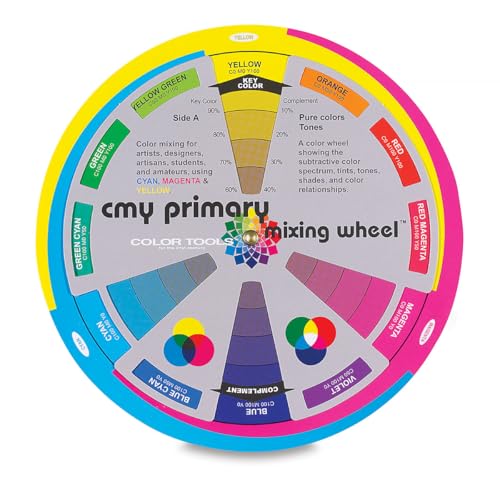
CMY Primary Mix Color Wheel

Jack Richeson Quiller Color Wheel 8.5-Inch

U.S. Art Supply 4″ and 8″ Mixing Wheel Set

Color Wheel Company Watercolor Wheel

Jack Richeson Small Color Wheel 30 Pk
More On The Choices That Made The List
This is the wheel most art teachers reach for first, and the reason shows up the moment you flip it over. The 9.25-inch face gives you room to actually read tints, tones, shades, and mixed results without squinting, which matters when you’re demonstrating to a room rather than studying alone.
It also lays out color harmonies and basic vocabulary like warm versus cool, so beginners absorb theory while they mix. Compared with the pocket guide later in this list, this one trades portability for teaching depth.
Practical Pluses
- Generous 9.25-inch diameter keeps every label legible from across a desk
- Shows tints, tones, and shades so you see what white, gray, or black does to a hue
- Includes harmony illustrations that turn abstract theory into usable pairings
- A gray scale comes built in, handy for judging value alongside hue
- Doubles as a classroom demonstration aid without extra handouts
Things To Consider
- The large format lives awkwardly in a small tote, so plan where it travels
- Paper stock means spills near the sink demand quick wiping
Key Specs
Who It Suits Best
Art students, teachers, and self-taught painters who want one thorough desk-side reference instead of scattered notes.
Where A Sibling Pick Shines
Working watercolorists will get more medium-specific value from the Color Wheel Company Watercolor Wheel further down this list.
Quilters think in fabric swatches, not paint tubes, and Dritz built this selector around that reality. Instead of asking you to memorize harmony rules, its arrow system points directly at the colors that coordinate with whatever shade you’ve chosen, which speeds up stash decisions considerably.
An illustrated instruction leaflet walks newcomers through the process, so even a first-time quilter can pull confident combinations. Where the Cox wheel teaches broad theory, this one answers a narrower question fast: what goes with this?
Useful Highlights
- Arrows point straight to coordinating colors, removing the guesswork from fabric pulls
- Rainbow layout covers the full spectrum for bold or subtle palettes alike
- Illustrated instructions make it approachable for absolute beginners
- Works equally well for scrapbooking, knitting, and home decor projects
Small Caveats
- It matches hues rather than predicting paint mixtures, so painters need a different tool
- Flat card construction can crease if shoved into an overstuffed sewing basket
Made For
Quilters, sewists, and crafters who coordinate multi-color projects and want instant pairing answers without theory homework.
Swap It Out When
Painters who need actual mixing predictions should look at the U.S. Art Supply double-sided set instead.
Permanent makeup and body-art pigments behave differently from tube paints, and ATOMUS designed this 9.25-inch guide with those workflows in mind. The rotating dial reveals mixture outcomes instantly, useful when a client appointment leaves no time for trial-and-error on a mixing pad.
Both faces demonstrate blend results clearly, and the same logic transfers to cosmetics, nail work, or a classroom demo. In our view it fills a genuine gap, since most general art wheels ignore pigment saturation entirely.
Where It Delivers
- Rotating dial shows combination results without mixing test batches
- Double-sided faces give you more reference data per tool
- Sized generously at 9.25 inches for easy reading under studio lighting
- Translates cleanly to makeup, brow and lip work, and teaching demos
Points To Note
- Its pigment emphasis makes it less intuitive for traditional canvas painters
- Spinning dials attract dust in busy studios, so a quick wipe between clients keeps it crisp
Right Fit For
Tattoo and permanent-makeup artists plus beauty professionals who need fast, reliable hue-combination answers at the chair.
Another Choice May Suit
General painters mixing acrylics or oils will find the Jack Richeson Quiller wheel better matched to their media.
Plein air painters know the problem: your reference tools are either useful or portable, rarely both. This pocket guide splits the difference by packing a working color wheel and a gray scale value finder into something that slips beside your sketchbook.
The gray scale deserves special mention. Judging value, meaning how light or dark a color reads, trips up experienced painters as often as beginners, and having a physical comparator outdoors beats eyeballing it against a bright sky.
A Favorable Mix
- Genuinely pocket-sized, so it rides along on location shoots and commutes
- Built-in gray scale helps you judge value quickly in changing light
- Serves both hobbyists and working professionals without adaptation
- Low commitment price-wise for a second or backup reference
Honest Caveats
- Small diameter means finer labels take a moment to read in low light
- Thin card stock benefits from a sleeve if it lives loose in a bag
Who Will Love This
Urban sketchers, travel painters, and students who want competent color and value guidance that disappears into a jacket pocket.
Reach For A Different Pick When
Classroom instructors needing large readable type should step up to the Cox 9.25-inch wheel.
Most wheels force a size compromise, and Wigearss sidesteps that by shipping three different diameters in one package. Keep the largest pinned above your painting station, toss the smallest into a travel kit, and hand the middle one to a student or fellow artist.
Each piece spins smoothly and works double-sided, revealing primary, secondary, and tertiary mixing results through the window as you rotate. The honest read is that no single wheel here is exceptional, but the flexibility of the trio is hard to argue with.
Why It Works Well
- Three sizes cover desk, classroom, and pocket scenarios in one purchase
- Double-sided faces show more mixing data than single-face competitors
- Smooth-spinning dials reveal combination results without wasted paint
- Suits acrylics, oils, watercolors, makeup, and tattoo applications alike
- Handy for early-childhood education settings introducing color basics
Less Ideal Details
- Print density varies by size, and the smallest wheel trades readability for portability
- Three loose pieces need a pouch or clip to avoid scattering through a drawer
Feature Rundown
Who Should Grab It
Multi-discipline creators and instructors who want one flexible set rather than committing to a single fixed-size wheel.
Not Your Match When
Watercolor specialists get sharper medium-specific guidance from the dedicated Watercolor Wheel listed below.
Here’s a detail many beginners miss: printers use cyan, magenta, and yellow as primaries because that model predicts pigment mixing more accurately than the red-yellow-blue version taught in grade school. This wheel embraces the CMY approach, showing how secondary and tertiary colors form from primary pigments.
It also maps tints, tones, and shades across all twelve core colors, giving you a fuller picture of relationships and harmonies. For anyone frustrated that their mixes never match the classic RYB chart, this explains why.
Strong Points
- CMY framework mirrors how real pigments combine, improving mix predictions
- Covers secondary and tertiary formation step by step
- Displays tints, tones, and shades for all twelve base colors
- Clarifies color relationships and harmonies for structured learning
What To Weigh
- The CMY framing can confuse learners whose classes still teach red-yellow-blue
- Standard card construction, so keep liquids at a polite distance
Quick Facts
Whose Shelf It Belongs On
Theory-curious beginners and intermediate painters ready to move past simplified school models toward accurate mixing.
Consider Something Else When
Total newcomers who want the familiar classroom format may prefer the straightforward Cox wheel at number one.
Stephen Quiller is a respected painter, and his wheel reflects how working artists actually think about mixing across media. Rather than treating oil, watercolor, and acrylic as afterthoughts, it’s built as a cross-medium aid from the ground up.
The lamination is the quiet hero here. Studios are messy places, and a plastic-laminated surface shrugs off the splashes and smudges that would ruin a paper card within weeks. A glossary of mixing terms printed on the back turns it into a compact lesson as well.
A Strong Showing
- Designed by a practicing artist with real mixing workflows in mind
- Laminated plastic survives tough studio conditions far better than card stock
- Supports oil, watercolor, and acrylic mixing in a single reference
- Back-side glossary reinforces terminology while you work
Trade Offs To Consider
- Fixed 8.5-by-8.5-inch size offers no pocket option for travel kits
- Glossy laminate can catch glare under strong overhead lighting
Core Details
Who Should Grab It
Serious intermediate and professional painters working across multiple media who want a durable, artist-designed reference.
Skip It When
Teachers equipping a full class will find better economics in the Jack Richeson 30-pack closing this list.
Starting a new hobby usually means buying everything twice once you learn what you actually need, and this two-wheel set hedges that risk nicely. You get an 8-inch wheel for the desk and a 4-inch companion for the pencil case, both double-sided.
Each wheel visualizes numerous color schemes so you can build harmonious combinations while learning the full spectrum. Compared with the Wigearss three-piece set, you sacrifice one size but gain a simpler, lower-cost entry point that still covers home and away.
The Good Stuff
- Two complementary sizes handle studio and portable roles together
- Double-sided faces expand the reference content per wheel
- Educational layout builds scheme-planning skills from day one
- Approachable choice for gifting to a new painter
Room For Improvement
- Card-style build won’t survive the same abuse as the laminated Quiller wheel
- The 4-inch size squeezes smaller type onto its face
The Right Fit
Budget-minded beginners, hobby painters, and gift-givers who want capable coverage without overspending.
Look Elsewhere When
Artists wanting maximum durability for daily studio abuse should invest in the laminated Jack Richeson Quiller wheel.
Watercolor breaks the rules other media follow. Transparent layers mix optically on the paper, and a wheel calibrated for opaque paints misleads you constantly. This one was designed specifically for watercolorists, mapping how twelve common tube colors actually combine.
You may find that specificity saves real money, since failed washes waste good paper along with good paint. Against the general-purpose Cox wheel, the trade is breadth for accuracy in one medium, and for devoted watercolorists that trade favors this pick.
Where It Helps
- Calibrated to twelve common watercolor pigments rather than generic hues
- Reduces wasted paper and paint from experimental mixing
- Clear visual picture of combinations speeds up palette planning
- Compact enough to sit beside your water container mid-session
Things To Weigh Up
- Watercolor focus limits usefulness for oil or acrylic painters
- Results vary somewhat between pigment brands, so treat it as a guide rather than gospel
Essential Details
Perfect Match For
Dedicated watercolor painters, from weekend hobbyists to exhibiting artists, who mix transparent washes regularly.
Where Another Pick Suits Better
Acrylic and oil painters should choose the Quiller wheel, which addresses their media directly.
Teaching color theory to a group changes the math entirely. Thirty individual 7-by-7-inch wheels mean every student holds their own reference, no passing one card down the table while half the room waits.
Each wheel combines a color wheel and gray scale in one unit, with general mixing instructions included, so a substitute teacher could run the lesson cold. At seven inches square they’re large enough to read comfortably yet light enough for kids to handle. One pack quietly solves an entire semester of supply planning.
Points In Its Favor
- Thirty wheels equip a full classroom from a single order
- Gray scale integrated on every unit for value-matching practice
- General mixing instructions printed for independent student use
- Manageable 7-inch size suits younger hands and crowded desks
Details To Watch
- Overkill for a solo artist who needs just one wheel
- Card stock units stack loosely, so a binder clip keeps the set tidy between terms
Built With In Mind
Art teachers, homeschool co-ops, workshop leaders, and parents running group craft sessions with several children.
Another Choice May Suit
Solo learners should put that budget toward the richer Cox 9.25-inch teaching wheel instead.
What Matters Most Before Choosing Artist Color Wheel
Match The Wheel To Your Medium
Watercolor, acrylic, oil, and cosmetic pigments all mix differently, and a wheel tuned to the wrong one will steer you astray. Watercolorists benefit from transparent-paint references, while tattoo and permanent-makeup artists need pigment-saturation guidance. General painters do well with all-media designs like the Quiller wheel.
Size And Readability
A nine-inch wheel stays legible across a classroom, while a four-inch pocket version trades print size for portability. Think honestly about where you’ll use it: plein air painters need compact, desk-bound learners need big type.
Content Depth
Basic wheels show primary and secondary relationships. Better ones add tints, tones, shades, gray scales, and harmony illustrations, letting one tool answer more questions as your skills grow.
Build Quality
Laminated plastic survives studio spills; card stock does not. Frequent handling, travel, or messy environments justify the sturdier construction.
Key Considerations Across These Picks
Wrong Turns To Avoid
The most common slip is buying a generic wheel for a specialized medium, then blaming yourself when mixes go muddy. Another frequent mistake is choosing tiny pocket versions for teaching, where small type frustrates everyone. Match format to setting before anything else.
What Separates Premium From Basic
Higher-tier wheels earn their cost through lamination, artist-designed layouts, and medium-specific calibration. Paying up makes sense for daily studio use; casual hobbyists lose little with simpler card-stock options.
Frequently Asked Questions
Do I really need a physical color wheel?
Yes, especially while learning. Physical wheels let you compare hues side by side without screen color distortion affecting your judgment.
What’s the difference between tints, tones, and shades?
Tints come from adding white, tones from adding gray, and shades from adding black. A good wheel shows all three so you predict the result before mixing.
Can one wheel work for every paint medium?
Partially. All-media wheels like the Quiller cover basics well, though watercolorists and tattoo artists get noticeably better accuracy from specialized versions.
Why does my mixing not match the wheel exactly?
Pigment brands vary in strength and transparency, so wheels provide close guidance rather than exact formulas. Treat them as a starting map, then adjust by eye.
Are gray scales worth having on a wheel?
Absolutely. Value mistakes cause more failed paintings than hue mistakes, and a built-in gray scale lets you check lightness and darkness instantly.
Closing Thoughts
Every painter eventually stops guessing and starts planning color deliberately, and a good wheel is usually the tool that gets them there. Match yours to your medium, your workspace, and honestly, your patience for small print. Start simple, upgrade when your skills demand it, and let the mixing confidence follow naturally.
