
A capo is a small clamp that presses all six strings down at one fret, instantly raising the pitch of everything you play. It’s the fastest way to change keys without relearning chord shapes, and it costs less than a set of strings. The catch is that a sloppy one buzzes, dulls your tone, or scratches the neck.
That last part matters more than most players expect. A good capo applies even pressure across the fretboard, protects the finish with padded contact points, and moves between songs in a second or two. Below are seven options that cover the range, from the classic spring-loaded workhorse to sculpted statement pieces, so you can match one to how you actually play.
The Choices Worth Comparing

Kyser Quick-Change Capo KG6SNB (Sunburst)

Sondery Multifunctional Guitar Capo

Salvori Blue-Plated Heavy-Duty Capo with 4 Picks

Alice Alligator Shape Aluminum Alloy Capo

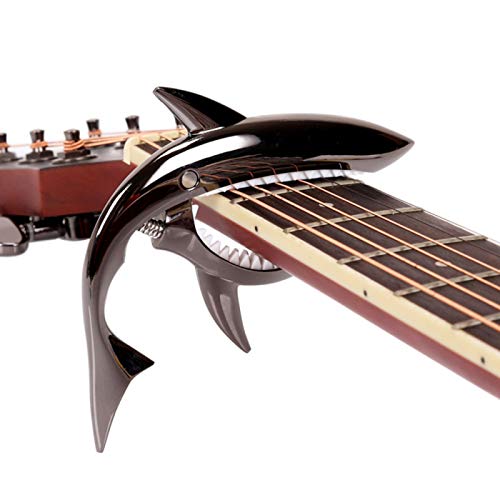
JINWEE Shark Guitar Capo Zinc Alloy (Black)

Martin One-Handed Guitar Capo
The Details Behind The Selections
This is the capo that defined the category. Kyser’s Quick-Change uses an aluminum body with an internal steel spring, sized specifically for six-string acoustics, and it clamps or releases with a single squeeze of one hand. Between songs at an open mic, that speed is the whole point.
The Sunburst finish looks sharp against a natural wood headstock, and when you’re not using it, it parks right there on the headstock instead of rattling around a pocket. Made in the USA and backed by a lifetime promise from the maker, it’s the option many teachers hand to students first.
A Few Strong Suits
- One-handed operation means key changes take a second, even mid-song.
- Lightweight aluminum body won’t pull the neck out of balance while playing standing up.
- Lives on the headstock between uses, so it never gets left at home.
- Steel spring tension holds six strings firmly across the fretboard.
Small Caveats
- Spring tension isn’t adjustable, so very light-gauge setups may need careful placement to avoid slight sharpness.
- The fixed-width body suits standard six-string necks best; wider classical profiles aren’t its territory.
Who Will Love This
Gigging singer-songwriters and weekend players who want a proven, no-fuss clamp they can operate without looking at it.
A Better Fit Elsewhere
Players who want adjustable pressure or a slimmer profile should look at the Martin One-Handed Guitar Capo further down this list.
Where the Kyser leans utilitarian, the Sondery leans polished. Its gloss black finish is treated to resist stage glare, which sounds minor until you’re under hot spotlights and every reflective surface catches the light. A contoured grip makes one-handed changes feel deliberate rather than fumbly.
Zinc alloy construction gives it a solid, reassuring heft at roughly 110 grams, and rubber contact pads protect both the fretboard and the finish behind the neck. It works on six-string electrics as well as acoustics, which makes it a sensible single capo for players who own both.
Key Advantages
- Glare-resistant gloss black stays discreet under performance lighting.
- Premium zinc alloy build feels durable enough for years of daily clamping.
- Scratch-proof rubber pads keep your guitar’s finish untouched.
- Precision pressure delivers clean tone without string dampening.
Points To Note
- Gloss finishes show fingerprints and smudges more than matte bodies, so occasional wiping keeps it looking fresh.
At A Glance
Made For
Performers and recording hobbyists who care about how their gear looks as much as how it functions.
Swap It Out When
Budget-focused first-timers will get everything they need from the Htaexpu Clip Capo later in this roundup.
Few capos double as a visual statement, but the Salvori SC-01S tries. Its blue-plated zinc alloy body shifts through gradient tones depending on the viewing angle, giving it a jewelry-like quality that stands out on any headstock. The bundle includes four picks, which covers spares for months of casual playing.
Functionally, it relies on an industrial-strength spring to deliver firm, even tension aimed at eliminating fret buzz, the rattling sound caused by uneven string contact. Beyond six-string acoustics, the maker lists compatibility with classical guitars, ukuleles, mandolins, and banjos, making it a practical choice for multi-instrument homes.
Notable Upsides
- Gradient blue plating shifts color with the angle, so no two views look identical.
- Heavy-duty spring targets strong, even clamping force for clean notes.
- Four included picks mean fewer small purchases later.
- Works across several stringed instruments, not just guitars.
Things To Consider
- Plated finishes can wear at high-contact edges over years of use, so gentle handling preserves the look.
- Strong spring tension may feel stiff for younger or smaller-handed players.
- Decorative styling won’t suit everyone’s taste on a vintage-style instrument.
Feature Snapshot
Right Fit For
Households with several stringed instruments, plus anyone who enjoys gear with a bit of personality.
Another Choice May Suit
Minimalists who dislike flashy hardware will prefer the understated black JINWEE Shark capo reviewed below.
An alligator-shaped capo sounds like a gimmick until you hold it. Alice shaped the aluminum alloy body into a crocodile silhouette finished in warm bronze, and the jaws actually form the clamping mechanism. For a student who needs a little encouragement to practice, gear with charm genuinely helps.
Underneath the styling sits a conventional steel-spring design with a padded grip meant to hold securely without buzzing. Repositioning takes seconds, and the clamshell package doubles as storage between sessions, which matters when a capo lives in a school bag or a gig tote.
Everyday Perks
- The crocodile shape makes it easy to find in a crowded accessory pouch.
- Warm bronze finish reads classy rather than toy-like on adult instruments.
- Steel spring maintains steady pressure along the fretboard.
- Clamshell packaging gives it a proper home between practices.
Worth Noting
- Novelty silhouettes can catch on clothing or case lining during quick removal, so store it closed.
- Aluminum alloy bodies, while light, dent more readily than steel if dropped.
Who Should Grab It
New players, teenagers, and gift shoppers looking for something functional that still raises a smile.
Where Another Pick Shines
Anyone wanting a more traditional look should consider the Kyser Quick-Change Capo at the top of this list.
This is the grab-and-go option of the group. Htaexpu built the clip around fast single-hand operation, quick enough that the maker suggests you can shift keys during a song without stopping the music. In campfire settings where someone calls out a transposition on the fly, that responsiveness earns its keep.
Versatility is the other headline: the same clamp suits electric guitar, acoustic, bass, mandolin, ukulele, and banjo. An upgraded aluminum body keeps weight down while staying rigid, and the plain black finish disappears visually against nearly any instrument. Nothing here is fancy, and that’s honestly fine.
The Value In It
- Fast clip-on action supports mid-song key changes without interrupting play.
- One unit covers six different stringed instruments.
- Aluminum construction balances strength with low weight.
- Neutral black styling suits every kind of guitar.
Less Ideal Details
- Fit across such a wide instrument range means tension is generalized rather than tuned per instrument.
- Owners of very narrow ukelele necks commonly report checking placement carefully to avoid muting outer strings.
Whose Shelf It Belongs On
Casual strummers and campfire players who want one inexpensive clamp that travels between instruments.
Reach For A Different Pick When
Dedicated acoustic specialists after tighter tone control will appreciate the Martin capo’s even-fretting design.
Compared with the Alice crocodile, the JINWEE shark goes darker and sleeker. Cast in zinc alloy with a matte black finish, the dorsal fin doubles as the squeeze point, and the teeth that touch the strings are covered in soft silicone. Those insets matter: they dampen cleanly without scratching, and the clamp face is smoothed so it won’t chew up a nitrocellulose finish.
Placement is the one skill this design asks of you. Set correctly behind the fret, owners report clean, buzz-free clamping thanks to a grip that’s strong yet gentle; set sloppily and any spring capo will let you know. Weight sits comfortably in the hand, giving changes a planted, confident feel.
A Favorable Mix
- Soft silicone inserts protect strings and the fretboard surface.
- Zinc alloy body provides satisfying heft without excess bulk.
- Smooth clamp area is safe for delicate guitar finishes.
- Distinctive shark shape sparks conversation at jam nights.
Honest Caveats
- Proper positioning behind the fret is required for a silent clamp, which takes beginners a few tries.
- Matte black coating can show wear lines along high-friction edges over long-term use.
Core Details
Best Suited To
Intermediate players who want character in their accessories but refuse to sacrifice finish safety.
Consider Something Else When
Players prioritizing maximum clamping force for twelve-string setups would be better served by the heavy-duty spring in the Salvori capo.
Martin has built acoustic guitars since 1833, and this is the company’s first capo, designed around the necks it knows intimately. The engineering priority is even pressure across all six strings, because uneven clamping is what pulls certain strings sharp and leaves others buzzing. Consistent fretting translates directly into clearer chords.
It also accommodates a wide range of neck profiles, from slim modern shapes to chunkier vintage-style carves, which is where many fixed-width capos stumble. Operation stays fully one-handed, so mid-set key changes remain effortless. In our view, this is the pick for anyone whose living depends on sounding tight.
What Pays Off
- Even cross-string pressure keeps intonation accurate up and down the neck.
- Broad neck-profile compatibility fits most acoustic guitars without adjustment.
- One-handed clamping speeds up live transitions between songs.
- Backed by a brand with deep acoustic-specific engineering experience.
The Fine Print
- Premium-tier pricing puts it above basic spring clamps in this roundup.
- Some players prefer the instant familiarity of the classic trigger shape used by the Kyser.
Technical Highlights
The Right Fit
Working musicians, studio players, and serious students who treat tone consistency as non-negotiable.
Not Your Match When
Occasional players watching their budget will be perfectly happy with the Htaexpu Clip Capo’s simpler approach.
Choosing A Capo Without Guesswork
Tension And Tone Come First
Spring tension determines whether every string lands squarely on the fret. Too little force causes buzz; too much drags notes sharp, especially past the seventh fret. Adjustable-tension designs solve this, while fixed springs rely on careful placement just behind the fret wire.
Match the clamp width to your instrument too. Standard six-string acoustics suit nearly everything here, but classical guitars, mandolins, and banjos have different neck dimensions.
Contact Materials Protect Your Investment
Anything touching your guitar should be rubber or silicone. Bare metal against a lacquered neck leaves marks that don’t buff out, and hard edges can nick fretboard binding over time. Every option in this list includes some form of padded contact, though pad softness varies.
Speed Matters More Than You Think
One-handed operation sounds like marketing fluff until you’re singing, holding a pick, and needing a key change in four bars. Trigger-style designs dominate here for good reason. Practice the motion at home so it becomes automatic on stage.
Weight And Balance
A heavy capo parked near the nut barely affects playing, but the same unit clamped at the fifth fret adds noticeable headstock weight. Light aluminum bodies minimize this; dense zinc alloy trades some balance for durability.
Key Considerations Across These Picks
Traps First Timers Fall Into
The most common mistake is buying purely on looks and ignoring neck width, then wondering why outer strings mute. The second is clamping directly on top of the fret instead of behind it, which guarantees buzz on almost any design. Both problems vanish with thirty seconds of correct placement.
When Paying More Pays Off
Higher-tier capos spend their extra cost on machining precision and pressure consistency. Casual strummers rarely notice the difference; players who record or perform nightly absolutely do. Spend up once intonation issues start costing you retuning time.
Frequently Asked Questions
Can one capo work on both acoustic and electric guitars?
Most designs in this list handle both, since six-string neck widths overlap considerably. Very flat electric fingerboards sometimes need slightly lighter tension to stay in tune.
Where exactly should I place a capo?
Position it just behind the fret wire, not on top of it. Pressing directly onto the fret forces strings out of tune and creates buzzing.
Do capos damage guitar finishes?
Quality models use rubber or silicone padding specifically to prevent this. Cheap bare-metal contact points are the real risk, so check the contact surfaces before buying anything.
Why do my strings sound sharp with a capo on?
Excess clamping pressure pushes strings further down toward the fretboard, raising their pitch slightly. Looser tension or adjustable-torque designs reduce this effect, especially above the seventh fret.
Is a capo useful for beginners?
Very much so. It lets new players use familiar open-chord shapes in any key, keeping early practice rewarding while hands build strength.
Closing Thoughts
Your ideal capo depends on how often you play and where. The Kyser remains the dependable default for gigging acoustic players, the Martin earns its premium for anyone chasing flawless intonation, and the Htaexpu covers casual use without fuss. Style-first shoppers have the Salvori and the JINWEE shark, while beginners get a friendly start with Alice’s alligator. Whichever you choose, learn to seat it just behind the fret and it’ll serve you for years of cleaner, faster playing.
