
Colored pencil work punishes sloppy corrections more than almost any other medium. Waxy pigment smears, hard rubber tears tooth out of the paper, and a cheap cap eraser can undo twenty minutes of layering in one swipe. Whether you sketch daily at a desk, tutor kids through homework, or fill a sketchbook on weekends, the right eraser setup saves paper and patience. This roundup covers seven options that handle everything from broad lifting to single-millimeter highlights, so you can match the tool to the way you actually draw.
Your Options, Compared

PRISMACOLOR Design Kneaded Rubber Eraser 1224 Grey (3 Pack)

Mr. Pen Pen Style Eraser Set 2 Pack

Four Candies 2.6MM Erasable Mechanical Colored Pencils 36PCS

STAEDTLER Mars Rasor Eraser Pencil with Brush
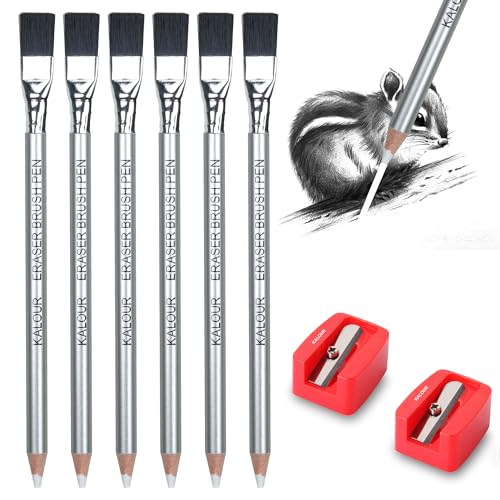
KALOUR Detail Eraser Pencil 6pc Set

Mr. Pen Art Eraser Set 12 pcs

Tamaki 60 Pack Pencil Top Erasers 6 Colors
A Breakdown Of The Leading Choices
Kneaded rubber is the softest correction tool in drawing, and this Prismacolor version comes in grey so you can spot graphite residue as you work. You pinch off a piece, press it onto a colored pencil mark, and lift the pigment away instead of scrubbing it sideways across the page. That makes it the safest option for toned or textured paper where abrasion shows.
The same pliable body doubles as a shading and blending aid, which is why charcoal and graphite artists keep one within reach at all times. Over months of use the material absorbs pigment and darkens; stretching and folding refreshes the surface temporarily before replacement becomes the honest answer.
Real Benefits
- Lifts marks by pressing rather than rubbing, protecting delicate paper surfaces
- Molds into points, wedges, or flats for targeted areas
- Works for shading and blending alongside its erasing duty
- Three-pack supply lasts a busy sketchbook season
Worth Noting
- Pigment builds up over time, so expect to replace each piece periodically
- Too soft for heavy waxy layers where firmer rubber performs better
Key Specs
Who It Suits Best
Graphite and charcoal artists who value gentle, moldable corrections over aggressive rubbing.
Where Another Pick Suits Better
For crisp removal of dense waxy color, the STAEDTLER Mars Rasor’s firm tip handles pressure better than any kneaded putty can.
A pen-style eraser feels like writing with a pen, only the nib lifts graphite instead of laying ink down. That grip changes everything for small corrections: you hold it close to the tip, brace your hand on the page, and remove a single letter or hairline without disturbing neighboring strokes. The set pairs a square tip for edges and corners with a round tip for softer spots.
In a planner, bullet journal, or exam booklet, this is the tool that stays clipped inside the cover rather than rolling off the desk. Slim barrels also slip into a pencil case next to your pens, which matters for students carrying everything between classes.
The Good Stuff
- Pen-shaped barrel gives precise, controlled handling for tight spaces
- Two tip shapes cover both angular and rounded corrections
- Removes pencil marks cleanly without heavy pressure
- Lightweight enough to live permanently in a pocket or case
Small Caveats
- Narrow tips wear down with frequent use, so refills or replacements come eventually
- Less suited to sweeping large areas than a block eraser like the Mr. Pen 12-piece set
Right Fit For
Students and journalers making frequent small edits in notebooks, planners, and forms.
Skip It When
Broad sketch corrections are the goal; the Tamaki cap erasers cover wide strokes more economically.
This kit flips the problem around: instead of erasing regular colored pencil, you draw with leads designed to erase cleanly in the first place. Thirty-six labeled barrels hold 2.6mm leads, a thickness that resists snapping under normal hand pressure yet still lays down visible color. Each barrel is printed with its shade name, which sounds minor until you have ever squinted at five similar blues.
Beyond the pencils themselves you get a matching sharpener, a DIY color chart card for tracking swatches, a 4B eraser tuned for soft lead removal, a waterproof storage pouch, and a full spare set of 36 refill leads. For casual coloring books, greeting cards, or a first art kit, that bundle removes most separate purchases. One trade-off worth weighing: erasable leads tend toward lighter laydown than wax-based artist pencils, so deep saturation takes extra passes.
Strong Points
- Erasable leads let you correct mistakes instead of living with them
- Complete bundle includes sharpener, chart, 4B eraser, pouch, and 36 refills
- Labeled barrels speed up shade selection mid-project
- 2.6mm lead width balances strength and visible color
- No sharpening needed between uses thanks to mechanical advance
Things To Consider
- Lighter pigment payoff than traditional wax pencils for saturated work
- Refill leads are brand-specific, so plan around availability
- Plastic barrels feel less premium than wooden pencils in hand
Feature Snapshot
Made For
Casual colorists and beginners who want an all-in-one erasable coloring setup without buying pieces separately.
Reach For A Different Pick When
You already own quality pencils and only need correction tools; the KALOUR Detail Eraser Pencil set targets that job directly.
Staedtler has made German drawing supplies since long before most brands on this list existed, and the Mars Rasor reflects that drafting-table heritage. One end carries a slim white eraser core firm enough to tackle not just graphite but ballpoint and India ink, a capability soft rubbers simply lack. The opposite end holds a brush that sweeps crumb residue off the page so debris never smears back into your lines.
Architects, technical illustrators, and comic inkers lean on tools like this because intricate linework leaves no room for clumsy correction. The pencil form means you sharpen the casing as the core wears, keeping a fresh point available indefinitely. Compared with the kneaded Prismacolor above, this trades gentleness for bite, and that bite is exactly what dense ink demands.
Notable Gains
- Firm white core removes graphite plus ballpoint and India ink marks
- Integrated brush clears residue without switching tools
- Sharpenable wood casing maintains a precise point over time
- Trusted drafting-brand construction aimed at professional linework
Minor Gripes
- Aggressive tip can rough up soft or heavily sized paper under pressure
- Single-pencil format means ordering again sooner than multi-packs
Quick Facts
Whose Shelf It Belongs On
Technical illustrators, inkers, and anyone correcting pen-based drawings where ordinary rubber fails.
A Better Fit Elsewhere
Gentle tonal work on textured paper calls for the PRISMACOLOR Design Kneaded Eraser instead of this firmer core.
An eraser pencil swaps the graphite core of a normal pencil for soft eraser material, letting you carve out tiny highlights in hair, eyes, or fur the way you would add a light stroke. Kalour ships six of these alongside two dedicated sharpeners, so a broken tip costs seconds rather than a shopping trip. Charcoal and sketch artists use them constantly for pulling bright accents out of dark passages.
The soft core behaves differently from the Staedtler’s firm one: it lifts gently and suits shading-heavy drawings, though it wears faster and needs more frequent sharpening. Beginners get an approachable price and enough spares to experiment freely, which is genuinely how you learn what detail erasing can do.
Positive Points
- Six pencils provide long runway for highlight and detail work
- Soft, pliable cores suit sketching and charcoal correction
- Two included sharpeners keep tips ready
- Pencil format reaches spots block erasers cannot
Honest Caveats
- Soft material consumes quickly under heavy use
- Regular sharpening produces shavings, so keep a waste sheet nearby
- Not intended for ink removal, unlike firmer eraser pencils
Best Suited To
Newer sketch artists practicing highlights in charcoal and graphite drawings on standard paper.
Swap It Out When
Versatility across several eraser types matters more; the Mr. Pen Art Eraser Set bundles five formats in one box.
Owning one eraser means compromising on every job; owning twelve means never compromising. This Mr. Pen collection stacks four categories into a single box: two eraser pencils for pinpoint corrections, three standard block erasers for everyday pages, three gum erasers for gentle broad lifting, and three kneaded erasers for molding and texture-safe work. A sharpener rounds out the count.
Art students figure out quickly which eraser personality fits their medium, and a mixed set lets that discovery happen without four separate orders. Gum eraser deserves a quick definition here: it is a soft, crumbly block that absorbs graphite while barely abrading paper. Compared with the specialized KALOUR set above, this trades depth in one format for breadth across many, which suits exploratory learners best.
Points In Its Favor
- Four distinct eraser types cover nearly every correction scenario
- Twelve pieces mean backups for every format
- Includes sharpener for the eraser pencils
- Serves students, hobbyists, and working artists alike
- Single purchase replaces several specialty buys
Points To Note
- Quantity per category is modest, so heavy users will exhaust favorites fast
- Kneaded pieces here are basic compared with the dedicated Prismacolor pack
At A Glance
Who Will Love This
Art students and mixed-media hobbyists experimenting to find their preferred eraser style.
Look Elsewhere When
Classroom-scale quantity is the priority; the Tamaki 60-pack delivers far more units per dollar.
Sometimes the job is not art, it is arithmetic homework, and sixty cap erasers solve it without ceremony. These wedge-shaped caps slide onto standard hexagonal pencils, reviving stubby pencils whose factory erasers died weeks ago. Six bright colors make it easy to assign caps to different kids or just find one in a messy drawer.
The wedge profile gives both a flat face for general marks and sharper edges for tighter spots, and owners commonly report clean removal without tearing standard notebook paper. Expect gradual wear like any cap eraser, and note that fit varies slightly across non-standard round pencils, though typical school pencils seat securely. Compared with every other item here, this is pure volume and convenience, and that is precisely its charm.
A Few Highlights
- Sixty caps keep a household or classroom stocked for a full year
- Wedge shape offers flat and edge surfaces for different marks
- Six colors help with sorting and quick identification
- Fits standard pencil sizes common in schools
Room For Improvement
- Caps loosen over repeated tugging, a widely reported quirk of this format
- Fit on non-standard or round-barrel pencils may be less secure
Core Details
The Right Fit
Parents, teachers, and office managers stocking shared pencil cups where volume beats specialization.
Where A Sibling Pick Shines
For controlled, precise edits, the Mr. Pen Pen Style Eraser Set outperforms any slip-on cap.
What Matters Most Before Choosing Color Pencil Erasers
Match The Material To Your Medium
Soft media forgive, waxy ones do not. Kneaded rubber and gum erasers lift gently from textured or toned paper, while firm vinyl-style cores cut through dense graphite and even some inks. Drawing with charcoal rewards pliability; correcting pen notes demands hardness. Identify your dominant medium first, then filter accordingly.
Think About Precision Needs
Block erasers clear area but blur boundaries. Eraser pencils and pen-style tools reach millimeter-scale details, which matters enormously in portraits, botanical work, and tight margins. Many artists carry both: a broad tool for passages, a pointed one for edges. Your sketchbook size and typical subject matter should drive that decision.
Weigh Quantity Against Longevity
Consumables reward bulk buying, but only for formats you actually finish. A 60-cap pack makes sense for a family desk, while six eraser pencils suit a solo sketcher. Single premium tools like the Staedtler last longest per unit thanks to sharpenable casings, offsetting their higher entry cost over time.
Consider Storage And Upkeep
Kneaded erasers collect pigment and need periodic replacement; gum erasers crumble and prefer a tin; capped erasers migrate off pencils mysteriously. Choose formats matching your tolerance for mess and maintenance, especially in shared spaces where tidiness rarely survives contact with children.
Key Considerations Across These Picks
Wrong Turns To Avoid
The most common mistake is grabbing one generic pink eraser for every task, then wondering why toned paper pills and colored layers smear. A second trap is ignoring tip geometry: a round nib cannot cut a crisp corner, and a square one drags on curves. Buy for the marks you actually make, not for a hypothetical average.
Where The Extra Money Goes
Pricier eraser tools buy material consistency and longevity. Sharpenable casings, residue brushes, and branded rubber compounds cost more to produce but extend usable life considerably. Casual users rarely notice the difference; daily drawers usually do within a month.
Frequently Asked Questions
Do erasers damage colored pencil artwork?
Aggressive rubbing can tear paper fibers and disturb surrounding pigment layers. Kneaded and gum erasers minimize that risk by lifting marks with pressing motions instead.
Can one eraser remove ink and pencil alike?
Only firm compounds such as certain eraser-pencil cores handle ballpoint or India ink. Soft rubbers are formulated for graphite and colored leads exclusively.
How long does a kneaded eraser last?
It depends on usage frequency and how much pigment it absorbs. Most artists replace theirs once darkening stops responding to folding and stretching.
Are pencil-top cap erasers suitable for drawing?
They handle schoolwork well but lack the precision and material quality serious drawing requires. Artists generally pair them with dedicated studio erasers.
Why do eraser pencils need sharpening?
Their eraser core sits inside a wood casing like ordinary pencil lead. Sharpening exposes a fresh, pointed surface for detailed corrections.
Final Verdict
Your correction toolkit should mirror your actual work. Gentle lifters like the Prismacolor kneaded trio protect delicate paper, while the Staedtler Mars Rasor earns its place wherever ink meets line. Beginners get the fastest start from the Four Candies bundle or the Mr. Pen twelve-piece set, and households drowning in homework benefit most from Tamaki’s sixty caps. Start with the format closest to your daily routine, then expand as your drawings demand it.
