
Anyone who has watched a river table pour turn cloudy or bubble-ridden knows the pain of the wrong resin. Deep pour epoxy solves that by letting you cast thick layers in one go instead of stacking thin coats over days. This roundup covers ten kits across every budget and batch size, from small trial pours to gallon-scale table builds, so you can match volume to your actual project rather than guessing.
The Shortlist At A Glance

FUHITIM Epoxy Resin 2 Gallon Crystal Clear Kit

TotalBoat Thickset Deep Pour Epoxy Resin 1 Gal

TotalBoat Thickset Deep Pour Epoxy Resin 4 Gal
TotalBoat Thickset Deep Pour Epoxy Resin 2 Qt
TotalBoat Thickset Deep Pour Epoxy Resin 2 Gal

Teexpert Deep Pour Epoxy Resin 1.5 Gallon Kit

Magic Resin Deep Pour Epoxy Resin Kit 3 Gallon

Teexpert Deep Pour Epoxy Resin 51oz Kit

LET’S RESIN 51OZ Deep Pour Epoxy Resin

Superclear 24 Hour Fast Cure Deep Pour Epoxy 3 Gal
More Details On Our Top Picks
A 1:1 mix ratio is the friendliest starting point in resin work, because equal volumes mean less measuring math and fewer cure failures. The FUHITIM kit ships two one-gallon bottles built around that simplicity, with a working window long enough to tint colors and still get everything into the mold.
You may find this the least intimidating option here for a first jewelry box or coaster set. The self-leveling behavior helps thin pours settle flat without constant coaxing, which matters when you’re juggling pigment mixing and mold prep at once.
Strong Points
- Equal-part mixing removes the most common beginner error, mis-measured ratios.
- Roughly 45 minutes of open time gives you room to blend mica colors properly.
- Cures within a day or so, so small projects move off your bench quickly.
- Self-leveling flow reduces the sanding you’ll do on surface pieces later.
Things To Consider
- Two gallons is a lot of shelf life to manage; store bottles sealed and upright between sessions.
- Fast-cure formulas like this generally suit thinner layers better than four-inch casts.
Who Should Grab It
First-time crafters tackling jewelry, coasters, and art panels who want a forgiving mix ratio and quick results.
Where A Sibling Pick Shines
The Teexpert Deep Pour Epoxy Resin 1.5 Gallon Kit handles much thicker single pours, so flower preservation fans should look there instead.
TotalBoat’s ThickSet line is built for pours between half an inch and two inches per layer, a range where ordinary tabletop resins overheat and crack. This one-gallon kit lets you learn that chemistry on a smaller budget before committing to table-sized quantities.
The slower cure profile is deliberate: thick resin generates heat as it hardens, and a relaxed reaction keeps that heat manageable. Woodworkers filling live-edge voids tend to appreciate how clear the cured layer stays, since yellowing ruins the glass-like look everyone chases.
Bright Spots
- Handles half-inch to two-inch layers, cutting multi-pour sessions down dramatically.
- High-gloss, non-yellowing finish keeps river table channels looking like poured glass.
- Scratch-resistant cure suits surfaces that see real handling.
Worth Noting
- Slower cures mean longer demold waits than hobby-fast kits like the FUHITIM.
- One gallon fills only modest voids; bigger slabs will need the 2-gallon version below.
At A Glance
Made For
Woodworkers testing deep-pour technique on knife scales, small inlays, and knot fills before scaling up.
Swap It Out When
Full river table builders should step up to the TotalBoat Thickset 2 Gal kit, which covers larger slab pours in one purchase.
Same ThickSet chemistry as the one-gallon kit above, scaled for people who already know their slab dimensions. Four gallons covers a typical dining-length river channel with room left for a second pass, which is exactly how experienced table makers plan their pours.
The honest trade-off is commitment. Deep pour resin has a limited shelf life once opened, so buying this size only pays off when a big project is genuinely scheduled. Pros running repeat commissions will burn through it happily; a one-off hobbyist probably won’t.
Reasons To Buy
- Volume supports full-length river channels without mid-project reordering.
- Identical 1/2″-2″ depth rating keeps thick layers safe from exotherm cracking.
- Glass-clear, scratch-resistant cure holds up on furniture that gets daily use.
- Longer working time suits careful, staged pours on large molds.
Small Caveats
- Opened resin degrades in storage, so partial leftovers are money sitting on a shelf.
- Large batches demand meticulous ratio measuring; errors get expensive at this scale.
The Right Fit
Professional woodworkers and serious makers building full dining or coffee tables on a deadline.
Another Choice May Suit
Occasional crafters should consider the TotalBoat Thickset 2 Gal version, which halves the storage risk while keeping the same performance.
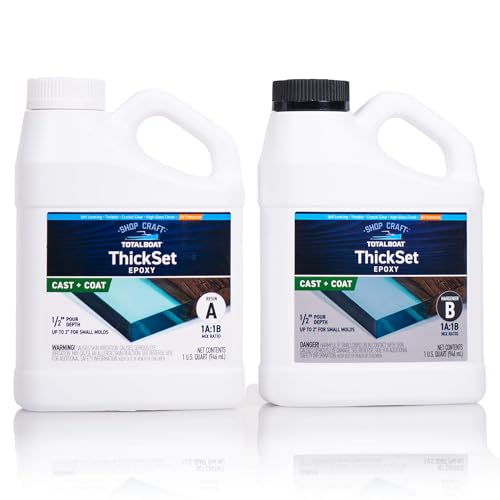
Not every project needs gallons. Filling a few knots in a walnut slab, sealing an inlay, or casting a set of drawer pulls takes maybe a quart of mixed material, and this two-quart ThickSet exists precisely for those jobs.
It carries the same UV-resistant, fast-cure system as its larger siblings, so results stay consistent across a project even when you buy different sizes at different times. That consistency is quietly valuable; matching clarity between a knot fill and a final flood coat is harder than it sounds.
Plus Points
- Right-sized for knot fills, inlays, and small castings without leftover waste.
- UV resistance helps outdoor-exposed pieces resist ambering.
- Matches the finish character of the gallon ThickSet kits for mixed-batch projects.
Points To Note
- Two quarts won’t cover a river channel; plan accordingly before committing.
- Small mixed batches cure faster in the cup, so work briskly once combined.
Who Will Love This
Furniture restorers and hobby woodworkers patching voids and blemishes on reclaimed boards.
Reach For A Different Pick When
Jewelry makers needing finer detail work may prefer the LET’S RESIN 51oz kit, whose lower viscosity suits intricate molds.
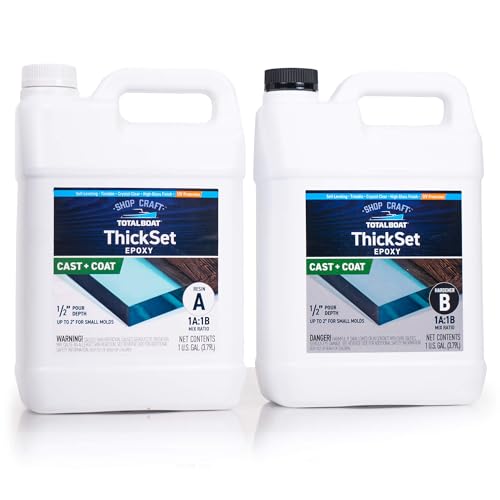
This is the middle child of the ThickSet family, and for many home shops it’s the sensible one. Two gallons handles a coffee-table channel or several rounds of knot filling, while leaving less unopened inventory at risk than the four-gallon jug.
Performance matches the rest of the line: pours up to two inches, a slow-reacting formula that sheds heat safely, and a cured surface that polishes to a glassy sheen. In our view, this size hits the best balance between capability and practicality for a first serious table build.
Standout Traits
- Enough volume for a coffee-table pour with margin for touch-up layers.
- Slow cure tames exotherm heat, protecting thick sections from bubbles and cracks.
- Non-yellowing clarity preserves pigment work and embedded objects.
- Scratch-hard finish stands up to everyday tabletop wear.
Softer Spots
- Extended cure times test patience compared to overnight-demold options like the Superclear.
- Requires accurate weighing or volumetric measuring; sloppy ratios show up as sticky spots.
Quick Facts
Whose Shelf It Belongs On
Intermediate makers stepping up from small castings to their first full river table project.
Consider Something Else When
Commercial shops producing tables weekly will find the TotalBoat Thickset 4 Gal kit more economical per pour.
Where TotalBoat tops out at two inches per layer, Teexpert’s 2:1 formula pushes to four. That difference matters enormously for flower preservation, ocean dioramas, and any project where depth itself is the design. A wedding bouquet encased whole needs that headroom.
The 2:1 ratio (two parts resin to one part hardener) trades a little measuring simplicity for a slower, cooler cure that tolerates real thickness. Bubble release is engineered into the formula, though a heat gun pass never hurts on detailed embeds.
What We Like
- Four-inch single pours eliminate days of layered casting on deep molds.
- Crystal-clear, high-gloss cure flatters preserved botanicals and suspended objects.
- Bubble-resistant formulation cuts down torching and rework.
- Suits river tables, keepsake blocks, and seasonal decor alike.
Honest Caveats
- The 2:1 ratio demands more careful measurement than 1:1 starter kits.
- Very deep pours benefit from a warm room; cold workshops slow curing noticeably.
Right Fit For
Keepsake artists and diorama builders who need genuine depth in a single pour.
Look Elsewhere When
Beginners wanting the simplest possible first experience will get along better with the FUHITIM’s 1:1 mixing.
Food contact changes the shortlist. Magic Resin’s three-gallon kit is formulated to be food-safe once fully cured, low odor, and low to zero VOC, which makes it a natural fit for charcuterie boards, serving trays, and kitchen tables that actually get used.
It’s also a 100% solids polymer, meaning virtually nothing evaporates during cure, so what you pour is roughly what you keep. The low viscosity mixes readily with mica powders, giving color work a smooth, streak-free result. Compared to the Teexpert, you give up nothing on depth: pours reach four inches here too.
Highlights
- Food-safe after full cure, opening up serving ware and dining surfaces.
- Low-odor, low-VOC formula keeps indoor workshop air comfortable.
- Up to four inches of depth in one pour for dramatic castings.
- 100% solids content minimizes shrinkage between pour and cure.
- Thin viscosity blends cleanly with pigments and mica.
Minor Gripes
- Three gallons is a serious quantity; casual users risk waste before it’s used up.
- Deep pours still need level molds and patient demolding regardless of brand claims.
Core Details
Best Suited To
Makers producing kitchenware, serving boards, and dining tables where cured food contact matters.
Not Your Match When
Small-scale hobbyists will find the Teexpert 51oz kit far easier to finish before shelf life runs out.
Think of this as the trial run for the 1.5-gallon Teexpert reviewed earlier. Same 2:1 chemistry, same 2-to-4-inch depth rating, just sized for a handful of keepsake pendants, a small flower block, or a first attempt at mold casting.
The appeal is low stakes. You get to learn how a deep-pour formula behaves, how long it really takes to gel in your workspace temperature, and whether four-inch casting fits your style, all without a large jug aging on the shelf. Owners commonly report the crystal-clear gloss holds up well on small embeds.
Upsides
- Entry-level volume keeps experimentation affordable.
- Retains the full 2-4 inch pour capability of the larger kit.
- High-gloss clarity suits jewelry and preserved-flower work.
Trade Offs
- Too little volume for anything beyond small molds and trinkets.
- 2:1 ratio still requires precise measuring despite the small batch size.
Who It Suits Best
Hobbyists making jewelry, ornaments, and single keepsake blocks who want deep-pour results in small batches.
Skip It When
Table builders should go straight to the TotalBoat Thickset 2 Gal, since 51 ounces won’t fill a river channel.
LET’S RESIN splits its 51 ounces into 34 ounces of resin and 17 of hardener, a clean 2:1 split that’s easy to eyeball once you’ve done it twice. The pitch is simple: pour two to four inches thick in one session instead of stacking layers across a week.
One quirk worth knowing upfront: small castings cure slowly, sometimes taking around three days, while larger masses firm up faster. That inversion surprises newcomers expecting uniform timing. Plan your demold around piece size rather than the calendar.
Positives
- Single-session 2-4 inch pours replace tedious multi-layer builds.
- Pre-split bottle sizes make the 2:1 ratio nearly foolproof.
- Approachable price point for casual weekend crafting.
Room For Improvement
- Small pieces may need up to three days before demolding, per widely reported user experience.
- Limited volume restricts you to modest molds and jewelry-scale work.
Feature Snapshot
Built With In Mind
Casual crafters trying deep-pour techniques on pendants, paperweights, and small decorative blocks.
A Better Fit Elsewhere
Anyone prioritizing faster turnaround on small pieces will prefer the Superclear’s 24-hour demold promise.
Speed is this kit’s whole personality. Pour up to one inch deep, then demold in as little as 24 hours, which turns a week-long bar top job into a weekend one. The Liquid Glass formula runs low-viscosity so trapped air escapes during cure, meaning less time waving a torch over the surface.
The cured result is hard and scratch-resistant, aimed squarely at functional surfaces: bar tops, counters, display pieces that take daily abuse. Zero VOC and low odor make indoor application far more pleasant than older solvent-heavy epoxies ever were.
Best Bits
- 24-hour demold slashes project timelines dramatically.
- Self-releasing air means minimal torching for a bubble-free finish.
- Rock-hard, scratch-resistant cure suits high-traffic surfaces.
- Zero-VOC, low-odor formula is comfortable for indoor rooms.
- Food-safe for contact once fully cured.
Areas To Watch
- One-inch max depth trails the four-inch capability of the Teexpert and Magic Resin kits.
- Fast cure shortens working time, so large batches need quick, confident spreading.
Details At A Glance
Perfect Match For
DIYers refinishing bar tops, countertops, and table surfaces who want durable results by Monday.
Where Another Pick Suits Better
Deep embedment work calls for the Magic Resin 3 Gallon kit, whose four-inch depth outclasses this coating-focused formula.
What Matters Most Before Choosing Deep Pour Epoxy
Match Depth Rating To Your Project
Pour depth is the spec that decides everything else. Coating a countertop needs only an inch, while encasing a bouquet demands four. Exceeding a resin’s rated depth traps heat, and trapped heat means bubbles, cracks, and wasted material. Check the number first, then compare volume.
Understand Mix Ratios And Working Time
Ratios come in 1:1 and 2:1 varieties. Equal parts are simpler for beginners; 2:1 formulas typically cure slower and tolerate thicker casts. Working time, the window before mixed resin gels, shapes your workflow. Short windows suit small batches, while long ones give you room to stage complex pours calmly.
Consider Cure Speed Against Patience
Fast-cure kits demold overnight but punish hesitation. Slow systems forgive mistakes yet tie up your workspace for days. Weekend warriors doing bar tops lean fast; artists embedding delicate objects usually prefer slow. Neither approach is wrong, they just serve different rhythms.
Factor In Finish And Environment
Clarity, yellowing resistance, and scratch hardness determine how a piece ages. Indoor pours also deserve attention to odor and VOC levels, since garages double as living space in many homes. Food-contact plans narrow the field further to explicitly food-safe formulations.
Key Considerations Across These Picks
Traps First Timers Fall Into
The classic error is buying volume before validating technique. A failed four-gallon pour costs far more than a failed quart. Another common slip is ignoring workshop temperature; cold rooms stretch cure times unpredictably. Measure by weight or marked cups, never by guesswork, and always mix fully along the container walls.
What The Higher Tier Buys
Pricier kits generally deliver deeper pour ratings, cleaner optical clarity, and lower odor. Those traits compound: a premium deep-pour formula saves hours of layering and sanding on a large table. For one-off crafts, the upgrade rarely pays. For commissioned furniture, it usually does.
Frequently Asked Questions
How thick can I pour epoxy resin in one layer?
It depends entirely on the formula, ranging from one inch on fast-cure kits to four inches on dedicated deep-pour systems. Always follow the manufacturer’s stated maximum to avoid overheating.
Why did my deep pour turn cloudy or bubbly?
Excess thickness generates heat that boils dissolved gases, and cold or humid conditions worsen it. Staying within the rated depth and warming your workspace prevents most cases.
Is deep pour epoxy food safe?
Some kits, like Magic Resin and Superclear, are formulated for food contact once fully cured. Verify the specific product’s guidance before using it on serving surfaces.
How long does deep pour epoxy take to fully cure?
Demold times run from 24 hours on fast systems to several days on slow ones, with full hardness often taking longer. Small castings frequently cure slower than large masses.
Can I color deep pour epoxy?
Yes, mica powders and liquid dyes blend well, especially into low-viscosity formulas. Mix thoroughly before pouring to avoid streaks in the cured layer.
Bottom Line
Your project size should drive this decision more than anything else. Start small with the FUHITIM or LET’S RESIN if you’re learning, choose the TotalBoat ThickSet family for classic river tables, and reach for Teexpert or Magic Resin when genuine depth is the goal. Whatever you pick, measure carefully, respect the rated pour depth, and give the cure the time it asks for.