
Resin and ABS printing fill a room fast, and anyone who has run a long print job in a spare bedroom knows the smell lingers well past the final layer. The right fume extractor pulls those vapors out at the source, whether that means a tiny carbon purifier clipped inside your printer or a full HEPA unit sitting beside your workbench. This list covers both approaches so you can match the tool to your setup instead of guessing.
Quick Look At Our Top Picks
The Shortlist At A Glance
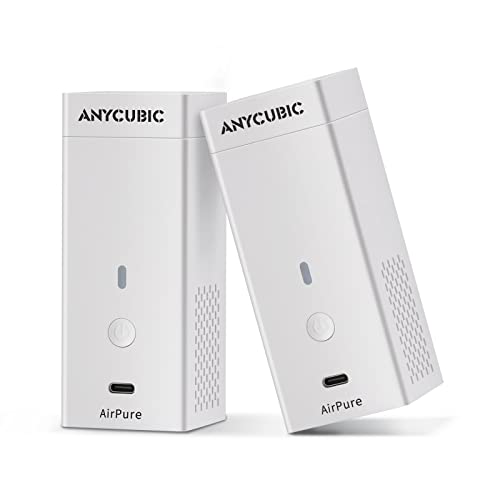
ANYCUBIC Mini Purifier for LCD DLP 3D Printers (Pack of 2)
HOCENWAY 3-Layer Filter Smoke Exhaust Kit 5000RPM
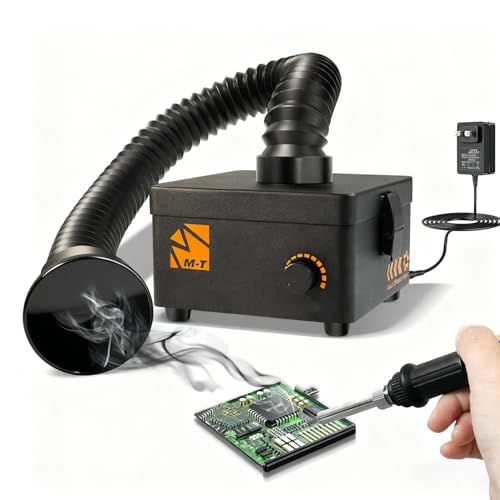
M-T Solder Fume Extractor 80W 168m³/h

Fumeclear FC-2001S Portable Solder Fume Extractor

YOOPAI Fan Fume Extraction Kit for 3D Printer Enclosure

KQZ B1 Solder Fume Extractor with H13 HEPA
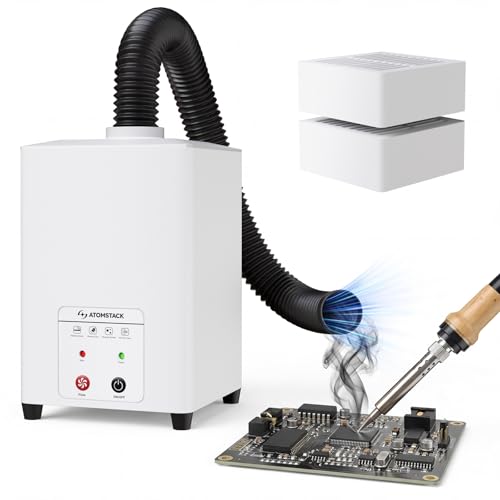
ATOMSTACK D5 Solder Fume Extractor 1400Pa

Creality Official Fume Extraction Kit 4000 RPM

Zericuf 180W Solder Fume Extractor 320m³/h
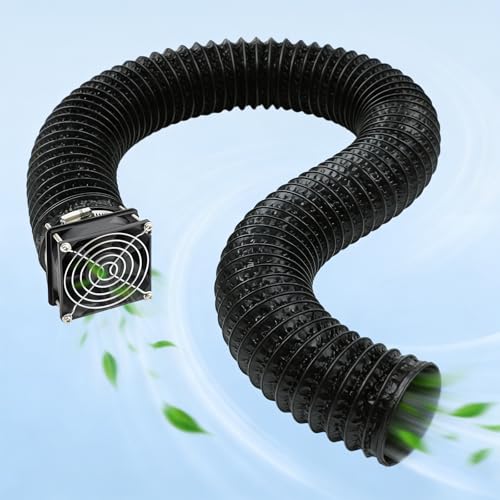
Baquler Fan Fume Extraction Kit 4000 RPM
More Details On Our Top Picks
Most fume solutions assume you have desk space to spare. This one doesn’t. The ANYCUBIC Mini Purifier is built around a high-density activated carbon filter, which traps resin odors by adsorption rather than venting them outside, and its tiny footprint lets you tuck it directly onto an LCD or DLP printer housing.
Getting two units in one pack changes the math for multi-printer owners. Run one per machine, or keep a spare filter cycle going while the first works. It’s a one-button operation, so there’s nothing to configure before a print starts.
Bright Spots
- Activated carbon media targets resin VOCs right where they’re released.
- Two-pack coverage suits anyone running more than one resin printer.
- Single-button start means zero setup friction between jobs.
- Small enough to sit on the printer itself without blocking access.
Things To Consider
- Carbon filters saturate over time, so budget for periodic replacements.
- It recirculates air rather than exhausting it, which suits odor control more than heavy smoke.
Made For
Hobbyists running LCD or DLP resin printers in shared living spaces who want quiet, contained odor reduction.
Where A Sibling Pick Shines
The HOCENWAY exhaust kit suits you better when your priority is pushing fumes fully out of the room through a ducted enclosure.
Enclosure builders tend to cobble together their own ventilation from loose fans and ducting, and the results are hit or miss. The HOCENWAY kit packages the whole chain: a 12V fan spinning at up to 5000RPM, a three-layer filter stack, and a power adapter with adjustable speed control so airflow matches the job.
That speed dial matters more than it sounds. Laser engraving sessions generate thick smoke that wants maximum pull, while a slow PLA print needs only a gentle draft. The adapter accepts standard AC input and outputs 3-12V at 2A, giving you real range rather than one fixed setting.
Reasons To Buy
- Variable speed control adapts airflow from whisper-quiet to full extraction.
- Three-layer filtration catches particles before air leaves the tent.
- Works across laser engravers, printers, and generic enclosure tents.
Minor Gripes
- You’ll need to cut or adapt a mounting opening on enclosures without one.
- Filter layers need checking regularly since clogged media chokes airflow.
Feature Snapshot
Right Fit For
DIY-minded makers fitting ventilation into a homemade or third-party printer tent who want tunable extraction on a modest budget.
Skip It When
Anyone wanting a sealed, plug-and-play benchtop unit will find the Fumeclear FC-2001S a cleaner path with no cutting required.
Benches that juggle soldering, welding touch-ups, and 3D printing rarely get served well by single-purpose gear. The M-T extractor leans generalist: an 80W motor moving up to 168 cubic meters per hour, three suction speeds, and a choice of carbon or HEPA filtration depending on whether odors or fine particles are your bigger concern.
In practice, that flexibility is the selling point. Drop it next to a soldering iron for flux smoke, swing the intake toward a printer mid-job, and adjust speed so it isn’t roaring during detail work. Owners commonly report it handles everyday smoke loads comfortably, though sustained heavy-smoke tasks call for frequent filter swaps to keep performance up.
What We Like
- 80W motor with 168m³/h airflow clears bench-level smoke quickly.
- Three-speed adjustment keeps noise reasonable during close work.
- Carbon or HEPA filter options let you prioritize odor or particles.
- Serves soldering, welding, printing, and even nail stations.
Softer Spots
- Heavy smoke applications may demand weekly filter replacement, an ongoing cost worth planning for.
- Laser marking work sits beyond what this model is tuned for.
Who Should Grab It
Multi-craft hobbyists whose bench hosts a soldering iron and a printer side by side and want one extractor covering both.
Another Choice May Suit
The KQZ B1 fits better for users who care most about deep particle capture, thanks to its thicker pre-filter and H13-grade HEPA stage.
Precision soldering lives or dies on clean air at the tip, and the FC-2001S is engineered around exactly that moment. Its three-stage system pairs a pre-filter with an H12-grade HEPA layer plus activated carbon, capturing fine particulates and flux fumes in one pass. Airflow runs 128 to 168 cubic meters per hour, strong enough for a crowded bench without overwhelming delicate components.
The compact shell is the quiet advantage here. It occupies minimal desk area, which matters when your workspace already holds a hot air station, microscope, and power supply. For board-level repair and small-batch assembly, this balance of suction and footprint is hard to argue with.
Highlights
- Triple-stage filtration combines pre-filter, H12 HEPA, and activated carbon.
- Captures very high percentages of fine particles at the source.
- Adjustable airflow range suits both light and demanding sessions.
- Portable size slots into cramped electronics benches easily.
Points To Note
- HEPA stages load up with use, so replacement scheduling keeps suction honest.
- Tuned for precision work rather than whole-room air turnover.
At A Glance
Who Will Love This
Electronics repair technicians and serious hobbyists doing fine-pitch soldering in compact home labs.
Swap It Out When
Workshop users needing raw volume should look at the Zericuf 180W unit, whose 320m³/h airflow dwarfs this portable’s reach.
Printing overnight in a bedroom or apartment changes your priorities: silence beats raw power. The YOOPAI kit vents enclosure air straight outdoors through a telescoping hose that stretches to two meters, so the printer can sit away from the window while fumes still make their exit. Its low-noise fan is the headline trait, letting long jobs run while you sleep.
Because it exhausts rather than filters, there are no cartridges to replace, which trims long-term upkeep to almost nothing. The trade-off is placement: you’ll want a window or vent within hose reach, and the retractable design helps you stow the pipe neatly between prints.
Plus Points
- Low-noise operation suits bedrooms and shared apartments.
- Hose extends up to two meters for flexible printer placement.
- No filter consumables, keeping running costs near zero.
- Retractable duct stores compactly when not printing.
Worth Noting
- Needs a window or external vent nearby to dump extracted air.
- Exhaust-only design means no particle capture for the room itself.
Best Suited To
Apartment dwellers running enclosed printers overnight who value quiet operation above filtration depth.
Consider Something Else When
Users without a ventable window should consider the ANYCUBIC Mini Purifier, which cleans air internally without any ducting at all.
HEPA grades matter, and H13 sits near the top of the consumer scale, capturing extremely fine particles that cheaper filters wave through. The KQZ B1 pairs that filter with a coal-based activated carbon bed, then drives everything with a centrifugal motor rated at 168 cubic meters per hour. Translation: instant pull at the nozzle and thorough cleaning before air returns to the room.
The dual-layer build uses a nine-millimeter-thick pre-filter ahead of the HEPA stage, which extends the expensive filter’s life by catching coarse debris first. That’s a sensible architecture for anyone soldering daily or printing with materials that shed particles.
Standout Traits
- H13 HEPA captures ultrafine particles at a very high rate.
- Coal-based carbon layer tackles gaseous odors alongside dust.
- Thick 9mm pre-filter shields the HEPA stage from premature clogging.
- Centrifugal motor delivers immediate suction on startup.
Small Caveats
- Replacement H13 filters cost more than basic carbon pads, so factor that into ownership.
- Benchtop capture zone favors close-range work over room-wide circulation.
Quick Facts
The Right Fit
Air-quality-conscious makers who solder frequently and want laboratory-grade particle capture on a home bench.
Not Your Match When
Shoppers prioritizing quiet above all else may prefer the YOOPAI kit, whose low-noise fan is designed for sleeping households.
Laser engraving produces denser smoke than almost any bench task, and the D5 was clearly designed with that reality in mind. A 7500RPM motor generates up to 1400Pa of static pressure, the figure that determines how well a unit pulls through resistance like hoses and loaded filters. Three speed settings let you throttle down for quieter soldering sessions.
Compared with the M-T earlier in this list, the D5 trades some airflow versatility for stronger pressure, which pays off when smoke has to travel through ducting before reaching the filter. The triple-stage structure gives it staying power across mixed workshop duties too.
Upsides
- 1400Pa suction maintains pull even through restrictive duct paths.
- 7500RPM motor responds quickly to sudden smoke bursts.
- Three-speed control balances noise against extraction strength.
- Handles laser cutting, engraving, marking, and electronics repair alike.
Areas To Watch
- Higher pressure settings generate noticeable sound during long laser jobs.
- Filter maintenance cadence depends heavily on how dusty your materials run.
Whose Shelf It Belongs On
Laser engraver owners and hybrid workshops needing pressure-driven extraction that survives hose runs and heavy smoke.
Look Elsewhere When
Quiet-focused bedroom printers will be happier with the YOOPAI kit, which sacrifices pressure for noticeably softer operation.
Brand-matched accessories remove guesswork, and that’s precisely the appeal here. This kit mounts directly onto Creality’s Ender Plus printer enclosure through its dedicated fan interface, no drilling or improvisation required. The 70mm-diameter hose connects to a 4000RPM ventilation fan that pulls smoke, particles, and odors out of the tent while a job runs.
Like the YOOPAI kit reviewed earlier, it exhausts rather than filters, and the telescoping hose reaches up to two meters. The difference is fitment certainty: Ender Plus owners get a clean, factory-style installation. Enclosures without a fan interface will need a cut opening, which the manufacturer notes plainly, so measure before ordering.
Positives
- Direct compatibility with the Ender Plus enclosure’s fan interface.
- 4000RPM fan clears smoke and odors quickly during active prints.
- Two-meter telescoping hose supports flexible room layouts.
- Also serves compatible laser engraver enclosures.
Honest Caveats
- Non-Creality enclosures require cutting your own mounting hole.
- Exhaust-only design offers no in-room filtration.
Details At A Glance
Who It Suits Best
Creality Ender Plus enclosure owners who want guaranteed-fit ventilation without modification work.
Reach For A Different Pick When
Generic-tent builders get broader mounting freedom from the Baquler kit, which ships flanges and mesh for custom installs.
Raw airflow usually costs you your hearing, and the Zericuf attacks that trade-off head-on. An 180W motor moves up to 320 cubic meters per hour, roughly double the M-T’s output, yet an acoustic foam-lined chamber inside the all-metal casing holds noise below 58dB. Even better, the rear vent slopes downward so hot exhaust never blows across your desk or your face.
Filtration follows the same generous pattern: thickened pre-filters feeding an H13 HEPA stage and high-iodine activated carbon. Shared maker spaces and production benches running back-to-back jobs are where this unit earns its keep, and the metal housing suggests it’s built to survive that pace.
Best Bits
- 320m³/h airflow clears heavy smoke faster than anything else on this list.
- Soundproofed chamber keeps noise under 58dB despite the power.
- Downward-sloping exhaust directs heat away from your workspace.
- All-metal construction suits demanding daily schedules.
- H13 HEPA plus high-iodine carbon covers particles and gases thoroughly.
Trade Offs
- Larger footprint than portable units, so plan bench space accordingly.
- Thickened pre-filters mean stocking spares for uninterrupted operation.
Who Should Grab It
Shared workshops, classrooms, and high-volume soldering stations that need industrial-level extraction without industrial noise.
Where Another Pick Suits Better
Desk-bound electronics hobbyists will find the compact Fumeclear FC-2001S easier to live with day to day.
Nothing stalls a weekend project like discovering the ventilation kit you bought is missing a bracket. The Baquler package arrives complete: mesh cover, ventilation fan, exhaust pipe, flange, clips, and screws, so a first-time installer can go from box to working extraction in one sitting. The 4000RPM fan circulates air and pushes odors, smoke, and harmful particle dust out of the enclosure.
Against the Creality kit earlier, this one trades brand-specific fitment for universal adaptability, which explains why it appeals to tinkerers with homemade tents. The low-noise rating keeps it livable in shared spaces, and the mesh cover doubles as protection against stray fingers and debris near the intake.
Strong Points
- Every mounting component ships in the box, eliminating extra hardware trips.
- 4000RPM fan delivers steady circulation and smoke removal.
- Mesh cover adds intake protection during operation.
- Low-noise design fits apartments and shared rooms.
Room For Improvement
- Universal fitment means measuring your own cutout carefully before mounting.
- Exhaust approach requires a nearby vent or window for discharged air.
Core Details
Built With In Mind
First-time enclosure builders who want every screw and clip included and a straightforward afternoon installation.
A Better Fit Elsewhere
Filter-free isn’t for everyone; the KQZ B1 serves users who’d rather scrub the air with HEPA than vent it outside.
What Matters Most Before Choosing 3d Printer Fume Extractors
Match The Method To Your Material
Extraction comes in two flavors, and picking wrong wastes money. Ducted kits push contaminated air outside through a hose, which works brilliantly when a window sits within reach and you’re printing PLA or venting laser smoke. Filtration units scrub air internally using activated carbon, which adsorbs gaseous resin vapors, often paired with HEPA media for particles. Resin printing almost demands carbon; venting alone won’t catch those fumes.
Read The Numbers That Actually Matter
Airflow in cubic meters per hour tells you how much air moves; static pressure in pascals tells you how hard it pulls through resistance. Long hose runs and loaded filters eat pressure, so a 1400Pa-rated unit like the ATOMSTACK D5 holds its grip where a weak fan would stall. Noise figures deserve equal attention in bedrooms and shared offices.
Budget For Consumables
Filters are recurring costs, not one-time purchases. Carbon saturates, HEPA clogs, and heavy-use benches may swap pre-filters weekly. Exhaust-only kits skip this entirely but need a permanent vent path. Honest math includes a year of replacements.
Key Considerations Across These Picks
Traps First Timers Fall Into
The classic error is buying a purifier sized for a closet and expecting it to clear a garage. Match airflow claims to your actual room volume and print duration. Second mistake: ignoring mounting requirements until the box arrives, then discovering your enclosure needs cutting. Check compatibility before checkout, always.
What Separates Premium From Basic
Money buys filtration depth and noise engineering. Entry kits move air; premium units add H13 HEPA stages, thickened pre-filters, and soundproofed chambers like the Zericuf’s sub-58dB design. Daily users recover that premium through fewer filter changes and quieter sessions. Occasional printers won’t notice the difference.
Frequently Asked Questions
Do 3d printer fume extractors remove all harmful fumes?
They significantly reduce airborne particles and odors in the immediate work area. No desktop unit replaces proper room ventilation for heavy-duty resin or laser work.
Can one extractor serve both my printer and soldering station?
Yes, models like the M-T and KQZ B1 handle multiple bench tasks. Position the intake closest to whichever source is active.
How often do filters need replacing?
Light users typically stretch carbon filters for months, while heavy smoke workloads may need weekly pre-filter swaps. Follow the manufacturer’s guidance for your specific media.
Is a ducted kit better than a filtered purifier?
Ducted kits excel when a window or vent is nearby and consumable costs matter. Filtered units win for resin printing and windowless rooms.
Will an extractor make my prints cooler or affect quality?
Enclosure extraction removes warm air, which can slightly lower chamber temperature on heated-material prints. Most users see no quality impact with normal settings.
Closing Thoughts
Clean air shouldn’t be the hardest part of a hobby built around making things. Whether you clip a carbon purifier onto a resin printer, duct an enclosure out a window, or park a HEPA workhorse beside your soldering iron, one of these ten options fits the setup you already have. Start with your material and your room, then let the specs settle the rest.