
A first guitar should make you want to pick it up, not fight it. That’s the real problem this list solves: every instrument here plays comfortably enough for a beginner to stick with it, yet sounds good enough that you won’t outgrow it in six months. Whether you’re shopping for a teenager starting lessons, a dorm-bound student, or your own long-delayed return to playing, these ten options cover nylon-string comfort, dreadnought volume, compact travel bodies, and even plug-in capability. All of them come from brands with long track records in the beginner market, so setup quality and parts availability won’t be a gamble.
The Shortlist At A Glance

Fender CN-60S Concert Nylon String Acoustic Guitar (Natural)

Fender CC-60S Concert Acoustic Guitar (3-Color Sunburst)

Fender CD-60S Dreadnought Acoustic Guitar (Black)

Fender California Debut Redondo CE Beginner Acoustic Guitar (Natural)

Fender California Debut Redondo CE Beginner Acoustic Guitar (Sunburst)

Fender California Debut Redondo CE Beginner Acoustic Guitar (Black)
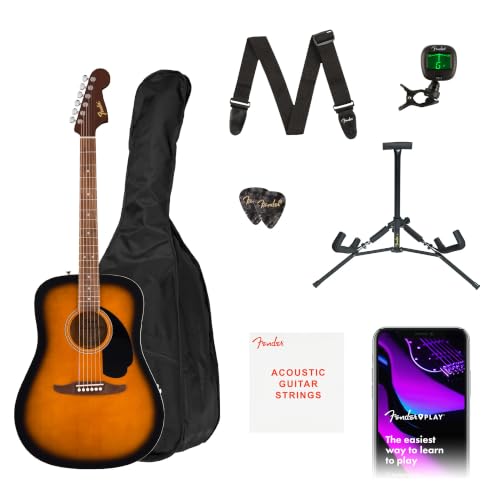
Fender California Debut Redondo Acoustic Guitar Pack (2-Color Sunburst)

Fender California Debut Redondo Beginner Acoustic Guitar (Black)

Fender California Debut Redondo Acoustic Guitar Starter Kit (Natural)

Yamaha APXT2 3/4-Size Acoustic-Electric Guitar (Black)
More Details On Our Top Picks
Nylon strings are the kindest thing you can do to uncalloused fingertips, and that’s the whole appeal of the CN-60S. The concert-size body keeps the instrument close to your body, which helps smaller-framed players reach around comfortably during those first awkward weeks.
The tone leans warm and mellow, closer to classical and Latin styles than bright pop strumming. In our view, that makes it a smart match for fingerstyle learners rather than anyone chasing big campfire volume.
Strong Points
- Nylon strings are far gentler on beginner fingertips than steel, so practice sessions last longer before your hands quit.
- The concert body sits snugly against you, making fretting positions easier to hold for smaller players.
- A solid spruce top tends to open up in tone over months of regular play.
- Handles jazz, folk, and blues voicings with a rounded, forgiving character.
Things To Consider
- Nylon tuning stability can frustrate newcomers; expect frequent retuning until the strings settle.
- Volume is modest compared with the dreadnought CD-60S further down this list.
Key Specs
Made For
Beginners drawn to classical, bossa nova, or gentle fingerstyle who value comfort over raw volume.
Where A Sibling Pick Shines
Players wanting louder steel-string strumming will get more from the Fender CD-60S Dreadnought instead.
Where the CN-60S goes soft and round, the CC-60S swaps in steel strings for a clearer, more articulate voice. Its concert body is noticeably easier to maneuver than a full dreadnought, which matters on a couch, in a car back seat, or at a cramped coffeehouse table.
The scalloped X-bracing under the solid spruce top gives fingerpicked notes definition without mud. Owners commonly report the rolled fingerboard edges feel smooth right out of the box, a small detail that adds up over hour-long practice runs.
Highlights
- Scalloped X-bracing lets the top vibrate freely, giving fingerstyle passages crisp separation between notes.
- The smaller concert shape suits beach trips, patios, and other casual settings where a dreadnought feels bulky.
- Solid spruce top responds well to light touch, rewarding careful players as their technique develops.
- Sunburst finish hides fingerprints and minor scuffs better than flat gloss colors.
Worth Noting
- Steel strings demand more fingertip pressure early on, so expect some soreness during week one.
- No built-in pickup, unlike the Redondo CE models later in this roundup.
Right Fit For
Fingerpickers and casual home players who want steel-string clarity in a manageable body size.
Swap It Out When
Loud group singalongs call for the bigger Fender CD-60S Dreadnought’s extra projection.
Dreadnought means the largest common acoustic body shape, built for volume and low-end punch. The CD-60S delivers exactly that: mahogany back and sides push a strong midrange, while the solid spruce top carries strummed chords across a room without effort.
Compared with the CC-60S above, you trade some intimacy for presence. Around a campfire or in an open living room, that trade pays off immediately. The black finish looks sharp too, though it does show dust more than sunburst.
Upsides
- Dreadnought body projects hard, so your chords stay audible over conversation outdoors.
- Rolled fingerboard edges soften the fret ends, easing the transition for hands still building strength.
- Mahogany back and sides give strumming a warm, balanced midrange rather than harsh brightness.
- Works equally well for rhythm backing and simple lead lines.
Small Caveats
- The large body can overwhelm players under about five-foot-four; the Redondo CE or Yamaha APXT2 fit smaller frames better.
- Gloss black surfaces show smudges, so keep a microfiber cloth handy.
Feature Snapshot
Who Should Grab It
Strummers, singalong hosts, and anyone whose main goal is being heard without an amp.
Another Choice May Suit
Apartment dwellers needing quieter practice might prefer the compact Yamaha APXT2’s smaller footprint.
The “CE” in this model’s name stands for cutaway electric, meaning the body has a scooped shoulder for high-fret access plus onboard electronics for plugging into an amp. At this price, that combination is genuinely uncommon.
Laminate spruce over sapele keeps the guitar resilient against humidity swings, which matters in dorm rooms and cars. You give up some tonal depth versus the all-solid CD-60S, but gain durability most beginners will appreciate.
Reasons To Buy
- Built-in preamp means you can join an open mic or band rehearsal without buying extra gear.
- The cutaway shoulder lets your hand reach upper frets that block-style acoustics hide.
- Laminate construction shrugs off humidity changes that crack delicate solid-wood guitars.
- Slim C-shaped neck profile suits smaller hands still learning to stretch.
Points To Note
- Laminate tops generally don’t mature tonally the way the CN-60S’s solid spruce does.
- You’ll need a cable and amp before the electronics earn their keep.
Who It Suits Best
New players who already know they want to perform plugged-in within their first year.
Look Elsewhere When
Purely unplugged home practice is better served by the simpler Fender California Debut Redondo non-CE version below.
This is the same Redondo CE platform as the natural-finish version above, wrapped in a vintage-leaning sunburst. Functionally nothing changes: laminate spruce top, sapele back and sides, cutaway body, and a preamp ready for an amp or PA.
The honest difference is motivation. A guitar you like looking at gets played more, and for teenagers especially, that’s not a trivial factor. The offset-inspired Redondo silhouette reads more surf-rock than traditional folk, which suits certain personalities perfectly.
Bright Spots
- Sunburst finish gives the Redondo’s retro body shape extra visual character.
- Same plug-and-play electronics as the natural CE model, ready for amps and open mics.
- Cutaway access keeps lead-line practice comfortable past the twelfth fret.
Softer Spots
- Identical hardware to the natural version, so pay only for the color if aesthetics truly matter to you.
- Dark burst edges can make small dings harder to spot when inspecting used units.
Quick Facts
Whose Shelf It Belongs On
Style-driven beginners, teens, and anyone who wants plug-in ability with retro personality.
Not Your Match When
Traditionalists after a classic look may prefer the natural finish or the conventional CD-60S shape.
Third colorway, same capable platform. The black Redondo CE carries the identical laminate spruce-and-sapele build, slim C neck, and onboard electronics as its two siblings earlier in this list, so your choice here really comes down to taste.
One practical angle worth weighing: matte-leaning black finishes tend to disguise wear better than glossy naturals, useful for guitars living in backpacks and car trunks. The slim neck remains the standout ergonomic feature for younger or smaller-handed players.
Plus Points
- Electronics are built in, so busking or jamming only requires a cable and an amp.
- The 25.5-inch scale matches standard string sets, making restringing cheap and predictable.
- Black finish coordinates with almost any room or stage outfit.
Minor Gripes
- Like all three CE variants, it ships without accessories; the Redondo Pack covers that gap.
- Laminate body means less tonal refinement over time than solid-wood rivals.
Who Will Love This
Minimalist players who want one dark, durable, amp-ready guitar and no fuss.
Reach For A Different Pick When
First-time owners lacking any gear should grab the Fender California Debut Redondo Pack with its bundled gig bag and stand.
Buying a first guitar usually triggers a second shopping trip: bag, stand, strap, tuner. This pack closes that loop in one box, bundling the Redondo body with a gig bag, stand, and other starter essentials alongside the guitar itself.
The guitar inside uses laminate construction with a spruce top and basswood back and sides, plus the familiar 25.5-inch scale and slim C neck. Basswood keeps weight down, which helps kids carry it to lessons without complaint.
What We Like
- Gig bag and stand arrive included, protecting the guitar from day one instead of week three.
- Lightweight basswood body makes hauling to school or lessons painless.
- Sunburst styling gives the bundle a gift-worthy presentation.
- Slim C-profile neck shortens the learning curve for small hands.
- One purchase covers nearly every accessory a beginner needs to start today.
Honest Caveats
- No cutaway or electronics here, unlike the Redondo CE models higher on this list.
- Bundled accessories are entry-grade; serious players eventually upgrade them.
Details At A Glance
Built With In Mind
Gift shoppers and parents equipping a brand-new player with zero existing gear.
Consider Something Else When
Players planning to perform amplified should step up to the Redondo CE versions instead.
Strip away the cutaway and the preamp, and you land here: the plain Redondo in black. It shares the spruce-top, basswood-backed laminate build and slim C neck of the rest of the family, just in a simpler, cheaper-to-make package.
For a dorm room, a shared apartment, or a guitar that lives in a closet between weekend sessions, that simplicity is a feature. Fewer electronics mean fewer things to break, and the laminate shell tolerates neglect that would punish a solid-wood instrument.
Standout Traits
- No onboard electronics to fail, drain batteries, or complicate repairs.
- Basswood back and sides keep overall weight low for easy handling.
- Laminate build handles dry winter air and humid summers without drama.
- Lower commitment level suits uncertain beginners testing their interest.
Trade Offs
- Ships alone, so budget separately for a bag, tuner, and strap.
- Fixed bridge and non-cutaway body limit upper-fret exploration.
The Right Fit
Budget-conscious students and casual hobbyists who play unplugged at home.
Where Another Pick Suits Better
Anyone set on performing live will find the Yamaha APXT2’s built-in pickup system more useful.
This natural-finish kit pairs the same Redondo platform with a full accessory loadout, making it the closest thing on this list to a complete first-lesson package. The guitar itself uses a spruce laminate top over basswood back and sides, tuned to the standard 25.5-inch scale.
Natural finish suits classrooms and family rooms where a flashier burst might feel loud. Widely reported owner feedback on this kit line emphasizes how quickly a new player can go from sealed box to first chord, which counts for a lot at this stage.
Positives
- Everything needed for structured lessons arrives together, removing guesswork for parents.
- Standard scale length accepts widely available replacement strings and setups.
- Natural finish ages gracefully and hides everyday handling marks well.
- Slim C neck keeps chord shapes reachable for hands still building flexibility.
Areas To Watch
- Kit accessories are functional but basic; plan upgrades as skills grow.
- Non-cutaway body restricts access to the highest frets.
Who Should Grab It
Young students enrolling in lessons and families buying their household’s first guitar.
Skip It When
Experienced players returning to the instrument will find more headroom in the Fender CD-60S Dreadnought.
The APXT2 is Yamaha’s scaled-down take on its long-running APX series, shrinking the body to three-quarter size while keeping a spruce top, rosewood fingerboard, and a pickup system based on the company’s ART contact design. A gig bag comes included.
It’s the only true acoustic-electric here besides the Redondo CE models, and the only one sized for airline overhead bins and back seats. An onboard tuner adds convenience no other pick in this roundup offers, which you’ll appreciate at noisy jams.
Reasons To Buy
- Three-quarter body fits small players, young teens, and tight travel spaces alike.
- Built-in pickup system plugs straight into amps or PA mixers for gigs.
- Integrated tuner means one less accessory to lose.
- Gig bag included, so transport protection starts immediately.
- Rosewood fingerboard feels smooth under fast position shifts.
Room For Improvement
- Shorter scale slightly reduces bass depth compared with full-size picks like the CD-60S.
- Thin-bodied design trades some unplugged resonance for portability.
Core Details
Perfect Match For
Commuters, frequent flyers, and smaller-framed players who still want amplification options.
A Better Fit Elsewhere
Full-volume home strumming is better matched by the Fender CD-60S Dreadnought’s larger body.
What Matters Most Before Choosing Acoustic Guitars Under 200
Body Size Shapes Everything
Dreadnought bodies project loudest but strain smaller frames, while concert and three-quarter shapes trade volume for comfort. Sit with the size question honestly: a guitar you can physically handle beats a louder one you avoid holding.
Solid Wood Versus Laminate
A solid spruce top vibrates more freely and often improves with age, while laminate construction resists humidity damage and costs less. Frequent travelers and dorm residents benefit from laminate; committed home players get more long-term payoff from solid tops.
Strings Decide Your First Month
Nylon strings like the CN-60S wears spare your fingertips, while steel strings deliver brighter tone at the cost of early soreness. New players who quit usually quit because of finger pain, so weigh this more heavily than finish color.
Electronics Only Matter If You’ll Plug In
Built-in pickups add convenience for open mics and band practice but cost money you could spend elsewhere. Honest self-assessment here prevents paying for features that sit unused.
Key Considerations Across These Picks
Traps First Timers Fall Into
Chasing the biggest body or the flashiest finish derails more first purchases than anything else. Another common slip is forgetting accessories entirely; a guitar without a bag, tuner, and strap sits idle while you wait on a second order.
Where The Extra Money Goes
Higher-tier models in this range typically add solid-wood tops, cutaways, or onboard electronics rather than dramatic sound leaps. Spending up makes sense once you know you’ll perform or play daily; otherwise, a well-built basic model serves most first years fine.
Frequently Asked Questions
Are guitars under $200 actually playable?
Yes, modern budget models from Fender and Yamaha use proper materials and consistent factory setup. Most need only a basic tune-up to play comfortably.
Nylon or steel strings for a total beginner?
Nylon hurts less, which keeps new players practicing longer. Steel rewards persistence with brighter tone suited to pop and rock.
Do I need a cutaway or electronics right away?
Neither is essential for home practice. Choose them only when performance plans are concrete.
What size suits a child or small adult?
Three-quarter models like the Yamaha APXT2 fit players roughly eight to twelve years old. Concert bodies suit most teens and smaller adults.
How often does a new guitar need maintenance?
Expect retuning frequently for the first weeks as strings stretch. A professional setup once a year keeps action comfortable.
Closing Thoughts
Every guitar on this list can carry a beginner from first chord to first performance without embarrassment. Match the body size to your frame, decide honestly whether you’ll ever plug in, and pick the one you’ll actually reach for. The right choice is the one that keeps you playing.