
Carbon fiber filament changed what a desktop machine can do. Parts come off the plate stiffer, lighter, and far less prone to warping than plain PLA or ABS, which is why drone arms, brackets, jigs, and functional prototypes have all moved to composites. The catch is that abrasive fibers chew through standard brass nozzles, and nylon blends demand dry storage and steady heat. This roundup covers four machines built to handle that workload plus six filaments worth loading into them, so you can match hardware to material instead of guessing.
Quick Look At Our Top Picks
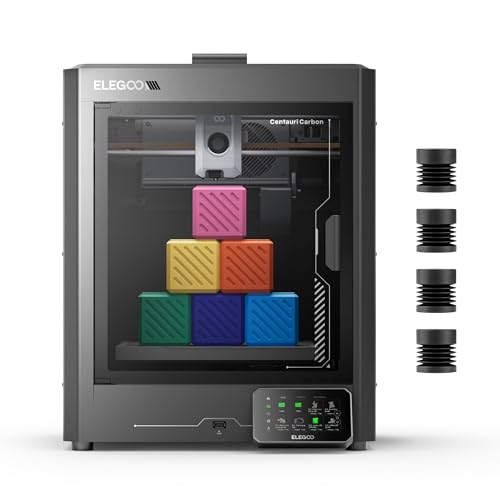
ELEGOO Centauri Carbon 3D Printer
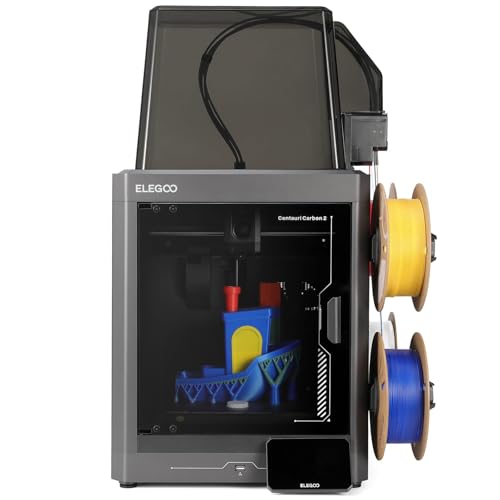
ELEGOO Centauri Carbon 2 Combo
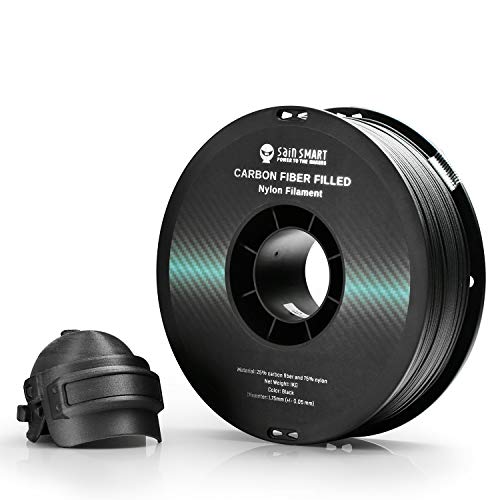
SainSmart ePA-CF Nylon Filament 1KG

FLASHFORGE Carbon Fiber PETG Filament 1KG
Creality K1C 3D Printer

Bambu Lab P1S 3D Printer

SUNLU PA6-CF Nylon Filament 1KG

Polymaker Fiberon PA612-CF15 Filament

Creality Hyper PLA-CF Filament 1KG
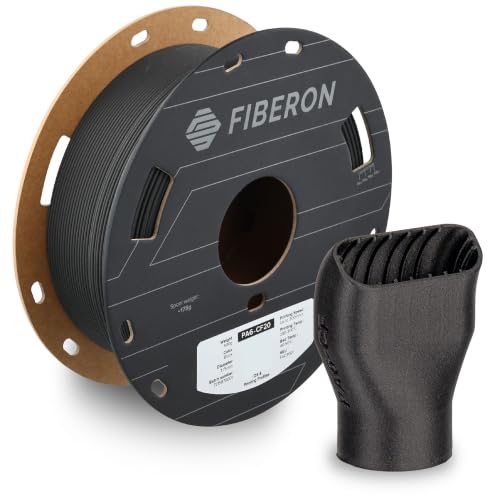
Polymaker Fiberon PA6-CF20 Filament
More Details On Our Top Picks
The Centauri Carbon uses a CoreXY layout, meaning both motors move the print head on fixed rails while the bed only drops, which keeps fast motion stable. It arrives assembled and pre-calibrated, so your first composite part can happen the same evening you unbox it.
A 320°C hotend gives real headroom for nylon blends, and the 256mm cube handles most brackets and enclosures comfortably. Owners commonly point to the auto calibration and touchscreen as the reasons setup feels painless.
Strong Points
- Ships fully assembled, so there’s no weekend of belt-tensioning before your first print.
- Auto bed leveling removes the manual paper-slide ritual most machines still require.
- The built-in camera lets you check a long nylon job from another room.
- 500mm/s top speed shortens iteration cycles when you’re tuning a design.
Things To Consider
- At this speed class, keep an eye on belt tension over the first few months of heavy use.
Key Specs
Who It Suits Best
Anyone stepping into carbon fiber printing who wants the hardware to disappear into the background rather than become a project itself.
Where A Sibling Pick Shines
Hobbyists who want multicolor output alongside composites will get more from the ELEGOO Centauri Carbon 2 Combo further down this list.
Where the original Centauri focuses on single-material speed, this Combo adds the CANVAS system for four-color prints with automatic filament switching. For signage, labeled fixtures, or parts where a color change marks a functional zone, that’s a genuine workflow upgrade.
ELEGOO also widened the material window here, pairing temperature control tuned for engineering-grade polymers with smart detection that catches tangles and refills spools mid-job. In our view, that automation matters more than raw specs once you start running unattended overnight builds.
Highlights
- Four-color switching happens inside the CANVAS unit, so no manual spool swaps at 2 a.m.
- Tangle detection stops a failed print before it wastes half a kilo of expensive composite.
- Broad material range covers basic PLA through higher-temp engineering blends.
Worth Noting
- The added color system means more moving parts to maintain than the single-extruder original.
- Nylon-based filaments still need dry storage regardless of how capable the printer is.
Made For
Makers producing client-facing or display pieces who want composite strength without giving up visual polish.
Consider Something Else When
Pure strength-per-dollar matters more than appearance, the SainSmart ePA-CF filament paired with a simpler machine serves better.
This is the workhorse of the group: an 80/20 mix of nylon and chopped carbon fiber aimed squarely at parts that carry load. Nylon brings toughness and chemical resistance, while the fibers add rigidity and cut the shrinkage that makes plain nylon warp on open beds.
In a busy workshop, that combination shows up as brackets that survive being bolted down tight and jigs that hold dimension week after week. SainSmart positions it as easier to print than older CF nylons, with surface finish good enough for visible parts too.
Upsides
- Lower shrink rate means flatter first layers and fewer warped corners on wide parts.
- The 80% nylon base absorbs impact better than glassy PLA-CF ever will.
- One-kilo spool suits shops running structural parts regularly.
Small Caveats
- Nylon is hygroscopic, meaning it pulls moisture from the air, so a sealed container with desiccant is basically required equipment.
- You’ll want a hardened steel nozzle; brass wears out quickly against carbon fiber.
Right Fit For
Printers with an enclosure and a dry box who need parts that take real mechanical abuse.
Swap It Out When
Your machine tops out around typical PLA temperatures; the FLASHFORGE Carbon Fiber PETG below prints far more forgivingly.
PETG-CF is the gentlest entry into composites. It keeps the impact resistance PETG is known for while the added fibers raise stiffness and heat tolerance, and it ships dried and wound on a 1KG spool with ±0.02mm dimensional consistency.
For someone whose printer lacks an enclosure, this is usually the smartest first composite. You may find it prints nearly as easily as plain PETG, just with a matte black finish that hides layer lines nicely. The trade-off shows up under sustained load, where it won’t match a true nylon blend.
Bright Spots
- Prints on open-frame machines without the warping headaches of nylon.
- Tight ±0.02mm tolerance keeps multi-part assemblies fitting together predictably.
- Rigidity plus impact resistance suits clips, mounts, and housings.
Points To Note
- Store the spool sealed between projects; even PETG absorbs enough moisture to cause stringing over months.
- Heat resistance improves over stock PETG but stays below what PA6 blends tolerate.
Feature Snapshot
Who Will Love This
Hobbyists on budget or open printers who want visibly better parts without changing their whole setup.
Another Choice May Suit
Anyone chasing maximum stiffness should step up to the Polymaker Fiberon PA6-CF20 near the end of this list.
The K1C is Creality’s answer to a simple question: how fast can a desktop machine push abrasive filament without falling apart? Its CoreXY motion system reaches 600mm/s with aggressive acceleration, and the direct-drive extruder feeds rigid composite spools without grinding them.
The tri-metal “Unicorn” hotend, a layered nozzle design that resists clogging, pairs with a 300°C ceiling that covers most carbon-filled materials. An AI camera watches for failed layers, and silent mode keeps it livable in a shared space. Compare that to the ELEGOO Centauri’s 500mm/s and the K1C clearly leans harder into throughput.
Reasons To Buy
- 600mm/s capability turns overnight jobs into afternoon ones.
- Clog-resistant hotend reduces the most common downtime cause with filled filaments.
- Direct extrusion grips flexible and composite spools alike.
- Auto leveling and quiet operation make it apartment-friendly.
Minor Gripes
- Owners commonly report that sustained top-speed runs demand occasional belt and rail maintenance.
- Fast printing amplifies any slicer profile mistakes, so expect some tuning time.
Best Suited To
Intermediate users churning through prototype batches who value cycle time over absolute simplicity.
Not Your Match When
First-time printers wanting the smoothest possible start will find the Bambu Lab P1S next door more forgiving.
The P1S earns its reputation by refusing to specialize. A fully enclosed body stabilizes temperatures for nylon and ABS-class materials, 500mm/s speed with 20000mm/s² acceleration keeps jobs quick, and the optional AMS unit expands it to sixteen colors across multiple spools.
That enclosure is the quiet advantage here. Carbon-filled nylons benefit from stable ambient air, and the P1S provides it without aftermarket panels. The honest read is that it costs more than the K1C, but the ecosystem, from filament handling to software, tends to reduce fiddling overall.
Plus Points
- Enclosed chamber widens your usable material list considerably.
- AMS compatibility supports up to 16 colors for mixed-material projects.
- High acceleration maintains detail even during rapid moves.
Softer Spots
- The AMS unit is a separate purchase, so full multicolor capability raises the total investment.
- Enclosed chambers trap humidity; a dry box feeding the AMS is worth planning for.
Details At A Glance
Who Should Grab It
Serious home workshops that want one dependable machine covering everything from PLA to carbon nylon.
Reach For A Different Pick When
Budget is the deciding factor, since the ELEGOO Centauri Carbon delivers similar speed for less.
SUNLU’s PA6-CF uses the same 80/20 nylon-to-fiber ratio as the SainSmart spool earlier in this list, but PA6 chemistry pushes heat resistance higher. Parts printed from it hold their shape near engines, hot enclosures, and other spots where lower-temp composites creep.
Layer adhesion is the standout claim here, and it matters: weak interlayer bonds are the usual failure point on loaded 3D-printed parts. With strong bonding plus fiber reinforcement, finished pieces behave closer to injection-molded components than layered plastic.
Standout Traits
- Excellent layer-to-layer bonding reduces delamination on stressed parts.
- Heat resistance suits automotive bays and machinery mounts.
- Full kilogram spool keeps per-part cost reasonable for production runs.
Areas To Watch
- PA6 absorbs moisture faster than most polymers, so drying before long prints is widely reported as necessary.
- Demands a hardened nozzle and, ideally, an enclosed chamber to hit its best results.
The Right Fit
Engineers and tinkerers printing functional end-use parts that live in warm environments.
Look Elsewhere When
You print composites only occasionally; the smaller Polymaker Fiberon PA612-CF15 spool avoids waste.
PA612 is the quieter cousin of PA6 nylon: slightly less heat tolerant, but far less eager to soak up ambient moisture. Polymaker’s Fiberon line exists to make composites approachable, and this 15%-fiber blend prints well on mainstream and entry-level machines alike.
The half-kilo spool is a thoughtful size for experimentation. You can validate profiles on a new material without committing to a full kilogram that might sit half-used in a drawer. Depending on your climate, you may find it tolerates a few days on the spool holder without immediate drying, unlike the SUNLU PA6-CF.
Positives
- Lower moisture sensitivity means fewer surprise stringing sessions.
- Optimized for high-speed printing on modern fast machines.
- Half-kilo format lowers the cost of trial and error.
Honest Caveats
- Smaller spool means a higher effective cost per gram than 1KG alternatives.
- 15% fiber content trades some stiffness versus 20% blends.
Spec Overview
Whose Shelf It Belongs On
Curious intermediate printers sampling engineering materials without overhauling their workflow.
Skip It When
You run composites daily and burn through spools; the 1KG SUNLU PA6-CF works out cheaper.
Most carbon fiber filaments ask something of your machine. This one mostly doesn’t. Creality formulated its Hyper PLA-CF for speeds from 50 up to 300mm/s, meaning it behaves on a basic bed-slinger just as happily as on the K1C reviewed above.
PLA-CF won’t survive a hot car interior, but for prototypes, cosplay props, and rigid brackets used indoors, the matte finish and easy printing make it the spool most people actually finish. Dimensional accuracy sits at ±0.03mm, tight enough for snap-fit assemblies.
What We Like
- Prints reliably on nearly any FDM printer, no enclosure required.
- Handles 300mm/s without sacrificing surface quality.
- Good layer adhesion for a PLA-based composite.
- Matte black look hides layer lines on display pieces.
Trade Offs
- Heat deflection stays PLA-level, so avoid cars, attics, and engine bays.
- Still abrasive enough to justify a hardened steel nozzle over time.
Who Should Grab It
Beginners and rapid prototypers who want the carbon fiber look and stiffness with zero learning curve.
Where Another Pick Suits Better
Parts facing heat or heavy loads belong on the SainSmart ePA-CF nylon instead.
This is the stiffest option in the lineup. Twenty percent carbon fiber loading in a PA6 base delivers the kind of rigidity and heat resistance that replacement-part printing demands, yet Polymaker tuned it for high-speed machines and broad compatibility.
Set it beside the PA612-CF15 from earlier and the difference is intent: that spool favors convenience, this one favors performance. Expect to run it dried, in an enclosure, through a hardened nozzle, and it will reward the effort with parts that feel industrial.
Best Bits
- 20% fiber content maximizes stiffness for structural brackets and fixtures.
- Heat resistance holds up in demanding environments.
- Optimized flow suits modern fast printers without constant retraction tweaks.
Room For Improvement
- Half-kilo spool goes quickly on large structural prints.
- PA6 moisture habits mean a dryer or sealed storage is part of ownership.
Core Details
Built With In Mind
Advanced hobbyists and small shops printing functional replacements where failure isn’t an option.
Swap It Out When
Your printer is open-framed and entry-level; the FLASHFORGE Carbon Fiber PETG gets you 80% of the benefit with none of the fuss.
What Matters Most Before Choosing 3d Printers For Carbon Fiber
Match The Machine To The Material
A 300°C-plus hotend opens the door to nylon blends, while anything less limits you to PLA-CF and PETG-CF. Enclosures matter just as much: carbon nylons warp in drafty rooms, so an enclosed chamber like the Bambu Lab P1S offers pays for itself on long jobs.
Nozzles And Extrusion Style
Chopped fibers act like liquid sandpaper. Hardened steel or ruby nozzles last where brass wears out within a few spools. Direct-drive extruders, which mount the motor right above the hotend, also feed stiff composite spools more reliably than bowden setups.
Speed Versus Sanity
CoreXY machines such as the Creality K1C hit 600mm/s, but fast printing magnifies every slicer mistake. Newer printers gain more from reliable auto leveling and calibration than from headline speed numbers alone.
Storage Is Part Of The Budget
Nylon-based filaments pull moisture from the air and print poorly once damp. Factor a sealed dry box or filament dryer into your total spend, because it protects every spool you own.
Key Considerations Across These Picks
Traps First Timers Fall Into
The classic mistake is buying a powerful nylon filament before owning a hardened nozzle or dry storage, then blaming the spool. Another common slip is chasing maximum speed on an untuned machine, which produces failed prints faster, not sooner. Start with a forgiving material like PLA-CF and climb gradually.
The Case For Spending Up
Higher-tier machines earn their price through automation: auto leveling, filament sensors, cameras, and enclosed chambers remove the failure modes that eat weekends. Paying more pays off once you print regularly or leave jobs running unattended. Occasional hobbyists rarely recoup that difference.
Frequently Asked Questions
Do carbon fiber filaments ruin a normal 3D printer?
They don’t destroy it, but the abrasive fibers wear brass nozzles quickly. Swapping to a hardened steel nozzle protects your machine at minimal cost.
Can I print carbon fiber nylon without an enclosure?
You can attempt it, though warping and poor layer adhesion are likely on larger parts. An enclosed chamber dramatically improves first-layer success and dimensional stability.
Why does my carbon fiber filament string and bubble?
Moisture absorbed by the filament flashes to steam in the hotend. Dry the spool in a filament dryer or sealed box with desiccant before printing.
Is a faster printer always better for composites?
No. High speeds amplify slicing errors and mechanical wear. Consistent, calibrated printing beats raw speed for strong, accurate parts.
How much stronger is carbon fiber PLA than regular PLA?
It’s noticeably stiffer and more dimensionally stable, though not dramatically tougher. For impact resistance, nylon-based blends are the better choice.
Closing Thoughts
Carbon fiber printing rewards a little planning more than a big budget. Pair one capable machine from this list with the filament that matches your parts’ real working conditions, add a hardened nozzle and dry storage, and most of the frustration disappears. Start simple, print often, and upgrade only when a specific failure tells you it’s time.